Siemens Uses Digital Thread to Accelerate Smart Manufacturing for New Energy Vehicles
Time:2026-08-27 Browse: 14
The competitive landscape for new energy vehicles (NEVs) is entering a new phase. As the industry moves beyond rapid volume expansion, automakers are increasingly focusing on manufacturing efficiency, faster model development, production flexibility, and global operational consistency.
Shorter vehicle development cycles, mixed-model production lines, and increasingly global manufacturing footprints are creating new challenges for automotive manufacturers and equipment suppliers. Product engineering, process planning, equipment engineering, automation, and production operations can no longer operate as isolated stages.
Siemens is addressing this challenge with a digital thread approach designed to connect vehicle manufacturers and manufacturing equipment suppliers throughout the engineering and production lifecycle.
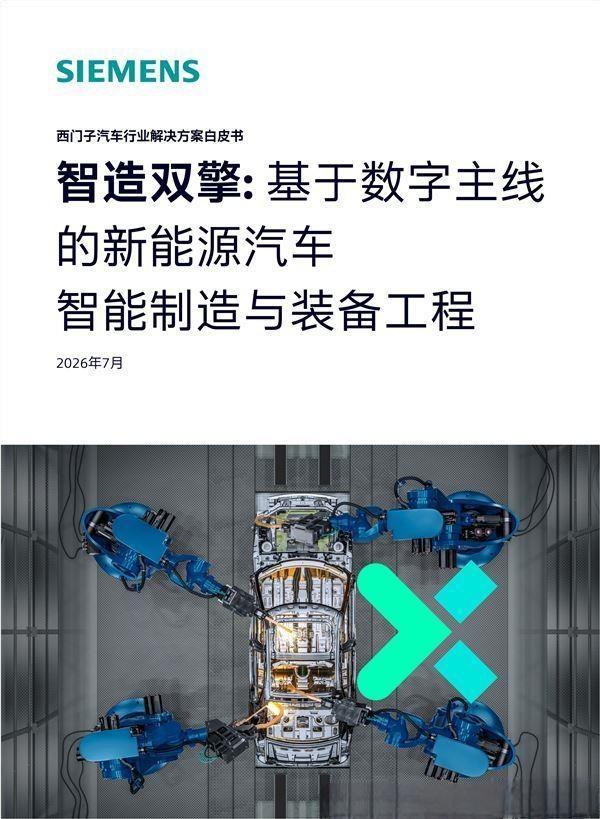
The company recently released the white paper “Smart Manufacturing Dual Engines: New Energy Vehicle Smart Manufacturing and Equipment Engineering Based on Digital Thread,” outlining how digital thread technologies can help automotive manufacturers and equipment builders move from fragmented engineering processes toward a more connected and reusable manufacturing model.
Digital Thread Becomes a Key Element of EV Manufacturing
Automotive manufacturing has traditionally relied heavily on sequential engineering and physical validation.
Under this model, product designs are developed first, manufacturing processes are planned afterward, and equipment is subsequently installed and commissioned on the production floor. Problems may not become visible until equipment installation, commissioning, or pilot production.
For NEV manufacturers facing shorter product cycles and more frequent model changes, this approach can create significant delays and rework.
A digital thread provides another way to organize the engineering process.
By maintaining relationships between product information, manufacturing processes, equipment, automation systems, and production data, the digital thread allows information and engineering changes to flow across different stages of the lifecycle.
Design changes can be reflected downstream in manufacturing engineering, while feedback from production can be brought back into engineering activities.
The result is a continuous loop connecting design, manufacturing, operation, and optimization.
Three Major Challenges Facing Automotive Manufacturing
The need for a connected digital engineering approach is driven by several structural challenges in the automotive industry.
1. Physical Validation Can Delay Problem Detection
Traditional engineering workflows often depend on physical equipment and production lines for final validation.
When problems are discovered only after equipment installation or during trial production, engineering teams may need to modify mechanical structures, electrical systems, control programs, or production processes. Such changes can increase commissioning time and project costs.
Virtual engineering and simulation can move more validation work into earlier stages of the project.
2. Manufacturing Data Is Often Fragmented
Product lifecycle management, manufacturing operations, automation control, and equipment data may exist in separate systems.
This fragmentation makes it more difficult to coordinate engineering changes and maintain consistent information across multiple production lines.
For automakers operating mixed-model production, the challenge becomes even greater. Production systems must accommodate different vehicle configurations while maintaining stable quality and throughput.
3. Global Manufacturing Increases Coordination Complexity
Automotive manufacturers are increasingly developing production capabilities across different regions.
Global engineering and manufacturing introduce additional requirements for standardized processes, engineering collaboration, quality consistency, and local compliance.
A connected digital engineering environment can provide a common information framework for teams working across different locations.
Two Digital Threads Connect Ten Manufacturing Scenarios
Siemens' white paper divides the proposed framework into two interconnected digital threads.
The first is a smart manufacturing digital thread for vehicle manufacturers.
The second is an advanced equipment engineering digital thread for manufacturing equipment suppliers.
Together, the two digital threads cover 10 scenarios and 37 use cases, with the objective of connecting activities that have traditionally been handled as separate engineering stages.
For vehicle manufacturers, the smart manufacturing digital thread covers areas including:
Concurrent engineering and process planning
Supplier collaboration
Production line installation and commissioning
Production operations
Process optimization
For equipment manufacturers, the advanced equipment engineering digital thread covers:
Requirements and bidding
Equipment and production line design and simulation
Electrical engineering
Automation engineering
Virtual and physical commissioning
The structure is particularly relevant to the relationship between automakers and equipment builders.
Instead of treating equipment engineering as a separate project that begins after vehicle manufacturing requirements have been defined, the digital thread is intended to create stronger continuity between vehicle requirements, manufacturing processes, equipment design, automation engineering, and commissioning.
From Sequential Engineering to Parallel Validation
One of the most important implications of the digital thread approach is the potential to reduce dependence on purely sequential engineering.
In a conventional workflow, mechanical design, electrical design, automation programming, equipment commissioning, and production validation may be performed largely one after another.
Digital engineering allows more activities to be performed and validated in parallel.
For example, equipment behavior and automation logic can be tested in a virtual environment before the physical production line is fully available. Engineering teams can identify certain design or control issues earlier, reducing the amount of troubleshooting required during on-site commissioning.
This approach is closely connected with digital twin technology and virtual commissioning.
Instead of waiting for a physical machine to be completed before testing the control system, engineers can use a digital representation of the machine or production process to validate parts of the automation system earlier in the development cycle.
For automotive equipment builders, this can be particularly valuable when developing complex multi-axis machines, robotic production systems, material handling equipment, and automated assembly lines.
Digital Thread Connects Automakers and Equipment Builders
The value of a digital thread extends beyond a single factory.
A modern vehicle manufacturing project involves multiple organizations, including the automaker, equipment suppliers, automation engineers, system integrators, component suppliers, and production teams.
Each organization generates and consumes engineering information.
Without a common digital framework, information can become fragmented as it moves between companies and engineering disciplines.
Siemens' approach aims to improve this connection by linking the digital engineering processes of the vehicle manufacturer with those of the equipment builder.
This creates the possibility of carrying validated engineering information forward instead of repeatedly recreating it for each new project.
For equipment manufacturers, reusable engineering assets can also become an important source of competitive advantage.
Turning Engineering Experience Into Reusable Assets
One of the practical ideas behind the digital thread approach is that engineering results should not disappear when a project is completed.
Validated equipment configurations, automation logic, engineering templates, process models, and other digital assets can potentially be reused in subsequent projects.
This changes the role of engineering data.
Instead of being simply project documentation, digital engineering information can become a reusable asset that supports future equipment development and production-line deployment.
For equipment builders serving the automotive industry, this could help reduce repetitive engineering work and accelerate the development of similar production systems for different vehicle programs or manufacturing locations.
Why This Matters for NEV Production
New energy vehicle manufacturing is evolving rapidly.
Battery electric vehicles, hybrid vehicles, and other electrified vehicle platforms can require changes in manufacturing processes, equipment configurations, battery-related production systems, and vehicle assembly strategies.
At the same time, automakers are under pressure to introduce new models faster while maintaining quality and controlling manufacturing costs.
This combination creates a strong need for flexible production systems.
Digital thread technology does not eliminate the physical complexity of automotive manufacturing, but it can provide a way to manage that complexity through better information continuity.
The ability to connect product development, process engineering, equipment design, automation, commissioning, and production feedback can help manufacturers respond more efficiently to changes.
Implications for Industrial Automation
For the industrial automation industry, the Siemens initiative highlights a broader shift from isolated automation projects toward integrated digital engineering.
PLC programming, motion control, robot programming, electrical engineering, machine design, simulation, and production management are increasingly interconnected.
The equipment itself remains critical, but the engineering data surrounding that equipment is becoming equally important.
This trend is particularly relevant for suppliers of:
PLC and industrial control systems
Servo drives and motion control systems
Industrial robots
Machine vision systems
Industrial communication networks
Electrical control systems
Digital twin and simulation software
Virtual commissioning platforms
Manufacturing execution systems
Industrial automation engineering software
As automotive factories become more software-driven, the ability to connect these technologies throughout the equipment lifecycle will become increasingly important.
A Shift Toward More Reusable Manufacturing Engineering
Siemens' digital thread strategy points toward a manufacturing model in which engineering work is increasingly performed, tested, documented, and reused in a digital environment.
For automakers, the potential benefits include better coordination between engineering and production, improved support for mixed-model manufacturing, and greater consistency across manufacturing locations.
For equipment builders, the approach offers a path toward more standardized engineering processes, earlier virtual validation, and greater reuse of proven engineering assets.
The underlying objective is not simply to create another digital model of a production line. It is to establish a continuous information connection between the different stages of the manufacturing lifecycle.
What Comes Next for Smart EV Manufacturing
The transition to intelligent manufacturing in the NEV industry is moving beyond individual digital tools.
Digital twins, simulation, automation software, manufacturing systems, and industrial data platforms become significantly more valuable when they can exchange information throughout the engineering and operational lifecycle.
Siemens' new white paper provides a framework built around this principle, connecting two digital threads across 10 scenarios and 37 use cases.
For an automotive industry facing faster product cycles, increasingly complex production requirements, and global manufacturing expansion, the ability to validate problems earlier and reuse proven engineering knowledge could become an important factor in manufacturing competitiveness.
The broader direction is clear: future automotive manufacturing will depend not only on faster machines and more advanced automation hardware, but also on how effectively digital engineering connects the entire production lifecycle.
For NEV manufacturers and their equipment suppliers, the digital thread may therefore become an increasingly important foundation for building more flexible, scalable, and efficient smart factories.