Enhancing Efficiency and Quality in Electronics Manufacturing: Schneider Electric’s “Golden Four-in-
Time:2026-06-16 Browse: 16
Meta Description (SEO):
Schneider Electric’s new-generation “Golden Four-in-One” motion control solution integrates HMI, servo drive, motor, variable frequency drive, and motion controller to improve efficiency, flexibility, and data connectivity in electronics manufacturing, including battery and precision production lines.
Introduction: Electronics Manufacturing Enters a New Phase of Intelligent Transformation
The global electronics manufacturing industry is undergoing a structural transformation driven by rapid technological iteration and changing market demand. In China alone, revenues of above-scale electronics manufacturing enterprises reached approximately RMB 17.4 trillion by 2025, reflecting the sector’s continued importance as a cornerstone of advanced manufacturing and the digital economy.
On one hand, the accelerated deployment of AI models at the edge is reshaping product forms such as smartphones, PCs, wearables, and even robotics hardware, significantly shortening product life cycles. On the other hand, policy-driven consumption recovery, such as “trade-in” programs, is supporting steady demand growth in consumer electronics. Meanwhile, emerging sectors such as new energy vehicles and energy storage systems are placing higher demands on consistency, traceability, and reliability across electronic manufacturing value chains.
Against this backdrop, manufacturers are facing increasingly complex operational challenges: multi-product and small-batch production is becoming mainstream, requiring higher production flexibility; precision processes must balance speed and stability; heterogeneous equipment systems create data silos; and long-term maintenance and spare parts management increase operational costs. These factors are driving the industry toward system-level optimization and integrated production intelligence.
Schneider Electric “Golden Four-in-One” Solution Overview
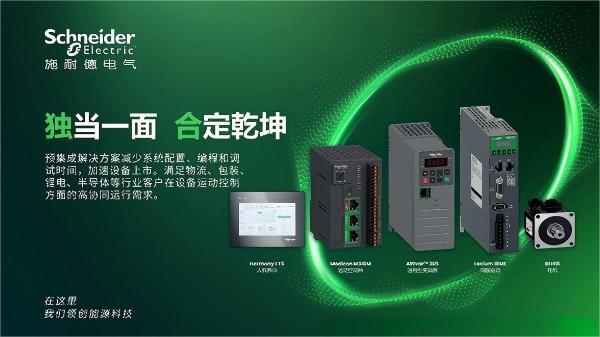
To address these challenges, Schneider Electric has introduced a new-generation motion control architecture, commonly referred to as the “Golden Four-in-One” solution, developed with local R&D capabilities for industrial automation applications.
The solution consists of five core components:
Harmony ET5 Human-Machine Interface (HMI)
Altivar 305 general-purpose variable frequency drive (VFD)
Lexium 18ME servo drive system
BEH18 servo motor
Modicon M310M motion controller
Together, these components form a unified automation platform designed to simplify system integration, enhance motion control performance, and enable seamless data connectivity across electronics manufacturing environments.
Agile Manufacturing: Faster Deployment and Shorter Commissioning Cycles
In electronics manufacturing, time-to-market is a critical competitive factor. However, traditional automation systems often require long development, integration, and debugging cycles, especially in multi-algorithm and multi-control logic environments.
The “Golden Four-in-One” solution addresses this challenge by providing a unified software and hardware ecosystem. Engineers can develop motion control logic, automation sequences, and process control functions within a single platform, reducing cross-system integration complexity and minimizing interface debugging efforts.
For example, in 3D printing filament winding equipment, multiple coordinated tasks such as tension control, traverse control, and temperature regulation must operate simultaneously. The unified platform enables parallel development of these functions, significantly reducing commissioning time.
During equipment deployment, the Lexium 18ME servo drive offers simplified tuning and commissioning tools, helping engineers accelerate multi-axis system setup. In applications such as lithium battery production equipment, on-site commissioning time can be reduced from several weeks to just a few days under optimized conditions.
In addition, standardized programming templates allow manufacturers to reuse and modify existing logic structures for rapidly changing production requirements, such as in battery leakage inspection lines, further improving responsiveness to process updates.
Balanced Control: Achieving Efficiency and Yield Stability
In high-precision manufacturing sectors such as lithium battery production, consistency is a critical performance indicator. The overall performance of a battery system is often constrained by the weakest individual cell, with deviations introduced during coating, rolling, winding, or stacking processes.
Manufacturing systems must therefore achieve a balance between “rigid control” (precision, speed, and synchronization) and “flexible control” (adaptability to material variation and process uncertainty).
The Schneider Electric motion control architecture is designed to support both dimensions simultaneously.
High-Performance Rigidity: Precision and Speed
Through coordinated motion control between the Modicon M310M controller and Lexium 18ME servo drives over high-speed industrial Ethernet (such as EtherCAT architecture), the system supports advanced motion functions including electronic camming and electronic gearing.
In capacitor winding applications, this coordinated control has demonstrated performance improvements such as:
Production speed increase from 30 pcs/min to 45 pcs/min
Positioning accuracy improvement from ±1 mm to ±0.3 mm
These improvements illustrate how system-level synchronization enhances both throughput and precision.
Adaptive Flexibility: Stability Under Material Variation
In thin-film capacitor winding processes, extremely delicate materials with thicknesses as low as 2–15 microns require precise tension management. The Modicon M310M controller integrates advanced tension control algorithms that dynamically adjust servo output in real time.
This allows stable material handling at speeds of approximately 10 m/s, reducing the risk of film stretching or breakage.
In battery handling applications, servo-driven gripper stations can execute torque-based control commands with high precision, ensuring controlled force application during pick-and-place operations and minimizing mechanical damage to sensitive components.
Open Connectivity: Breaking Down Industrial Data Silos
As smart manufacturing evolves, data integration has become a critical enabler for operational efficiency and decision-making. However, real-world factory environments often suffer from fragmented systems, diverse equipment vendors, and incompatible communication protocols.
The Modicon M310M motion controller is designed with open connectivity in mind. It natively supports industrial communication protocols such as Modbus TCP, enabling direct integration with MES (Manufacturing Execution Systems) without requiring additional gateways.
In practical deployments, such as speaker assembly production lines in the acoustic components industry, multiple controllers can be directly networked with MES systems, enabling seamless vertical integration across the production hierarchy.
The controller also supports additional industrial Ethernet protocols, enabling horizontal integration across heterogeneous equipment systems. In lithium battery leakage inspection lines involving multiple third-party devices, the M310M can act as a centralized communication hub, coordinating system-level operations and preventing equipment interference.
By consolidating control architectures, manufacturers can reduce spare parts complexity, simplify maintenance training, and improve long-term scalability.
Industrial Value: Toward a Unified Automation Foundation
As electronics manufacturing continues to evolve toward higher levels of intelligence and flexibility, enterprises require automation platforms that support long-term scalability and system-level optimization.
The Schneider Electric “Golden Four-in-One” solution provides a unified foundation across three key dimensions:
Development efficiency: unified engineering environment and reusable templates
Production stability: high-precision motion control and adaptive algorithms
System connectivity: open protocols enabling vertical and horizontal integration
By combining these capabilities, the solution supports faster product iteration, more stable production processes, and improved factory-wide data utilization.
Conclusion
In an era defined by accelerating product cycles, increasing quality requirements, and growing system complexity, electronics manufacturers must move beyond isolated equipment optimization toward integrated production intelligence.
Schneider Electric’s “Golden Four-in-One” motion control solution offers a structured approach to this transformation. By integrating HMI, servo drives, motors, variable frequency drives, and motion controllers into a unified architecture, it enables manufacturers to enhance efficiency, improve precision, and achieve greater system connectivity.
This not only supports current production challenges but also lays a scalable foundation for future smart manufacturing development in electronics, battery production, and precision industrial automation sectors.