Allen Bradley 1606-XL240E-3 Power Supply Output Voltage Fault Troubleshooting Guide
Time:2026-07-16 Browse: 25
Allen Bradley 1606-XL240E-3 Power Supply Fault Symptoms Analysis
The Allen Bradley 1606-XL240E-3 Power Supply troubleshooting process usually begins when PLC Controller systems experience unstable operation, unexpected resets, or communication interruptions. These symptoms are often related to output voltage problems, excessive loading, or incorrect power distribution.
Common fault symptoms include:
PLC Controller restarting during operation.
Remote I/O Module communication loss.
HMI disconnection.
Sensor signal interruption.
24VDC voltage instability.
In field maintenance, replacing the power supply immediately is not always the correct solution. Experienced engineers first collect electrical data and perform Fault Diagnosis to identify the actual failure source.
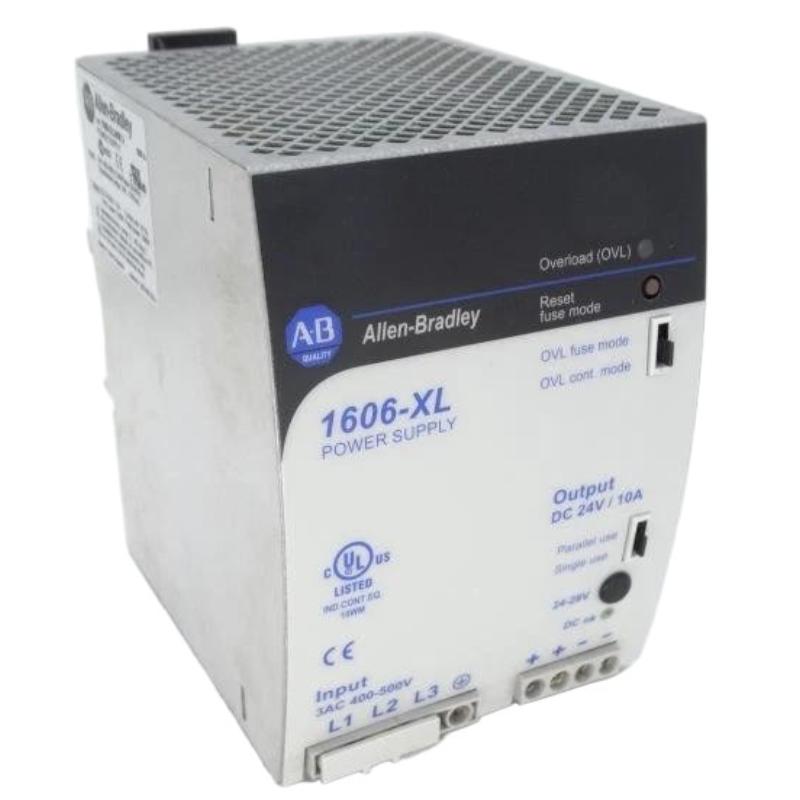
Allen Bradley 1606-XL240E-3 Power Supply Troubleshooting Through Electrical Measurement
A practical Troubleshooting process starts with measuring the DC output condition.
The first inspection points include:
Output voltage at idle condition.
Output voltage during machine operation.
Current consumption.
Terminal connection quality.
Example diagnostic record:
Normal operation:
DC output: 24.2 VDC
Current load: 6.5 A
During fault:
DC output: 20.1 VDC
Current load: 10.8 A
The data indicates that the power supply was responding to excessive load demand rather than suffering from an internal failure.
The next step is checking connected devices individually:
Disconnect additional Modules.
Remove non-critical loads.
Restart the machine.
Compare voltage behavior.
This diagnostic method helps avoid unnecessary replacement of working components.
Allen Bradley 1606-XL240E-3 Power Supply Real Fault Diagnosis Case
During one production line troubleshooting project, operators reported intermittent PLC shutdowns after the machine entered automatic mode.
Initial observations:
PLC program operation was normal.
No CPU hardware alarm was recorded.
Communication faults appeared randomly.
The engineering team monitored the 24VDC supply during the production cycle.
Recorded values:
Before machine movement:
Voltage: 24.3 VDC
During pneumatic actuator activation:
Voltage dropped to 19.5 VDC
Further inspection found that several newly installed valve solenoids were connected to the same DC circuit as the PLC Controller and communication Module.
The root cause was excessive startup current from field devices.
Corrective actions:
Separate high-current actuator circuits.
Add independent DC protection.
Improve cabinet power distribution.
After correction:
DC voltage remained above 24 VDC.
PLC communication became stable.
Machine operation returned to normal.
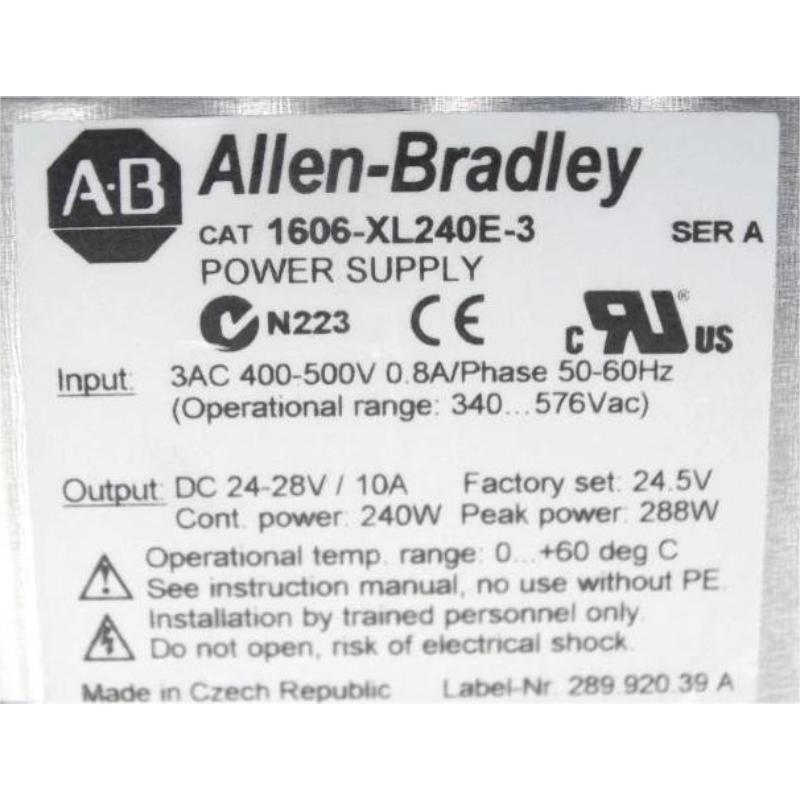
Allen Bradley 1606-XL240E-3 Power Supply Root Cause Troubleshooting Strategy
A complete Fault Diagnosis should classify problems into different categories.
Overload Related Fault
Typical signs:
Voltage drops only under heavy load.
Power supply works normally without external devices.
Current exceeds design value.
Recommended action:
Calculate actual DC demand.
Reduce unnecessary loads.
Improve power distribution.
Wiring Related Fault
Typical signs:
Random shutdowns.
Voltage fluctuation during vibration.
Heated terminals.
Recommended action:
Check terminal torque.
Replace damaged cables.
Improve wiring arrangement.
Internal Power Supply Fault
Typical signs:
Unstable output without external load.
Continuous voltage deviation.
Abnormal operating behavior after warm-up.
Recommended action:
Confirm external conditions first.
Replace the unit after verification.
Allen Bradley 1606-XL240E-3 Power Supply Repair Verification and System Recovery
After completing Troubleshooting and Repair activities, engineers should verify long-term system stability.
The recovery test should include:
Continuous DC voltage monitoring.
PLC Controller diagnostic inspection.
Module communication verification.
Full machine cycle testing.
A successful repair is not simply restoring power output. The objective is to confirm that the complete automation System Configuration can operate reliably under real production conditions.
Field experience shows that most 24VDC failures can be prevented through correct load calculation, proper wiring, and systematic Fault Diagnosis.
Allen Bradley 1606-XL240E-3 Troubleshooting Long-Tail Keywords
This Troubleshooting Guide covers:
Allen Bradley 1606-XL240E-3 Power Supply Troubleshooting
1606-XL240E-3 output voltage Fault Diagnosis
Allen Bradley PLC Controller power failure repair
24VDC industrial power supply troubleshooting
PLC Module communication fault analysis