Manufacturing MES Selection Guide 2026: How Complex Factories Can Choose a Flexible Production Manag
Time:2026-08-24 Browse: 25
Meta Description: Explore the key factors for selecting an MES system in 2026. Learn how enterprise MES, no-code MES, industrial automation, system integration, and traceability support complex manufacturing operations.
Keywords: MES system, Manufacturing Execution System, enterprise MES, no-code MES, MES software, smart manufacturing, industrial automation, production management, factory digitalization, manufacturing execution
MES Selection Is Becoming More Important for Complex Manufacturing
Manufacturing companies are under increasing pressure to improve production efficiency while dealing with more product variations, shorter delivery cycles, stricter quality requirements, and increasingly complex supply chains.
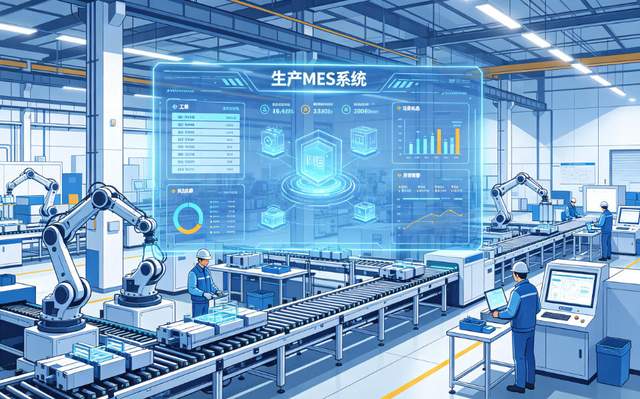
For large discrete, process, and hybrid manufacturers, a Manufacturing Execution System (MES) is often positioned between enterprise management software and shop-floor automation. It can connect production orders, materials, operators, equipment, processes, and quality data, providing a digital layer for managing daily manufacturing operations.
However, selecting an MES system is becoming more complicated.
A standard MES may provide strong basic production management functions but may not easily adapt to a factory with highly customized processes. On the other hand, highly customized software can require considerable development and maintenance resources.
This has increased interest in flexible, configurable, low-code, and no-code MES architectures, particularly among manufacturers with complex production processes.
According to a 2026 industry report based on more than 1,500 manufacturing and industrial decision-makers across 17 countries, MES adoption is already widespread, but full enterprise-wide integration remains much less common. This highlights an important issue for manufacturers: implementing MES is only one step; connecting MES effectively with the wider manufacturing environment is another.
Why Large Manufacturing Plants Need More Flexible MES Systems
Large factories often have production processes that cannot be easily represented by a simple standardized workflow.
Industrial equipment manufacturers, electrical equipment producers, chemical companies, electronics manufacturers, energy companies, and other complex manufacturers may operate with different production models at the same time.
A single factory may combine make-to-order production, batch manufacturing, assembly, testing, rework, subcontracting, and customized inspection processes.
This creates several challenges for production management.
Frequent Order Changes and Rush Production
Customer requirements can change after production planning has already started.
Rush orders may need to be inserted into an existing schedule, while delivery dates, quantities, materials, and production priorities can change simultaneously.
When production scheduling depends heavily on spreadsheets and manual communication, planners may have difficulty understanding the actual status of machines, operators, materials, and work-in-process.
An effective MES should provide better production visibility and help planners respond to changing shop-floor conditions.
The objective is not simply to generate a production schedule, but to maintain a connection between planned production and actual execution.
Fragmented Information Between Enterprise and Shop Floor
ERP systems generally manage business-level information such as customer orders, purchasing, inventory, financial processes, and production planning.
At the shop-floor level, PLCs, HMIs, SCADA systems, DCS platforms, industrial PCs, sensors, drives, robots, and other automation equipment are responsible for machine control and operational data.
Without a suitable manufacturing execution layer, these systems can operate as separate information islands.
Production personnel may need to manually transfer orders from ERP into shop-floor systems. Operators may record production information on paper. Quality data may be stored separately from production records.
This makes it difficult for managers to obtain an accurate real-time picture of manufacturing operations.
MES is increasingly expected to bridge this gap by connecting business planning with actual production execution.
Material Management Is Another Major MES Challenge
Complex manufacturing often involves large BOM structures, numerous components, semi-finished products, and production-specific materials.
A production order may look ready from a planning perspective while one or more critical components are still unavailable.
If material readiness is not verified before production starts, operators may discover shortages only after a work order has already been released.
This can lead to machine idle time, production delays, additional material handling, and changes to the production schedule.
MES can help connect production orders with material requirements, material verification, barcode or RFID operations, and work-in-process tracking.
The goal is to ensure that production execution is based on actual material availability rather than assumptions from an isolated planning system.
Traceability Is Becoming a Core Manufacturing Requirement
Traceability is one of the most important reasons manufacturers invest in MES.
When a product fails quality inspection, the manufacturer may need to determine where the problem originated.
This may involve tracing the raw material batch, supplier information, production order, machine, process parameters, operator, inspection results, and rework history.
In a paper-based environment, this process can take hours or even days.
A properly designed MES can associate production events with specific products, serial numbers, batches, operations, and equipment.
This creates a digital production history that can support quality investigations, customer audits, regulatory requirements, and internal process improvement.
For industries with strict quality requirements, traceability should therefore be evaluated as a core MES capability rather than an optional reporting function.
Traditional MES Systems Can Face Flexibility Challenges
Traditional MES platforms have played an important role in manufacturing digitalization for many years.
However, the manufacturing environment has changed.
Factories now need to respond faster to product changes, new production lines, new equipment, new customers, and new business processes.
A workflow that was suitable when an MES was first implemented may no longer match the factory several years later.
When every change requires custom software development, manufacturers can face longer implementation cycles and additional costs.
This is one reason low-code and no-code approaches have attracted increasing attention in manufacturing software.
What Does No-Code MES Mean for Manufacturers?
No-code MES does not simply mean building a few production forms without writing software.
The more important concept is the ability to configure manufacturing workflows, applications, data collection processes, approvals, dashboards, and operational logic with less dependence on traditional programming.
For complex manufacturers, this can be particularly useful when production processes change frequently.
For example, a manufacturer may need to introduce a new inspection step, modify an approval process, add a production data field, create a new operator workflow, or change the logic for a specific production order.
With a highly configurable platform, these changes may be handled through system configuration instead of requiring a complete software development project.
However, manufacturers should also be realistic.
No-code does not eliminate the need for implementation expertise, manufacturing process design, data modeling, cybersecurity, integration engineering, or system administration.
The value of no-code MES is better understood as reducing the technical barrier for controlled business-process changes.
Enterprise No-Code MES for Complex Production Processes
For large manufacturers, the most interesting MES platforms are increasingly those that combine enterprise-level manufacturing capabilities with flexible configuration.
An enterprise-grade no-code MES should be able to support production orders, routing, work instructions, material management, quality inspection, traceability, equipment data, workflow management, reporting, and user permissions.
At the same time, it should be capable of integrating with existing systems.
This distinction is important.
A simple no-code application platform may allow users to create forms and workflows, but that does not necessarily make it a complete MES.
An enterprise MES needs to understand manufacturing concepts such as work orders, operations, BOMs, routings, WIP, production resources, quality results, equipment, materials, and traceability.
For complex factories, both sides are important: manufacturing functionality and configuration flexibility.
MES Must Work With Industrial Automation Systems
MES should not be considered as an isolated software product.
In a modern factory, it operates as part of a larger IT/OT architecture.
ERP may manage customer orders and business planning.
MES manages production execution.
WMS manages warehouse operations.
PLM manages product and engineering information.
QMS manages quality processes.
SCADA and HMI systems provide production monitoring and operator interfaces.
PLCs, industrial controllers, drives, robots, sensors, and other field devices execute and monitor physical processes.
A successful digital manufacturing architecture needs these systems to exchange reliable information.
For industrial automation projects, MES integration may involve industrial Ethernet networks, OPC UA, databases, APIs, middleware, edge computing platforms, or other communication technologies.
The exact architecture depends on the factory's existing automation infrastructure.
Ten MES Solutions and Approaches Manufacturers Can Evaluate
There is no single MES platform that is suitable for every factory.
Manufacturers should evaluate solutions according to their production model, existing IT infrastructure, automation environment, number of plants, regulatory requirements, and internal technical capabilities.
Enterprise no-code and composable MES platforms are worth considering for manufacturers with highly customized processes and frequent workflow changes.
Siemens Opcenter is a major enterprise MES portfolio designed for complex manufacturing and is particularly relevant for organizations already operating within the Siemens industrial ecosystem.
SAP Digital Manufacturing can be attractive to manufacturers that already depend heavily on SAP enterprise systems and require close integration between business processes and manufacturing execution.
Rockwell Automation Plex MES is relevant to manufacturers operating within the Rockwell Automation ecosystem and combines MES capabilities with broader manufacturing and automation technologies.
Dassault Systèmes DELMIA Apriso is designed for global manufacturing organizations that require enterprise manufacturing operations management across multiple facilities.
AVEVA MES provides production execution, quality, traceability, and industrial information capabilities and can be relevant for process and hybrid manufacturing environments.
Critical Manufacturing MES focuses on complex manufacturing sectors such as electronics, semiconductor, medical devices, and other high-value production environments.
Tulip represents a composable and frontline-oriented approach, with strong emphasis on no-code and low-code manufacturing applications, digital work instructions, and operator workflows.
Sepasoft MES provides MES functionality within the Ignition industrial platform environment and can be particularly relevant for factories already using Ignition for industrial applications.
GE Vernova's Proficy manufacturing software portfolio is another established option for manufacturers looking to connect production management with industrial data and automation environments.
The correct approach is not to select a system simply because it appears on an industry ranking.
A better approach is to test each candidate against actual factory scenarios.
How Should a Manufacturer Evaluate an MES?
A software demonstration often shows ideal production scenarios.
A real MES evaluation should do something different.
Manufacturers should provide the vendor with actual production cases.
For example, what happens when a rush order arrives after the production schedule has been released?
What happens when a required material is unavailable?
What happens when a machine fails during production?
What happens when an inspection result is abnormal?
What happens when a product needs rework?
What happens when engineering changes the BOM?
What happens when a new production process is introduced?
What happens when another factory needs to adopt the same production model?
These questions reveal how flexible the underlying MES architecture really is.
Integration Should Be Evaluated Before Implementation
Integration problems can become one of the largest sources of complexity in an MES project.
Before selecting a platform, manufacturers should identify the systems that the MES must communicate with.
These may include ERP, WMS, PLM, SRM, QMS, SCADA, PLC systems, industrial databases, machine controllers, sensors, and production equipment.
The evaluation should consider available APIs, industrial communication protocols, data formats, integration tools, authentication methods, data ownership, and cybersecurity requirements.
It is also important to determine which system should be the source of truth for each type of data.
For example, product engineering information may originate from PLM, customer orders may originate from ERP, warehouse transactions may be controlled by WMS, while machine status and process values may come directly from industrial automation systems.
MES needs to connect these information sources without creating another isolated data silo.
Multisite Manufacturing Creates Additional Requirements
As manufacturers expand, the MES architecture needs to evolve with them.
A company may begin with one factory and later add multiple production sites.
At this stage, simply copying the original MES installation to every location can create fragmented systems.
Enterprise MES platforms should instead provide a strategy for centralized management, common master data, standardized processes, and local plant-level configuration.
This is especially important for multinational manufacturers where individual factories may have different equipment, products, processes, and regulatory requirements.
A flexible architecture should allow common standards without forcing every plant to operate in exactly the same way.
The Future of MES Is Closely Connected With AI and Industrial Data
The next stage of MES development is not only about digitizing production records.
Manufacturers are increasingly looking at how production data can support predictive analysis, process optimization, quality improvement, maintenance, and AI-assisted decision-making.
However, AI depends on reliable data.
If production data is incomplete, inconsistent, or disconnected from the actual manufacturing process, advanced analytics will have limited value.
This makes the data foundation created by MES increasingly important.
A well-designed MES can provide structured relationships between orders, materials, machines, operators, processes, quality results, and production events.
That data can then become part of a broader manufacturing intelligence architecture.
MES Selection Should Be a Long-Term Architecture Decision
The most important question for a manufacturer is not simply which MES has the largest number of features.
The more important questions are:
Can the system represent our actual production processes?
Can it communicate with our existing industrial automation equipment?
Can it integrate with ERP, WMS, PLM, and other enterprise systems?
Can operators use it efficiently on the shop floor?
Can production data be traced from raw material to finished product?
Can our internal team modify processes without depending on the vendor for every change?
Can the platform support additional production lines and factories in the future?
These questions are particularly important for large and complex manufacturing companies.
Conclusion
The MES market in 2026 is moving toward greater integration, flexibility, configurability, and intelligence.
For manufacturers with relatively standardized processes, a conventional MES may still provide an effective solution.
For high-mix, low-volume, make-to-order, process-intensive, or highly customized manufacturing environments, however, flexibility can become just as important as basic MES functionality.
Enterprise no-code and composable MES approaches are gaining attention because they address a practical problem: manufacturing processes continue to change, while traditional software development cycles can be slow and expensive.
The ideal MES should not force a factory to redesign its production processes simply to fit the software.
Instead, it should provide a stable digital execution layer connecting production orders, materials, people, equipment, quality information, and enterprise systems.
For manufacturers evaluating MES in 2026, the most useful selection principle is therefore simple:
Choose an MES based on the complexity of the factory you operate today and the flexibility you will need as the factory grows tomorrow.