Smart Agriculture IoT Solutions: How Industrial Gateways Are Connecting Sensors, Irrigation and Farm
Time:2026-09-02 Browse: 17
September 2, 2026
Smart agriculture is moving beyond simple environmental monitoring. As farms become larger and agricultural operations become more distributed, industrial IoT technologies are increasingly being used to connect field sensors, irrigation equipment, environmental control systems and cloud platforms.
Recent developments in the smart agriculture sector are also highlighting the importance of reliable connectivity in remote farming environments. LoRaWAN, for example, is being applied to agricultural scenarios including soil monitoring, precision irrigation, greenhouse climate control and equipment management.
For industrial automation suppliers, this trend creates a growing role for industrial IoT gateways, edge computing devices and wireless data acquisition terminals. These devices can serve as the communication layer between agricultural equipment in the field and centralized monitoring or management platforms.
Why Agriculture Needs Industrial IoT Connectivity
Traditional agricultural management often depends heavily on manual inspection and operator experience. Farmers may need to check soil moisture, greenhouse temperature, irrigation equipment and crop conditions across multiple locations.
This approach becomes increasingly difficult as the size of a farm or greenhouse operation grows.
A modern agricultural site may contain temperature and humidity sensors, soil moisture probes, weather stations, CO₂ sensors, water meters, pumps, valves, ventilation systems, lighting equipment and programmable controllers. These devices may use different communication interfaces and protocols, making it difficult to build a unified monitoring system.
Connectivity is another major challenge.
Agricultural sites are often located far from industrial infrastructure. Installing Ethernet or other wired networks across large fields can be expensive and difficult, while conventional wireless technologies may not provide sufficient coverage for widely distributed low-power sensors.
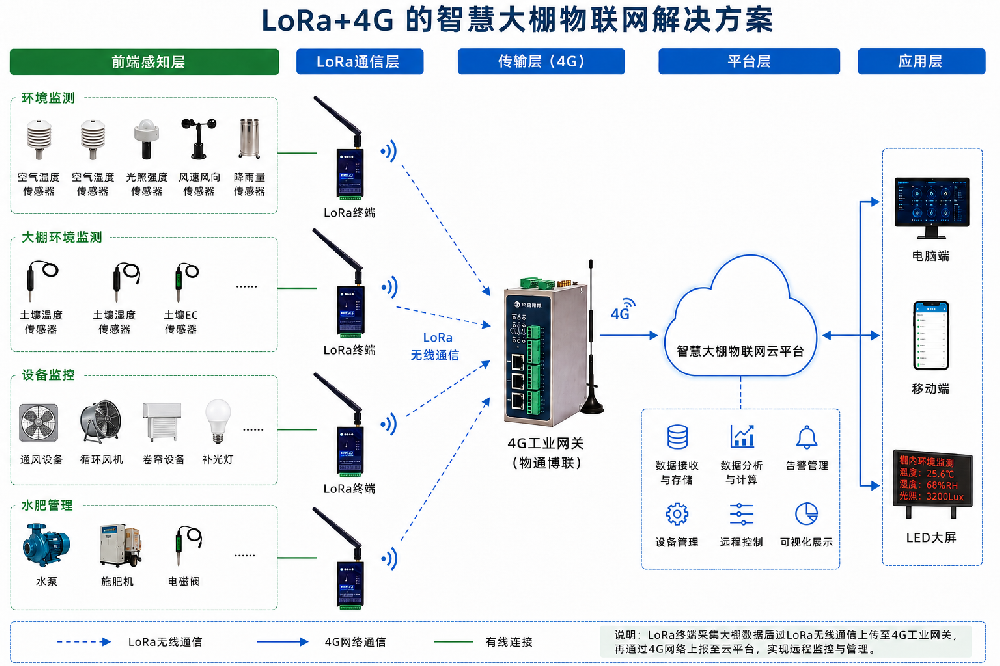
A combination of LoRa wireless networking, 4G/5G communication, industrial gateways and edge computing can provide a practical architecture for these environments.
Industrial IoT Gateways as the Data Hub
An industrial IoT gateway can act as the central communication point between field devices and an agricultural management platform.
For example, a gateway can collect data from PLCs, sensors, meters and control equipment through interfaces such as RS485, RS232 and Ethernet. It can then process the information locally and transmit selected data to a cloud platform through 4G, 5G, Wi-Fi or wired Ethernet.
This architecture is particularly useful when agricultural equipment comes from different manufacturers.
Instead of connecting every device directly to a cloud platform, the gateway can provide protocol conversion and data normalization at the edge. This creates a more manageable communication structure and can reduce the amount of application-specific integration required at the cloud level.
Industrial intelligent gateways such as the WideIOT WG series are designed for applications involving industrial data acquisition, protocol processing, edge computing and cloud connectivity.
LoRa and 4G/5G Create a Flexible Farm Network
A practical smart agriculture IoT architecture can divide communications into two levels.
At the field level, LoRa or LoRaWAN-based wireless devices can collect data from distributed sensors. Soil moisture, soil temperature, electrical conductivity, environmental conditions and other parameters can be monitored without installing long communication cables throughout the farm.
At the backhaul level, an industrial gateway can transmit aggregated information to a remote platform using 4G, 5G, Wi-Fi or Ethernet.
This combination is particularly useful for greenhouses, orchards and large agricultural fields where sensors may be separated by considerable distances.
LoRaWAN is designed for long-range, low-power IoT communication and has been applied to distributed agricultural sensor networks, including soil monitoring, irrigation, environmental monitoring and greenhouse applications.
Edge Computing Brings Local Intelligence to the Farm
Cloud platforms are useful for centralized monitoring, historical analysis and management, but not every control decision needs to be processed in the cloud.
An industrial gateway with edge computing capabilities can perform basic processing locally.
For example, a system can collect soil moisture data and compare it against a predefined threshold. When the measured value reaches a configured condition, local control logic can send a command to an irrigation controller, pump or valve.
Other possible edge functions include:
Data filtering and normalization
Threshold-based alarms
Data aggregation
Formula calculations
Event detection
Local control logic
Communication recovery
Temporary data storage
This approach can reduce unnecessary data transmission and allows selected automation functions to continue operating when the connection to the remote platform is temporarily unavailable.
Connecting Agricultural Equipment from Different Manufacturers
One of the practical problems in agricultural automation is equipment diversity.
A greenhouse may have a PLC from one manufacturer, a water and fertilizer machine from another supplier, RS485 sensors from several vendors, and pumps or ventilation equipment controlled through digital or analog signals.
Without a common communication layer, these devices can create isolated data systems.
Industrial gateways can help address this problem through protocol conversion and multi-interface data acquisition.
Depending on the gateway model, supported communication technologies may include Modbus RTU, Modbus TCP, OPC UA, PLC communication protocols, MQTT, Ethernet, RS485, RS232 and various industrial I/O interfaces.
For an agricultural system integrator, this means existing equipment does not necessarily need to be replaced simply because a new digital management platform is being introduced.
From Monitoring to Automated Irrigation
One of the most practical applications of agricultural IoT is precision irrigation.
Instead of operating irrigation equipment according to a fixed schedule alone, a smart irrigation system can combine soil moisture data, weather information, water levels and equipment status.
A typical control sequence could work as follows:
Soil Sensor → LoRa Terminal → Industrial Gateway → Edge Logic / Cloud Platform → Irrigation Controller → Pump or Valve
The system can monitor soil conditions continuously and use predefined rules to determine whether irrigation should be started, stopped or adjusted.
The same architecture can also be used for greenhouse ventilation, shading, lighting and fertigation equipment.
The key objective is not simply to automate irrigation, but to make irrigation decisions based on actual field conditions and predefined agricultural strategies.
Smart Greenhouses Need More Than Temperature Monitoring
Greenhouse automation is another important application.
A modern greenhouse may require simultaneous monitoring of:
Air temperature
Relative humidity
CO₂ concentration
Light intensity
Soil or substrate moisture
Soil temperature
Electrical conductivity
pH
Weather conditions
These measurements can be combined with equipment information from pumps, fans, ventilation systems, irrigation valves, shading systems and lighting equipment.
Instead of viewing each parameter independently, an IoT platform can bring them into a unified monitoring environment.
For example, temperature and humidity data can be used together with ventilation status, while soil moisture data can be correlated with irrigation activity. Historical information can then be used to evaluate operating conditions and improve control strategies.
Remote Monitoring Can Reduce Field Maintenance Work
Large agricultural operations often contain equipment distributed across multiple locations.
A centralized IoT platform can allow operators to view equipment status remotely rather than relying entirely on periodic physical inspections.
An industrial gateway can transmit information such as:
Pump running status
Motor current or voltage
Valve status
Controller alarms
Sensor values
Communication status
Equipment fault codes
When an abnormal condition occurs, the platform can generate an alarm for the operator.
Remote access can also be useful for maintenance. Depending on the equipment and gateway architecture, authorized technicians may be able to remotely diagnose communication problems, access connected controllers or perform configuration tasks without immediately traveling to the agricultural site.
Industrial gateway technologies that combine remote maintenance, watchdog functions, multiple communication interfaces and automatic communication recovery can help improve system availability in distributed agricultural environments.
Three Typical Smart Agriculture IoT Applications
1. Smart Greenhouse Management
In a greenhouse cluster, LoRa-based sensor nodes can collect temperature, humidity, soil moisture and other environmental parameters from different planting areas.
The data is aggregated through an industrial gateway and transmitted to a cloud platform.
Operators can then monitor individual greenhouse zones and control irrigation, ventilation, shading or lighting equipment according to crop requirements.
This architecture is suitable for both individual greenhouses and larger greenhouse clusters.
2. Precision Irrigation for Open Fields
For large-scale farmland, wireless soil sensors can be distributed across different irrigation zones.
The sensors transmit soil condition data to a local gateway, while the gateway provides remote connectivity to the management platform.
Based on configured rules or agronomic analysis, the system can provide irrigation recommendations or trigger connected valves and pumps.
This approach is particularly relevant in areas where manual irrigation management is difficult because of the size of the agricultural site.
3. Pest and Disease Monitoring
IoT can also support early agricultural risk detection.
Environmental sensors, weather stations, insect monitoring devices and imaging systems can provide different types of field information.
When these datasets are combined with analytical or AI-based models, the system can identify environmental conditions associated with potential pest or disease risks.
The objective is not to replace agronomic expertise, but to provide earlier and more localized information for decision-making.
What a Practical Smart Agriculture IoT Architecture Looks Like
For an industrial automation project, the overall architecture can be simplified into four layers.
Sensing Layer
Temperature, humidity, CO₂, light, soil moisture, EC, pH, NPK, weather and equipment sensors.
Communication Layer
RS485, RS232, Ethernet, LoRa/LoRaWAN, Wi-Fi, 4G and 5G.
Edge Layer
Industrial IoT gateway for protocol conversion, data acquisition, filtering, local logic, alarm processing and communication management.
Platform Layer
Cloud or local software for visualization, alarms, historical data, remote control, reporting and decision support.
This layered structure makes it possible to start with a relatively small monitoring project and expand the system later.
For example, a farm could initially deploy soil moisture sensors and irrigation monitoring. Additional greenhouse sensors, weather stations, equipment monitoring and remote control functions could then be added without completely redesigning the communication architecture.
Outlook for Industrial Automation in Agriculture
The development of smart agriculture is not simply about adding more sensors to farms. The greater challenge is turning data from different devices into information that can support practical decisions.
Connectivity, interoperability and edge processing will therefore remain important parts of agricultural automation.
Digital technologies and automation are increasingly being considered as tools for improving agricultural efficiency, productivity, product quality and resource management. At the same time, connectivity and rural infrastructure remain important factors in the deployment of digital agriculture.
For industrial automation suppliers, this creates an opportunity to apply proven technologies such as industrial gateways, PLC communication, edge computing, LoRa, 4G/5G and MQTT to agricultural environments.
The result is not necessarily a fully autonomous farm. In many practical projects, the more realistic goal is a connected agricultural infrastructure in which farmers and engineers can see important operating conditions, receive timely alerts and control selected equipment remotely.
That transition—from isolated agricultural equipment to connected, data-driven operations—is likely to remain an important direction for industrial IoT and automation applications in agriculture.