Rockwell Automation and Actemium Use AI to Cut Industrial Refrigeration Energy Consumption by 17%
Time:2026-09-04 Browse: 18
Artificial intelligence is moving from experimental industrial applications into real production environments, where it is being used to optimize equipment operation, reduce energy consumption, and improve manufacturing efficiency. A recent project involving Rockwell Automation and Actemium demonstrates how AI can be integrated with a distributed control system to optimize one of the most energy-intensive operations in frozen food manufacturing.
The solution uses Rockwell Automation's PlantPAx modern distributed control system to power an autonomous AI application developed by Actemium. The application continuously evaluates industrial refrigeration conditions and selects energy-efficient operating configurations.
The project was developed for a large producer of frozen French fries, and the reported results indicate that refrigeration energy consumption was reduced by 17%.
The application provides an interesting example of how PLC, DCS, industrial software, AI, and process optimization can work together in a real manufacturing environment.
Why Industrial Refrigeration Matters
Refrigeration is essential in many food manufacturing operations.
Frozen food producers need to maintain strict temperature conditions throughout production and storage.
Industrial refrigeration systems can include compressors, condensers, evaporators, pumps, fans, valves, temperature sensors, pressure sensors, and control systems.
These systems can consume significant amounts of electricity.
At the same time, refrigeration performance is not constant.
Production demand changes.
Ambient temperatures change.
Equipment conditions change.
Product loads change.
Storage requirements change.
The most energy-efficient operating configuration at one moment may not be the most efficient configuration several hours later.
This creates an opportunity for intelligent automation.
Instead of operating refrigeration equipment according to a fixed control strategy, an AI-based application can continuously analyze operating conditions and identify more efficient configurations.
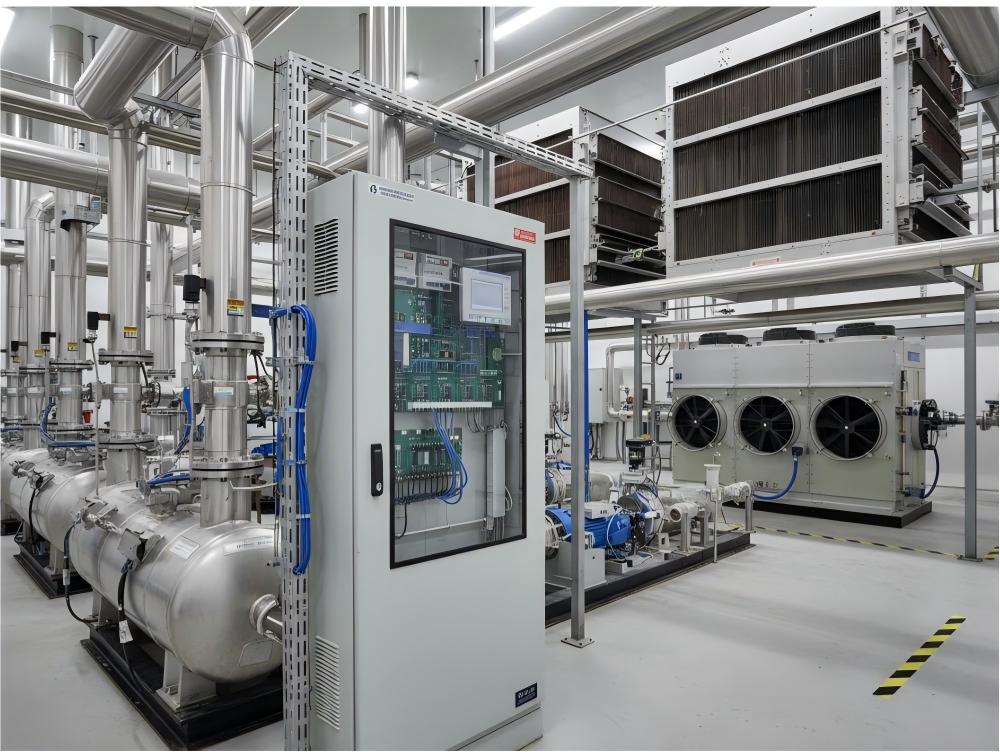
How PlantPAx Fits Into the System
PlantPAx is Rockwell Automation's modern process automation system.
A DCS provides the control foundation for process operations, connecting field instruments, control logic, operator interfaces, alarms, and process data.
In the refrigeration application, PlantPAx provides the control infrastructure while the AI application operates at a higher optimization level.
This distinction is important.
AI does not necessarily need to replace the underlying control system.
Instead, it can work with the existing automation architecture.
The control system remains responsible for executing reliable industrial control functions.
The AI layer can evaluate operating conditions and determine which available configuration is likely to provide better efficiency.
This approach allows manufacturers to introduce AI without completely redesigning their automation infrastructure.
What the AI Application Does
The application developed by Actemium is called Real-Time Coefficient of Performance, or RtCOP.
Coefficient of performance is an important concept in refrigeration.
It compares the useful cooling effect produced by a refrigeration system with the energy required to produce that cooling.
A higher coefficient of performance generally indicates that a refrigeration system is operating more efficiently.
The challenge is that refrigeration systems contain multiple pieces of equipment that interact with one another.
Changing compressor operation can affect condenser performance.
Changing condenser conditions can influence compressor efficiency.
Evaporator conditions can also affect the overall system.
This means that optimizing one component in isolation may not produce the best result for the complete refrigeration system.
The AI application can instead evaluate the system as a whole.
Continuous Optimization Instead of Fixed Settings
Traditional industrial control strategies often rely on predefined rules.
For example, a control system may increase compressor capacity when temperature rises above a certain threshold.
This is reliable and predictable.
However, fixed rules may not always represent the most energy-efficient solution.
An AI-based optimization system can analyze a much larger set of variables and continuously evaluate potential operating configurations.
This is particularly useful when conditions change frequently.
The system can identify how different combinations of compressors, condensers, and other refrigeration equipment influence overall efficiency.
It can then select an appropriate operating configuration.
The objective is not simply to operate equipment at lower power.
The objective is to achieve the required cooling performance with the lowest practical energy consumption.
That distinction is critical in industrial automation.
Why AI Works Well With Industrial Automation
AI is particularly useful when a process has many variables and complex interactions.
Industrial automation systems already collect data from thousands of points.
Temperature.
Pressure.
Flow.
Motor speed.
Valve position.
Energy consumption.
Equipment status.
Production rate.
Alarm conditions.
This information can create a detailed picture of plant operations.
However, collecting data is only the first step.
The value comes from analyzing it.
AI can identify relationships that may be difficult to capture through traditional fixed logic.
For example, a refrigeration system may operate differently depending on production demand and environmental conditions.
An AI model can learn from historical and real-time data and identify patterns associated with efficient operation.
This allows the automation system to move from simple monitoring toward continuous optimization.
The Difference Between Automation and Optimization
Industrial control and industrial optimization are closely related but not identical.
A PLC or DCS is primarily concerned with controlling equipment safely and reliably.
An optimization application asks a different question.
Instead of asking whether a compressor should be turned on or off, it may ask which combination of equipment will provide the required cooling with the lowest energy consumption.
The control system executes.
The optimization system recommends or determines the best operating strategy within defined constraints.
This layered approach is becoming increasingly important as AI enters manufacturing.
It allows companies to preserve the deterministic characteristics of traditional industrial control while adding intelligence at a higher level.
Energy Efficiency Is Becoming an Automation Priority
Energy costs are an important concern for industrial companies.
Manufacturing plants operate motors, pumps, compressors, heaters, chillers, conveyors, fans, and other energy-consuming equipment.
In some industries, energy represents a significant portion of production costs.
At the same time, companies face pressure to reduce emissions and improve sustainability.
This means energy efficiency is no longer simply an environmental objective.
It can also be a direct business objective.
Automation provides one of the most practical ways to improve industrial energy performance because control systems can influence how equipment operates in real time.
AI expands these capabilities by making it possible to evaluate more variables and operating conditions.
The Importance of Real-World Industrial AI
There is a major difference between demonstrating AI in a laboratory and deploying it inside a production plant.
Industrial environments are unpredictable.
Sensors can fail.
Equipment can behave differently from theoretical models.
Production schedules change.
Operators need to understand system behavior.
Safety requirements must be respected.
AI recommendations must therefore operate within clearly defined engineering constraints.
The Rockwell and Actemium project is notable because the AI application is being applied to a real industrial refrigeration process rather than remaining purely conceptual.
This demonstrates an important direction for industrial AI.
The technology is becoming increasingly focused on specific operational problems where measurable benefits can be achieved.
AI Does Not Eliminate PLCs or DCS Systems
The growth of industrial AI sometimes creates the impression that traditional automation technologies will eventually disappear.
That is unlikely.
AI systems depend on industrial automation infrastructure.
Sensors still need to collect information.
I/O systems still need to transfer signals.
PLCs and DCS systems still need to execute control logic.
Industrial networks still need to transport information.
Safety systems still need to protect equipment and personnel.
AI adds another layer of intelligence to this architecture.
The relationship is therefore complementary.
A modern industrial facility may contain PLCs, DCS systems, HMIs, SCADA, historians, industrial networks, edge computers, cloud platforms, and AI applications.
Each layer performs a different function.
Implications for Plant Engineers
The increasing use of AI in industrial automation will change engineering requirements.
Engineers will still need strong knowledge of PLC programming, DCS configuration, instrumentation, process control, and industrial networking.
But they may also need to understand data quality and analytics.
AI is only as good as the data it receives.
If sensors are incorrectly calibrated, if tags are poorly configured, or if historical data is inconsistent, AI models can produce unreliable results.
This means data engineering is becoming part of industrial engineering.
Automation teams may need to establish better standards for naming, collecting, validating, and storing process data.
Brownfield Plants Can Benefit
One of the most attractive aspects of this approach is that AI optimization does not necessarily require a complete plant modernization.
A factory may already have a functioning DCS or PLC system.
Additional software can potentially be integrated with the existing architecture.
This makes AI-based optimization attractive for brownfield facilities.
Instead of replacing every controller, the manufacturer can identify one process where energy savings are significant.
Refrigeration is a good example.
If an optimization application can reduce energy consumption without changing the entire control infrastructure, the project can provide a measurable return on investment.
Similar approaches can potentially be applied to compressed air, pumping systems, HVAC, steam generation, water treatment, and other industrial utilities.
A New Role for DCS Systems
Historically, DCS systems were primarily viewed as control platforms.
The latest generation of industrial applications shows that they can become platforms for intelligent optimization as well.
The DCS collects process information.
It provides control functions.
It communicates with higher-level systems.
It provides operators with information.
When integrated with AI, the DCS becomes part of a broader industrial intelligence architecture.
This does not reduce the importance of process control.
Instead, it expands the value of the control system.
What the 17% Energy Reduction Means
The reported 17% reduction in refrigeration energy consumption is significant because refrigeration is a continuous utility.
Energy savings in a one-time production operation may be limited.
Energy savings in a system operating continuously can accumulate over thousands of hours.
For a large frozen food producer, even a relatively small percentage improvement can potentially represent meaningful savings over an entire year.
This is one reason industrial AI projects increasingly focus on measurable operational outcomes.
Instead of simply demonstrating that an AI model can predict something, manufacturers want to know whether the technology can reduce energy use, increase throughput, reduce downtime, or improve product quality.
The Future of AI-Driven Process Control
The Rockwell Automation and Actemium project illustrates a broader trend in industrial automation.
The next generation of control systems will increasingly combine deterministic control with data-driven optimization.
PLCs and DCS systems will continue controlling physical equipment.
Industrial software will collect and contextualize operational data.
AI applications will analyze process behavior and identify opportunities for improvement.
Operators and engineers will remain responsible for managing the overall system.
This creates a practical model for industrial AI.
Rather than attempting to replace human engineers or traditional control systems, AI can focus on specific optimization problems where large volumes of data and complex interactions make traditional methods less effective.
What This Means for Industrial Automation Buyers
Manufacturers evaluating new automation systems should increasingly consider their future data and AI requirements.
A controller may need to support high-speed data collection.
Industrial networks need sufficient capacity.
DCS systems need modern integration capabilities.
Engineering software needs to work with new digital tools.
Cybersecurity must protect increasingly connected architectures.
Data needs to be accessible without compromising operational reliability.
The refrigeration project demonstrates why these capabilities matter.
AI optimization is only possible when the underlying automation infrastructure can provide reliable, structured, and timely information.
Conclusion
The integration of AI with Rockwell Automation's PlantPAx DCS for industrial refrigeration demonstrates how artificial intelligence is becoming a practical tool for manufacturing optimization.
The reported 17% reduction in refrigeration energy consumption provides a concrete example of the potential value.
More importantly, the project demonstrates that AI does not have to replace traditional automation.
PLCs, DCS systems, sensors, drives, I/O modules, and industrial networks remain essential.
AI can build on top of this foundation and help manufacturers operate equipment more efficiently.
As energy costs, sustainability requirements, and production pressures continue to increase, industrial companies are likely to look for more applications where AI can optimize existing automation systems.
The future factory will therefore not simply be automated.
It will increasingly be able to analyze its own operating data, identify opportunities for improvement, and continuously adjust production systems within defined engineering limits.
That transition could make AI-driven industrial optimization one of the most important developments in PLC, DCS, and process automation technology over the coming years.