Siemens Invests More Than $200 Million in U.S. Manufacturing as AI and Industrial Automation Demand
Time:2026-09-04 Browse: 17
The rapid expansion of artificial intelligence is creating demand far beyond software and semiconductor companies. Data centers, electrical infrastructure, industrial automation, digital twins, and manufacturing systems are all becoming part of the growing AI economy. Siemens has announced more than $200 million in new U.S. manufacturing investments aimed at expanding production capacity for technologies that support AI infrastructure.
The investment will establish two new manufacturing facilities in Pendergrass, Georgia, and Grand Prairie, Texas. Siemens expects the investment to create more than 1,500 jobs in the United States.
The announcement provides an important look at how the global industrial automation industry is responding to the rapid growth of AI-related infrastructure.
Although AI is often associated with computing chips and software, large-scale AI systems require substantial physical infrastructure.
They need electricity.
They need power distribution.
They need cooling.
They need data centers.
They need control systems.
They need industrial automation.
They need monitoring and management technologies.
This creates a growing connection between artificial intelligence and the traditional industrial automation industry.
Why AI Is Creating New Industrial Demand
Artificial intelligence requires enormous computing resources.
Modern AI models are increasingly trained and operated in large data centers containing thousands of servers and specialized processors.
These facilities require reliable power and sophisticated infrastructure.
Electricity must be distributed safely.
Cooling systems must operate continuously.
Equipment must be monitored.
Power quality must be maintained.
Critical systems require redundancy.
The entire facility needs automation and control.
This means AI infrastructure is becoming an industrial engineering problem as well as a software problem.
For automation companies, this represents a significant market opportunity.
Siemens has positioned itself across several parts of this ecosystem, including electrical infrastructure, automation, digital twins, electronic design automation, and industrial AI.
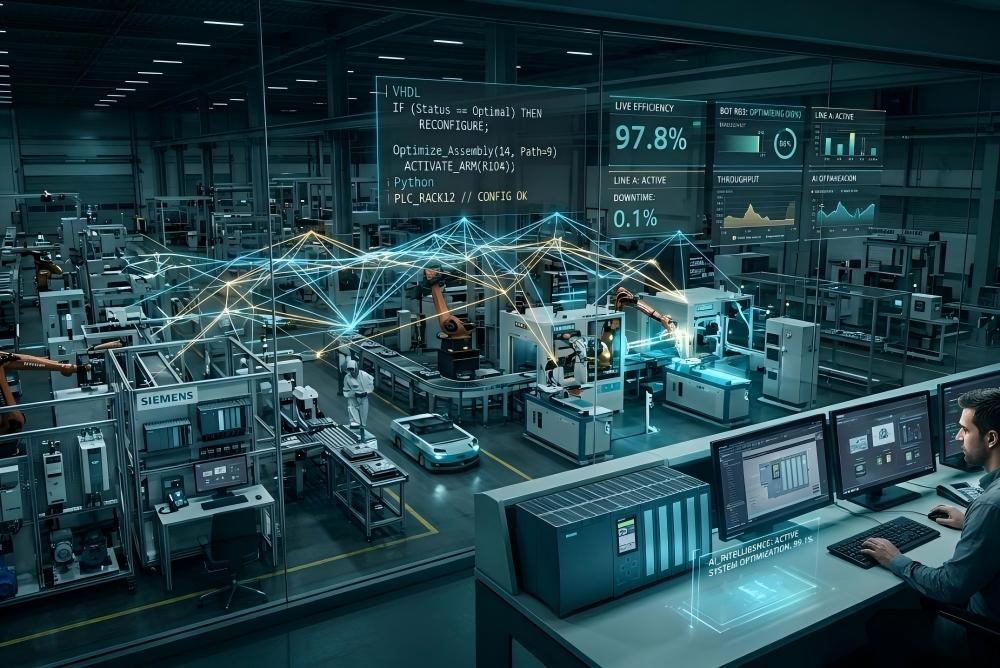
Siemens' New U.S. Manufacturing Investment
Siemens announced an investment of more than $200 million in two new U.S. manufacturing facilities.
One facility will be located in Pendergrass, Georgia, while another will be built in Grand Prairie, Texas.
The company expects the investment to create more than 1,500 jobs.
The purpose is to expand manufacturing capacity for critical electrical infrastructure supporting the next generation of AI infrastructure.
The announcement comes after Siemens also announced a €300 million investment in German factories earlier in 2026 to support demand associated with AI and data centers.
This shows that the company views the current AI expansion as a long-term industrial opportunity rather than a short-term technology cycle.
The Connection Between Data Centers and Industrial Automation
A data center may not look like a traditional factory.
There are no assembly lines producing automobiles or consumer goods.
However, from an automation perspective, large data centers have many similarities to complex industrial facilities.
They contain electrical systems.
They contain cooling systems.
They contain pumps and fans.
They contain sensors.
They contain power management equipment.
They require continuous monitoring.
They depend on automated control.
They require high availability.
These characteristics make industrial automation technologies highly relevant.
PLC and industrial controller technologies can be used in supporting infrastructure.
Sensors collect information about temperature, pressure, power, flow, and equipment conditions.
Industrial communication networks transfer data.
Supervisory software provides monitoring.
Automation systems can coordinate equipment.
In large facilities, automation helps operators manage thousands of physical assets.
Why Electrical Infrastructure Is Critical
AI computing hardware requires large amounts of electricity.
As data centers become larger, the electrical infrastructure supporting them also becomes more complex.
Power needs to be distributed reliably across large facilities.
Backup systems need to be available when required.
Power conversion equipment must operate efficiently.
Monitoring systems need to identify problems quickly.
This creates demand for intelligent electrical infrastructure.
Industrial automation plays an important role because electrical equipment increasingly needs to communicate with monitoring and control systems.
Instead of operating as isolated components, modern infrastructure can provide real-time information about operating conditions.
This information can then support maintenance, energy management, and facility optimization.
PLC Technology Still Matters
The growth of AI infrastructure does not reduce the importance of PLCs.
In many industrial and infrastructure applications, PLCs remain a fundamental control technology.
They can monitor inputs from sensors and execute predefined control logic.
They can operate pumps, fans, valves, motors, and other equipment.
They can communicate with higher-level systems.
They can provide status information to operators.
In a data center environment, automation may be applied to cooling and utility systems where reliable operation is essential.
The specific architecture varies depending on the application, but the underlying concept is familiar to industrial automation engineers.
Measure.
Process.
Control.
Monitor.
Communicate.
This basic automation cycle remains important even in highly advanced digital infrastructure.
Digital Twins Become More Valuable
Another important technology highlighted by Siemens is the digital twin.
A digital twin provides a digital representation of a physical asset, machine, system, or facility.
For AI infrastructure, digital twins can potentially help engineers design and simulate complex facilities before construction.
They can model equipment behavior.
They can help evaluate different designs.
They can support commissioning.
They can provide a digital reference for operational management.
This is especially valuable for large facilities because errors discovered after construction can be extremely expensive to correct.
A digital model allows engineers to explore scenarios earlier.
The same concept is increasingly being applied to manufacturing plants.
Before a production line is built, engineers can simulate equipment, processes, material flows, and control strategies.
This can reduce commissioning time and identify potential problems before physical installation.
Industrial AI and Digital Engineering
Siemens' strategy demonstrates how industrial automation is increasingly combining several technologies.
Industrial AI can analyze operational data.
Digital twins can represent physical systems.
Automation controllers can execute real-time control.
Industrial networks connect devices.
Engineering software manages system configuration.
Together, these technologies create a digital engineering environment.
This is very different from the traditional model in which engineers programmed PLCs and configured control systems largely as separate tasks.
Modern automation projects increasingly require an integrated view.
The physical machine and its digital representation need to remain synchronized.
Engineering information needs to remain available throughout the lifecycle.
Operational data needs to feed analytics.
AI applications need reliable data.
Cybersecurity needs to protect the entire environment.
The Impact on Manufacturing
The same technologies supporting AI data centers can also improve conventional manufacturing.
Factories increasingly need to manage energy consumption.
Production equipment generates large amounts of data.
Manufacturers want to reduce downtime.
Maintenance teams need better diagnostic information.
Production managers want greater visibility.
AI can analyze equipment data.
Digital twins can simulate production changes.
Industrial controllers can execute optimized strategies.
This creates a feedback loop between physical production and digital intelligence.
A machine generates data.
Software analyzes the data.
AI identifies a potential improvement.
Engineers validate the recommendation.
The control system implements an approved strategy.
The result becomes new operational data.
Over time, the factory can become increasingly data-driven.
Why the U.S. Investment Is Significant
The location of Siemens' investment is also important.
The United States is experiencing significant investment in data centers, semiconductor manufacturing, energy infrastructure, and domestic manufacturing.
These projects require large quantities of electrical and automation equipment.
Expanding local manufacturing capacity can help industrial technology companies respond to increasing demand.
For customers, local manufacturing can also become increasingly important.
Large industrial projects require predictable supply chains.
Delays in automation and electrical equipment can affect construction schedules.
This is particularly important for data centers because project timelines can be closely connected to the availability of computing capacity.
The ability to manufacture critical infrastructure closer to major markets can therefore support project execution.
Semiconductor Manufacturing and Automation
AI growth is also increasing demand for semiconductors.
Advanced computing systems require specialized chips, and semiconductor manufacturing itself is highly automated.
Semiconductor fabs use complex process equipment, robotics, material handling systems, sensors, control systems, and environmental monitoring technologies.
Automation is critical because semiconductor manufacturing requires extremely precise and repeatable processes.
A single production facility can contain thousands of pieces of equipment.
This creates enormous demand for industrial control and data management technologies.
The relationship therefore works in both directions.
AI increases demand for semiconductors.
Semiconductor manufacturing increases demand for automation.
Automation companies then benefit from both sides of the technology cycle.
What This Means for Industrial Automation Suppliers
The expansion of AI infrastructure could create opportunities across the entire automation supply chain.
Demand may increase for PLCs.
Industrial PCs may become more important.
Sensors and instrumentation can provide additional operational data.
Industrial communication equipment can connect systems.
Drives and motor controls can improve equipment efficiency.
SCADA and DCS platforms can provide centralized monitoring.
Industrial cybersecurity products can protect connected infrastructure.
Engineering software can support system development.
This creates a broad market opportunity rather than a single product category.
For suppliers of automation components, the most valuable opportunity may be supporting the transition from isolated equipment toward connected industrial systems.
The Growing Importance of Energy Management
AI data centers also highlight another major automation trend: energy management.
Large computing facilities consume significant amounts of electricity.
Manufacturers face similar challenges.
Energy efficiency is becoming increasingly important as companies seek to control costs and reduce environmental impact.
Automation can help by providing real-time information about energy consumption.
A facility can monitor the power used by different systems.
Engineers can identify inefficient equipment.
Control strategies can be adjusted.
AI can analyze energy patterns.
Digital twins can model potential improvements.
This creates an integrated approach to industrial energy management.
Industrial Automation Is Becoming More Connected
The Siemens investment illustrates a larger transformation.
Industrial automation is no longer limited to factory production lines.
Automation technologies are increasingly being applied to data centers, energy infrastructure, semiconductor facilities, warehouses, logistics systems, buildings, and other complex environments.
The common requirement is the same.
Large physical systems need to be monitored, controlled, optimized, and maintained.
This is where industrial automation becomes particularly valuable.
What It Means for PLC and DCS Technology
PLC and DCS systems will continue to play different but complementary roles.
PLCs remain highly suitable for machine-level and equipment-level control.
DCS platforms are particularly valuable for complex continuous and process operations.
SCADA systems provide supervisory monitoring.
Industrial software connects operational data with higher-level applications.
AI provides additional analytical capabilities.
The future industrial architecture will likely combine all of these technologies.
The question will not simply be whether a company should use a PLC or DCS.
Instead, engineers will need to determine how controllers, field devices, networks, software, AI, cybersecurity, and enterprise systems should work together.
The Future of Industrial AI Infrastructure
Siemens' more than $200 million U.S. manufacturing investment demonstrates that the AI boom is already influencing physical industrial infrastructure.
The development of AI requires much more than advanced algorithms.
It requires factories.
It requires power systems.
It requires data centers.
It requires cooling.
It requires automation.
It requires sensors and control equipment.
It requires digital engineering.
This creates a powerful connection between the technology sector and the industrial automation sector.
For automation professionals, the opportunity is significant.
The next generation of industrial systems will increasingly combine traditional control engineering with artificial intelligence, digital twins, advanced networking, and software-defined architectures.
The PLC will remain important.
The DCS will remain important.
But both will increasingly become components within larger digital ecosystems.
As AI infrastructure continues to expand, industrial automation will play a critical role in building and operating the physical systems that make this digital transformation possible.
The future of AI therefore depends not only on software and computing power, but also on the engineers, factories, control systems, electrical infrastructure, and automation technologies that support them.