Siemens Expands AI-Powered Robotics Simulation with New Tecnomatix Capabilities
Time:2026-09-14 Browse: 0
Siemens Pushes AI Deeper Into Manufacturing Automation
Siemens is continuing to expand the role of artificial intelligence in industrial automation through new capabilities in its Tecnomatix digital manufacturing portfolio. The latest developments in Process Simulate and Plant Simulation demonstrate how AI is increasingly being integrated into robotics programming, manufacturing simulation, process optimization and virtual commissioning.
The development is significant because simulation has traditionally required considerable engineering expertise. Automation engineers and robotics specialists often need to build production models, configure robots, define paths, check collisions, analyze cycle times and validate manufacturing processes before equipment reaches the physical production floor.
AI-assisted engineering is beginning to change that workflow.
Rather than relying entirely on manual configuration and traditional software menus, engineers can increasingly interact with simulation environments using natural-language instructions and AI-assisted tools.
Tecnomatix 2606 Brings New Automation Capabilities
The Tecnomatix 2606 release introduced a series of updates across Siemens’ digital manufacturing software portfolio.
One of the major areas of development is Process Simulate X, a cloud-enabled environment for simulating robotic, automated and human operations.
The platform is designed to help manufacturers validate production processes in a virtual environment before physical implementation.
This is particularly important for factories with complex automation systems.
A modern production line may contain multiple industrial robots, conveyors, PLC-controlled equipment, vision systems, safety devices, tooling and material handling systems. Making changes after equipment has already been installed can be expensive and time-consuming.
Simulation allows engineers to identify problems earlier.
AI Copilot for Robotics and Manufacturing Simulation
Siemens has also expanded its Process Simulate Copilot capabilities.
The AI assistant is designed to help engineers interact with simulation data and perform automation-related tasks more efficiently. Instead of manually navigating through multiple functions, engineers can use natural-language commands to retrieve information, analyze objects and perform certain configuration tasks.
The system can assist with object management, visualization and positioning workflows.
For robotics engineers, this type of functionality can reduce repetitive engineering work.
For example, a conventional robotics simulation workflow may require an engineer to locate robot components, identify tools, create collision relationships and inspect the virtual production environment. AI-assisted functions can simplify some of these tasks and allow engineers to spend more time on process optimization rather than basic software operations.
This does not eliminate the need for engineering expertise. Instead, it changes how that expertise is applied.
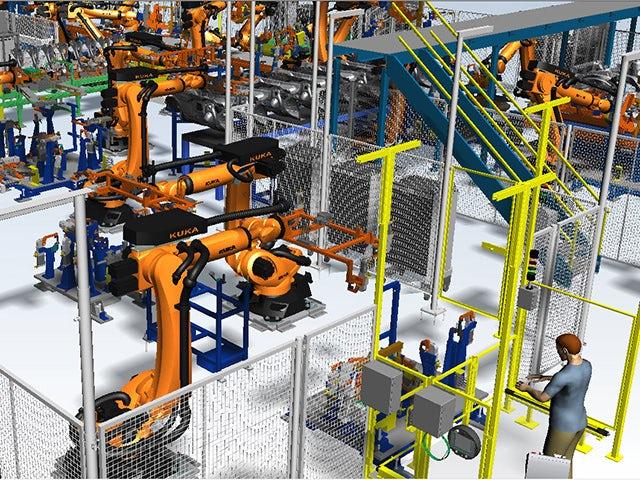
From Robot Programming to Virtual Commissioning
One of the most important benefits of advanced simulation is the ability to move more engineering work upstream.
Traditionally, robot programming and commissioning often take place after physical equipment is installed. Engineers must then test the system, identify unexpected interactions and modify programs on the production floor.
Virtual commissioning aims to reduce this dependency on physical testing.
A digital model can represent robots, tools, conveyors, machines and other production elements. Engineers can test sequences and identify potential problems before the physical system is fully operational.
When AI assistance is added to this process, engineers can receive support during analysis and programming.
This can be especially valuable when production lines contain many robots or when manufacturers must frequently change product variants.
AI Can Help Reduce the Engineering Barrier
Industrial automation has a persistent skills challenge.
Experienced robotics programmers and controls engineers are highly valuable, but the number of qualified specialists may not always be sufficient to support increasingly complex automation projects.
AI-assisted engineering tools can help reduce the amount of repetitive knowledge required for certain software operations.
A less experienced engineer may be able to ask the system for assistance when configuring a simulation, interpreting an error or creating a specific operation.
Experienced engineers can also benefit because AI tools can automate repetitive tasks and provide faster access to technical information.
The objective is not to replace engineering knowledge. Instead, AI can help engineers apply their knowledge more efficiently.
Digital Twins Become More Practical
The development also strengthens the role of digital twins in industrial automation.
A digital twin can provide a virtual representation of production equipment and processes. When connected to engineering data and operational information, it can become a powerful tool for planning and optimization.
For PLC and automation engineers, digital twins can provide a virtual environment in which control sequences can be tested before commissioning.
For robotics engineers, digital simulation can be used to validate paths, cycle times and interactions between robots and equipment.
For production managers, simulation can help evaluate throughput and manufacturing capacity.
This creates a connection between engineering, automation and production planning.
The Relationship Between PLCs and Simulation
Although Siemens’ latest developments focus heavily on AI and simulation, PLC technology remains an important part of the overall architecture.
A simulated production system still needs to represent the behavior of controllers, sensors, actuators and industrial equipment.
In real-world applications, PLCs execute control logic based on inputs from sensors and commands from higher-level systems. Simulation environments can reproduce parts of this behavior so that engineers can test sequences before connecting the physical equipment.
This can make PLC commissioning more efficient.
Instead of discovering every issue during startup, engineering teams can identify many problems during the virtual stage.
For manufacturers operating complex automated lines, the potential savings can be substantial because commissioning delays can affect entire production schedules.
AI-Assisted Automation Engineering
The emergence of AI Copilot technologies also changes the definition of automation engineering software.
Traditional engineering software provides tools that engineers operate manually.
AI-assisted engineering software introduces another layer: software that can understand user instructions and assist with completing technical tasks.
In the future, automation engineers may increasingly work with a combination of traditional programming, graphical configuration and natural-language interaction.
However, industrial environments impose stricter requirements than ordinary software development.
Engineers must still validate generated logic, confirm robot movements, verify safety conditions and ensure that the final automation system behaves correctly.
AI-generated suggestions should therefore be treated as engineering assistance rather than automatic approval.
Why This Matters for Smart Factories
Smart manufacturing is not only about installing more sensors or connecting more machines.
The real challenge is making engineering and production processes more efficient.
AI-assisted simulation can contribute by reducing repetitive engineering tasks, improving design validation and making digital manufacturing tools easier to use.
For manufacturers building new production lines, this can help reduce the risk associated with automation projects.
For existing factories, digital simulation can support modifications and optimization without immediately interfering with live production.
This is particularly valuable in industries such as automotive, electronics, battery manufacturing, aerospace and general machinery, where production processes can involve complex robotic operations.
The Next Stage of Industrial Automation
The development of Siemens Tecnomatix shows how the boundaries between automation engineering, simulation and artificial intelligence are becoming less distinct.
PLCs will continue to control machines. Robots will continue to perform physical operations. Sensors will continue to collect information. Industrial networks will continue to connect equipment.
But the engineering layer surrounding these technologies is becoming increasingly intelligent.
AI can help engineers analyze simulation data, automate repetitive configuration tasks and explore production alternatives faster.
This could eventually lead to a new engineering workflow in which production systems are designed, simulated, tested and optimized digitally before physical equipment is commissioned.
For companies investing in industrial automation, this trend is worth watching closely.
The future of automation may not simply be about making machines more intelligent. It may also be about making the engineering process itself more intelligent, faster and more collaborative.