Siemens Brings Industrial AI Closer to PLC Engineering and Factory Automation
Time:2026-09-15 Browse: 0
Artificial intelligence is moving from experimental demonstrations into practical industrial automation, and PLC engineering is becoming one of the areas where this transformation could have a significant impact.
In September 2026, Siemens highlighted the growing role of industrial AI in factory automation and engineering, with a particular focus on combining AI capabilities with established industrial control technologies. The development reflects a broader shift in manufacturing: AI is no longer being treated only as an analytical tool outside the control system. Instead, it is increasingly being integrated into engineering workflows, automation software, and industrial operations.
For PLC engineers, system integrators, maintenance teams, and factory operators, this trend could change how automation projects are designed, programmed, tested, and maintained.
From Traditional PLC Programming to AI-Assisted Engineering
PLC technology remains one of the fundamental technologies behind modern industrial automation.
For decades, engineers have developed control programs manually using engineering software and programming languages such as ladder logic, function block diagrams, structured text, and related industrial programming methods.
This traditional approach remains essential because industrial control requires predictable behavior, validation, testing, safety, and engineering responsibility.
However, automation projects are becoming increasingly complex.
A modern production line may contain multiple PLCs, distributed I/O systems, variable frequency drives, servo systems, safety controllers, HMIs, industrial networks, robots, sensors, vision systems, and higher-level manufacturing software.
As systems become larger, the amount of engineering information that must be understood and maintained also increases.
Industrial AI is now being explored as a way to assist engineers with these tasks.
The objective is not simply to ask an AI chatbot a general technical question. Industrial AI is becoming more specialized by incorporating engineering context, automation knowledge, project information, and the structure of real industrial systems.
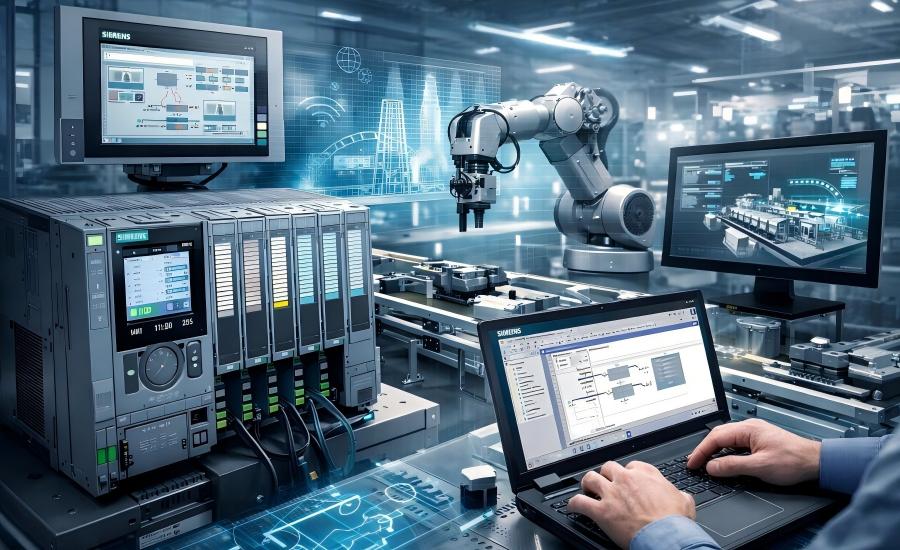
Siemens Eigen Engineering Agent
A major example of this development is Siemens' Eigen Engineering Agent.
Siemens introduced the technology as an industrial AI agent designed to move beyond simple suggestions and toward executing engineering tasks. The technology is connected with the Siemens automation engineering environment and is designed to assist engineers working with automation projects.
This distinction is important.
A conventional AI assistant may generate a text response when an engineer asks a question. An engineering agent can potentially interact with project information and perform defined engineering activities within an automation workflow.
For PLC engineers, this could eventually reduce the amount of repetitive engineering work required for certain tasks.
For example, an engineer may spend significant time reviewing project structures, creating similar programming elements, organizing tags, checking configuration information, or preparing documentation.
AI-assisted engineering can help automate portions of these repetitive activities while engineers remain responsible for reviewing and validating the final result.
Why Human Validation Remains Essential
Industrial automation is different from many software applications because mistakes can have physical consequences.
A programming error in a PLC can stop a production line, damage equipment, affect product quality, or create a safety risk.
For this reason, industrial AI cannot simply generate code and place it directly into a running machine without engineering controls.
Siemens has emphasized the importance of human oversight and validation in industrial AI workflows.
Simulation is particularly important.
Before an AI-generated or AI-assisted change reaches physical equipment, engineers can test how the controller is expected to behave. This provides an additional layer of engineering verification.
The concept is similar to the established engineering principle of testing changes before deployment, but AI makes it possible to accelerate portions of the development process.
The engineer remains responsible for understanding the process, evaluating the generated result, checking safety requirements, and approving the final implementation.
This human-in-the-loop approach is likely to become an important characteristic of industrial AI.
AI and TIA Portal Engineering
For engineers working with Siemens automation systems, the relationship between AI and TIA Portal is particularly relevant.
TIA Portal is widely used for PLC configuration, programming, HMI engineering, drives, diagnostics, and integrated automation projects.
An AI engineering assistant connected to this environment has access to much more useful context than a general-purpose AI system.
Instead of asking an AI system a question without knowing the exact project configuration, the engineering assistant can work within an automation project and understand relevant engineering information.
This can make AI more useful for real industrial applications.
The potential applications are broad.
Engineers may use AI assistance to understand existing project structures, identify possible configuration issues, generate programming elements, explain code, assist with troubleshooting, or accelerate repetitive engineering tasks.
For large factories with thousands of tags and multiple automation stations, even small improvements in engineering productivity can become significant.
Industrial AI Is Moving Toward the Shop Floor
Another important aspect of the latest development is that industrial AI is increasingly being connected with physical production.
AI in manufacturing is no longer limited to analyzing historical data in an office environment.
Industrial AI can be used in areas such as predictive maintenance, machine vision, process optimization, energy management, quality inspection, production scheduling, and engineering assistance.
This creates a new relationship between AI and OT.
Traditional IT systems are designed primarily around information processing.
OT systems are designed around physical processes.
Industrial AI needs to operate between these two worlds.
It must understand industrial equipment, process constraints, timing requirements, engineering rules, and operational context.
That is why industrial AI is different from simply adding a general AI model to a manufacturing company.
The Importance of Industrial Context
A general-purpose AI model may understand programming concepts, but industrial automation requires much deeper context.
For example, a PLC controlling a packaging machine may have hundreds of interlocks. A change to one sequence may affect conveyors, sensors, actuators, safety conditions, HMI states, alarms, and downstream equipment.
An AI system must therefore understand relationships rather than isolated lines of code.
This is one reason why industrial companies are investing heavily in domain-specific AI.
The value of industrial AI will depend not only on the intelligence of the underlying model but also on how effectively the model can understand industrial engineering information.
This includes PLC programs, electrical schematics, equipment configurations, process documentation, alarm histories, maintenance information, and production data.
What This Means for Automation Engineers
The growth of industrial AI does not necessarily mean that PLC engineers will become less important.
In many ways, their expertise may become more valuable.
AI can generate code, summarize information, or identify possible solutions, but it still needs industrial context.
An experienced automation engineer understands why a particular interlock exists, how a machine should behave under abnormal conditions, which signals are safety-critical, and what operational constraints must be respected.
These are not simply programming problems.
They are engineering problems.
As AI takes over more repetitive tasks, engineers may spend more time reviewing system architecture, validating AI-generated solutions, improving machine performance, and solving difficult process problems.
This could gradually change the skill profile of industrial automation professionals.
Knowledge of PLC programming will remain important, but knowledge of data, networks, cybersecurity, simulation, AI tools, and system integration may become increasingly valuable.
AI Can Also Help Address the Automation Skills Gap
Manufacturers around the world are facing shortages of experienced automation and controls engineers.
At the same time, production systems are becoming more complicated.
This creates a difficult situation: factories need more automation, but experienced engineers are not always available to handle every project.
AI-assisted engineering could help address part of this challenge.
An AI system can provide contextual assistance to engineers, explain existing programs, help locate relevant information, and accelerate repetitive engineering tasks.
For less experienced engineers, this could reduce the time required to understand complex projects.
For experienced engineers, AI could reduce administrative and repetitive work, allowing them to focus on higher-value engineering decisions.
However, this does not remove the need for training.
Automation professionals still need to understand PLC fundamentals, industrial networking, control theory, electrical systems, instrumentation, safety, and commissioning.
AI should be considered an engineering productivity tool rather than a replacement for engineering knowledge.
A Shift Toward Software-Defined Automation
The combination of industrial AI, simulation, digital twins, and modern automation software is also contributing to a broader movement toward software-defined automation.
In traditional automation, hardware configuration and control software are closely tied to physical machines.
Modern approaches increasingly separate certain engineering functions from specific hardware while maintaining deterministic control where it is required.
This can make automation systems more flexible and easier to update.
AI can become another software layer within this environment.
Engineers can use simulation to test changes, AI to assist with engineering, industrial data to monitor performance, and automation controllers to execute validated control logic.
The result is a more connected engineering lifecycle.
What Comes Next for PLC and DCS Automation?
The development of industrial AI is likely to affect both discrete and process automation.
In discrete manufacturing, AI can support robotics, machine vision, PLC programming, production optimization, and quality inspection.
In process industries, similar concepts can be applied to DCS engineering, process optimization, alarm management, asset performance, and predictive maintenance.
The technology will not eliminate traditional automation architectures overnight.
PLCs, DCS controllers, remote I/O, sensors, drives, HMIs, and industrial networks will continue to provide the physical foundation of industrial control.
What is changing is the software and intelligence surrounding these systems.
The future industrial automation engineer may work with traditional control logic while also using AI agents, digital twins, simulation platforms, industrial data systems, and advanced analytics.
The Future of AI-Assisted Automation Engineering
The latest developments from Siemens demonstrate that industrial AI is moving closer to the actual engineering workflow.
The most important change is not simply that AI can answer questions.
The bigger development is that AI is becoming capable of understanding industrial engineering context and assisting with practical automation tasks.
For PLC engineers, this could mean faster project development, easier access to technical information, more efficient troubleshooting, and reduced repetitive work.
For manufacturers, the long-term objective is improved productivity without compromising reliability and safety.
The transition will require careful validation, cybersecurity, engineering governance, and skilled professionals.
Industrial AI is therefore not replacing automation engineering. It is becoming another tool within the automation engineer's toolbox.
As factories become more connected and production systems become increasingly software-driven, the ability to combine PLC technology, industrial networks, data, simulation, and AI may become one of the defining capabilities of the next generation of industrial automation.