Siemens and Battery-NY Advance Digital Battery Manufacturing with Standardized Automation
Time:2026-09-15 Browse: 0
The battery manufacturing industry is entering a new stage in which automation, industrial data, digital twins, and flexible production systems are becoming increasingly important. In September 2026, Siemens and Battery-NY announced a collaboration to establish a standardized automation and digital manufacturing architecture for a flexible battery development and pilot manufacturing facility in upstate New York.
The project represents an important development for industrial automation because it addresses one of the most difficult challenges in modern manufacturing: integrating equipment, control systems, production data, and software from different machine builders into one reliable manufacturing environment.
Battery production involves a large number of specialized processes. Depending on the production technology, manufacturers may need equipment for material mixing, electrode coating, calendaring, slitting, cell assembly, formation, and cycling. Each production stage can involve different machines, controllers, sensors, industrial networks, and software platforms. Without a common automation and data structure, these systems can become isolated islands of information.
The Siemens and Battery-NY initiative takes a different approach by considering digitalization and automation from the beginning of the factory development process.
Standardized Automation for Flexible Battery Manufacturing
Battery-NY is a federally supported initiative led by Binghamton University that is designed to connect battery research with practical manufacturing. The new pilot facility is intended to provide researchers, manufacturers, suppliers, and other industrial partners with an environment where new battery technologies can be tested using manufacturing-relevant equipment.
One of the central ideas behind the project is standardization.
Rather than allowing every machine to operate with completely different control and data structures, the project is developing common principles for automation, equipment interfaces, and industrial data. Siemens is supporting the development of the IT/OT architecture and industrial data foundation, while Battery-NY is using the Siemens Battery Automation Framework as a reference for standardization.
For automation engineers, this approach is particularly significant.
In a traditional factory project, equipment integration is often performed after individual machines have already been selected. A machine builder may provide a PLC, HMI, motion system, industrial communication interface, and proprietary data structure. Another supplier may use a different PLC platform and another communication architecture.
The equipment may work correctly as individual systems, but connecting everything together can require substantial engineering effort.
A standardized automation architecture can reduce this complexity by establishing common rules before the equipment is fully integrated.
Connecting PLC-Level Control with Manufacturing Data
Modern industrial automation is no longer limited to controlling machines.
A PLC remains essential for real-time control, sequencing, interlocking, motion control, safety-related functions, and machine operation. However, manufacturers increasingly need to connect PLC-level information with higher-level manufacturing systems.
This creates an important relationship between OT and IT.
At the equipment level, PLCs, remote I/O modules, drives, sensors, and industrial networks collect and control real-time process information. At higher levels, MES, historians, analytics platforms, quality systems, and enterprise applications use this information to understand production performance.
If these layers are not properly connected, manufacturers may have accurate data inside individual machines but limited visibility across the complete production process.
The Battery-NY project is designed to establish a common industrial data foundation that can connect equipment-level control with broader manufacturing information.
This can support production visibility, quality monitoring, traceability, and material genealogy.
For battery manufacturers, traceability is especially important. Battery production involves expensive materials and tightly controlled processes. A quality issue may not be caused by a single machine. It could be associated with material properties, process parameters, environmental conditions, equipment settings, or a combination of several factors.
A connected automation architecture makes it easier to associate these factors with individual production batches and process stages.
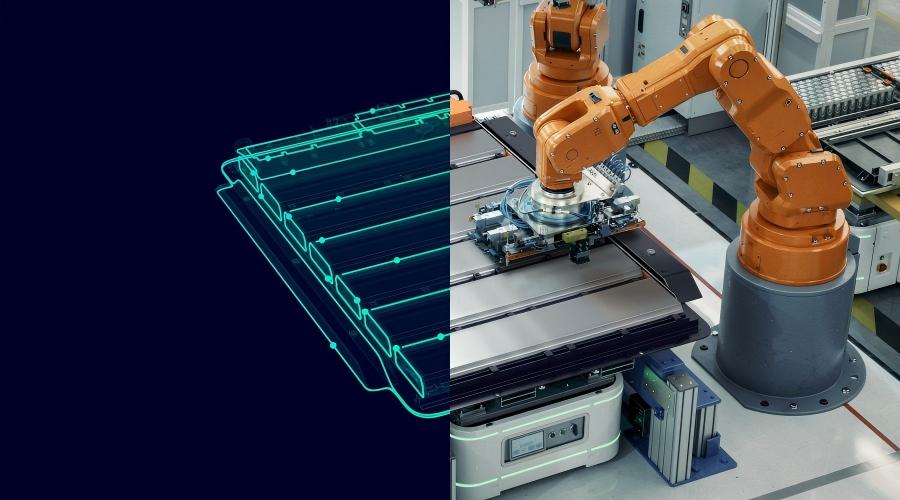
Digital Twin Technology Moves Closer to Production
Another important element of the project is the planned use of digital twin technology.
Digital twins allow manufacturers to create virtual representations of equipment, production processes, and manufacturing environments. Instead of testing every change directly on a physical production line, engineers can use simulation to study processes before implementation.
For battery manufacturing, this can be particularly valuable during the development and scale-up phase.
A research team may develop a new material or cell design in a laboratory, but laboratory success does not automatically guarantee that the technology can be manufactured efficiently at production scale.
A pilot manufacturing environment provides a bridge between laboratory research and industrial production.
By combining automation data with digital models, engineers can study how production equipment behaves, evaluate process changes, and identify potential problems earlier.
This also creates opportunities for future AI applications.
Artificial intelligence requires high-quality data to produce reliable results. If industrial data is fragmented, inconsistent, or difficult to trace, AI models may struggle to generate useful insights.
A standardized automation and data architecture therefore becomes an important foundation for industrial AI.
Why This Matters for Industrial Automation Engineers
The Battery-NY project illustrates a broader change in the role of industrial automation.
In the past, automation projects often focused primarily on machine control. The main objectives were to make equipment operate safely, reliably, and efficiently.
Today, the automation engineer increasingly has to think about the complete data lifecycle.
A PLC program may control a process, but the information generated by that process can also become part of quality management, predictive maintenance, production analytics, digital twins, and AI-based optimization.
This means that PLC programming, industrial communication, data architecture, cybersecurity, and manufacturing software are becoming more closely connected.
The same trend is visible in other industries, including semiconductor manufacturing, pharmaceuticals, food and beverage, automotive production, and process industries.
Building a More Flexible Manufacturing Environment
Flexibility is another major objective of the Battery-NY initiative.
Battery technology is developing rapidly, and manufacturing processes may need to change as new materials, cell designs, and production methods become available.
A rigid automation architecture can make these changes expensive.
If control systems and production data are heavily customized for one particular production configuration, introducing new equipment or changing a process may require extensive engineering work.
A modular architecture can make future changes easier.
Standardized interfaces, reusable automation concepts, consistent data structures, and digital simulation can allow manufacturers to introduce new technologies without rebuilding the entire automation environment.
This is particularly important for pilot manufacturing facilities, where experimentation and continuous improvement are central to the operation.
The Growing Role of Industrial Data
The latest Battery-NY initiative also highlights an important reality about Industry 4.0.
Digital transformation does not begin with artificial intelligence.
It begins with reliable industrial data.
Sensors must generate accurate information. PLCs and controllers must capture process conditions. Industrial networks must transfer data reliably. Equipment interfaces must be standardized. Manufacturing systems must understand the meaning of the data.
Only after these foundations are established can manufacturers effectively apply analytics, digital twins, machine learning, and AI.
This makes industrial automation infrastructure increasingly strategic.
A PLC, remote I/O module, industrial communication interface, HMI, DCS controller, or process instrument may appear to be only one component of a larger system, but these components collectively create the operational data foundation of a modern factory.
A New Model for Battery Manufacturing Automation
The Siemens and Battery-NY collaboration demonstrates how future factories may be designed around automation, data, and digital engineering from the earliest stages.
Instead of treating automation as something added after machines are installed, the automation architecture becomes part of the factory's overall design.
This approach can help reduce integration complexity, improve traceability, support digital twin development, and create a foundation for future AI-enabled operations.
For battery manufacturers, the objective is not simply to automate individual machines. The larger goal is to create a connected manufacturing environment where equipment, controls, data, software, engineering, and human expertise can work together.
As battery demand continues to develop globally, flexible and scalable manufacturing will become increasingly important. Standardized industrial automation may therefore play a critical role in helping battery manufacturers move from laboratory research to reliable commercial production.
The Battery-NY project is an example of this transition: from isolated machine automation toward integrated, data-driven industrial manufacturing.