ABB 5STP24L2800 Thyristor Module Troubleshooting Guide (Fault Diagnosis)
Time:2026-09-15 Browse: 0
ABB 5STP24L2800 thyristor faults should not be diagnosed by replacing the semiconductor immediately. In ABB DCS converter systems, the 5STP24L2800 operates as part of a larger power stage involving pulse-transformer circuitry, semiconductor fuses, interface electronics, and cooling equipment. A missing output, abnormal current, or repeated fuse failure can therefore originate outside the thyristor itself.
ABB 5STP24L2800 Thyristor Fault Symptoms
Typical symptoms can include:
Reduced or missing converter output
Unbalanced current between converter sections
Semiconductor fuse operation
Abnormal heating
Converter overcurrent
Poor DC output regulation
Repeated failure after replacement
No response despite a valid firing command
The symptom alone does not identify the failed component.
For example, a blown semiconductor fuse can be the consequence of a failed thyristor, but it can also indicate an abnormal load condition or another problem in the power circuit.

ABB 5STP24L2800 Fault Diagnosis: Start With the Pattern
A useful troubleshooting method is to compare the failed power path with a known-good path.
Instead of asking:
“Is the 5STP24L2800 bad?”
ask:
“What is different between the abnormal phase and the healthy phase?”
Check:
Input voltage
Output voltage
Current balance
Fuse condition
Gate-drive signal
Thermal condition
Mechanical contact
Cooling airflow
This comparison often reduces the diagnostic area much faster than replacing parts sequentially.
ABB 5STP24L2800 Unequal Current Troubleshooting
Unequal current is a particularly useful diagnostic clue.
Suppose a converter has three comparable power paths and one path shows substantially lower current while the control command remains consistent. The first suspicion should be the individual firing and conduction path rather than the entire control system.
Measure the relevant voltage and firing signals using equipment suitable for the converter's electrical environment.
If the control command is present but the gate-drive signal is absent, investigate the pulse-transformer and interface circuitry.
If the gate-drive signal is present but the power path does not conduct, the investigation moves toward the thyristor and its electrical connections.
This separation between command failure and power-device failure is fundamental to effective Fault Diagnosis.
ABB 5STP24L2800 Repeated Fuse Failure Analysis
Repeated semiconductor fuse operation requires a different diagnostic approach.
ABB documentation lists semiconductor fuses as part of the converter assembly associated with the 5STP24L2800.
Do not simply install another fuse and restart the converter.
First determine whether the thyristor has developed an abnormal conduction path. A shorted power semiconductor can produce immediate protection operation when the circuit is energized.
The diagnostic logic should be:
Fuse failed → inspect power device → verify gate circuit → inspect busbar/load condition → confirm protection arrangement → replace damaged components → controlled restart.
If a new fuse fails again immediately, stop repeated energization. Repeated fault-current events can increase damage to surrounding power components.
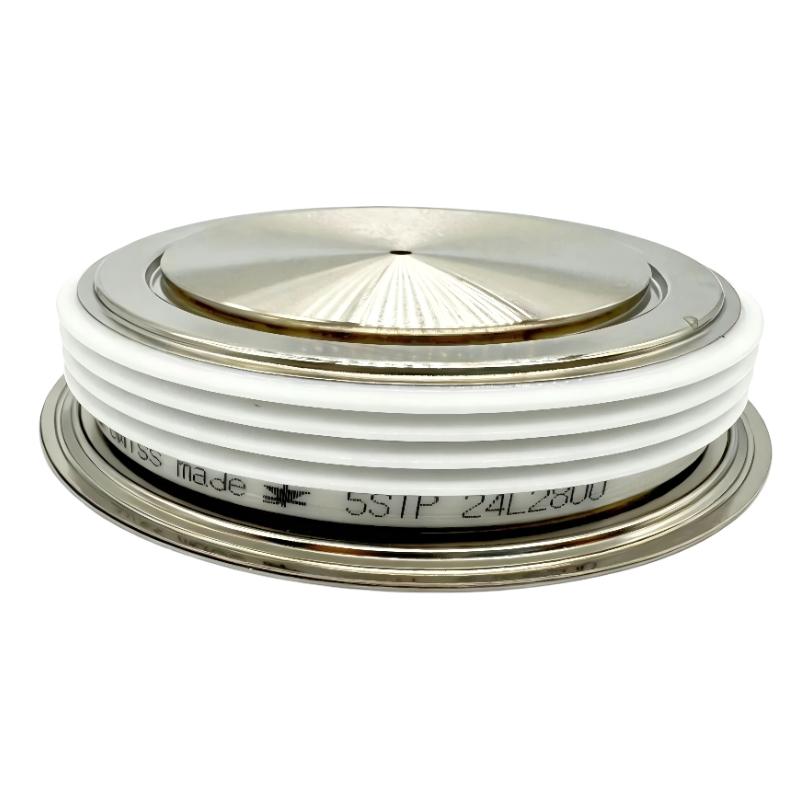
ABB 5STP24L2800 Thermal Fault Diagnosis
A thermal problem does not always mean that the thyristor itself is defective.
Check the cooling path before replacing the semiconductor.
ABB DCS converter documentation identifies dedicated cooling fans for these converter assemblies, including RG35P-4DK.7M.1R and RG35P-4DK.7M.1L variants.
A practical inspection should include:
Fan rotation
Airflow direction
Blocked ventilation paths
Dust accumulation
Mechanical mounting
Thermal interface condition
Abnormal current loading
If the electrical current is within the expected range but the device temperature rises unusually quickly, thermal resistance and airflow deserve priority in the investigation.
ABB 5STP24L2800 Shorted Thyristor Detection
A shorted thyristor can create a characteristic failure pattern: the converter may show abnormal conduction even when the control system is not commanding normal firing.
For an isolated and safely de-energized device, use an appropriate semiconductor test procedure to compare forward and reverse behavior with the manufacturer's expected characteristics.
Do not use a basic resistance measurement as the only acceptance test. A multimeter can identify an obvious short in some cases, but it cannot reproduce the operating conditions of a high-power thyristor.
For field repair, electrical isolation and correct test equipment are essential because the converter power circuit can retain hazardous energy after shutdown.
ABB 5STP24L2800 Gate Pulse Troubleshooting
One of the most misleading failures is a healthy-looking power semiconductor that never receives an effective firing pulse.
The diagnostic path should be:
Controller output → firing circuit → pulse transformer → gate connection → thyristor response.
If the command exists at the control level but disappears before the gate connection, replacing the 5STP24L2800 will not solve the problem.
ABB service documentation identifies the pulse-transformer board as a dedicated component in converter assemblies using this thyristor.
This is why System Configuration and hardware Fault Diagnosis must be considered together.
ABB 5STP24L2800 Troubleshooting Field Case
A representative field troubleshooting pattern is a converter that repeatedly trips after a power-device replacement.
The first observation is a protection trip during startup. The replacement thyristor is then tested and appears normal under a basic static check.
Rather than replacing it again, the technician compares the three firing paths. Two paths show the expected gate-drive response, while the affected path has a substantially different pulse waveform.
The investigation then moves upstream toward the pulse-transformer and interface circuitry. Once the abnormal firing path is corrected, the converter can be restarted under controlled conditions without another immediate semiconductor failure.
This type of case demonstrates why Troubleshooting should follow the signal path instead of assuming the last replaced component is defective.
ABB 5STP24L2800 Repair Decision: Semiconductor or Circuit?
The repair decision should be based on evidence.
Replace the 5STP24L2800 when the power device has confirmed abnormal electrical behavior, physical damage, or a failure pattern consistent with the measured circuit condition.
Investigate the surrounding hardware when:
Gate pulses are missing
Gate connections are inconsistent
The cooling system is abnormal
The semiconductor tests normally
The same fault returns after replacement
Only one firing channel behaves differently
A successful repair is not simply installing a new Module. The objective is to restore the complete converter power path.
ABB 5STP24L2800 Troubleshooting Long-Tail Keywords
Useful long-tail searches include ABB 5STP24L2800 Troubleshooting Guide, ABB 5STP24L2800 Fault Diagnosis, 5STP24L2800 thyristor fault, ABB 5STP24L2800 fuse failure, 5STP24L2800 gate pulse troubleshooting, ABB DCS thyristor repair, 5STP24L2800 overheating troubleshooting, 5STP24L2800 converter fault, and ABB 5STP24L2800 Module testing.
For field engineers, the most useful principle is simple: verify the command, verify the firing path, verify conduction, then verify the power device. That sequence prevents many unnecessary thyristor replacements.