Rockwell Automation Expands Allen-Bradley Industrial Safety Automation for Modern Manufacturing
Time:2026-09-17 Browse: 0
Rockwell Automation is expanding the role of Allen-Bradley industrial automation and safety technology in modern manufacturing, with a recent facility-wide safety project demonstrating how PLC-based control, safety systems, industrial networking, and machine diagnostics are becoming increasingly connected. The project involves Turkish poultry processor Beypiliç and its newly constructed production facility, where Rockwell Automation is implementing a comprehensive safety solution designed to cover the wider manufacturing environment rather than treating machine safety as an isolated function.
Allen-Bradley Industrial Safety Automation Moves Beyond Individual Machines
Industrial safety has traditionally been associated with emergency-stop buttons, safety relays, guard switches, light curtains, and machine-level protective devices. These technologies remain important, but modern production facilities require a more coordinated approach.
A large manufacturing plant can contain hundreds of motors, conveyors, sensors, drives, robotic systems, processing machines, packaging lines, and operator stations. When these machines are interconnected, a safety event in one area can affect equipment elsewhere in the production process.
This creates a more complex engineering requirement.
A safety system must determine which equipment needs to stop, which equipment can remain operational, and how the production control system should respond after a safety event.
Allen-Bradley automation technology is widely used in these types of industrial environments because PLC-based control can be integrated with distributed I/O, drives, operator interfaces, industrial networks, and safety-related control functions.
The recent Beypiliç project illustrates how safety is increasingly being designed as part of the overall automation architecture.
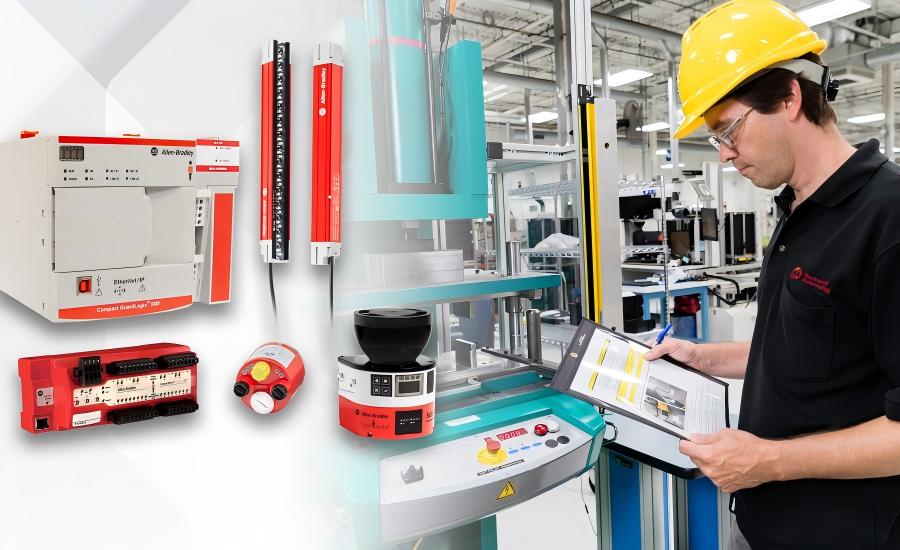
Allen-Bradley PLC and Safety Control Architecture
A modern manufacturing system normally contains two related but distinct control layers.
The standard PLC manages production.
It can control conveyors, motors, valves, machine sequences, production recipes, sensors, and communication with supervisory systems.
The safety system has a different responsibility.
It monitors safety-related devices and ensures that hazardous equipment reaches an appropriate safe state when a dangerous condition is detected.
This distinction is important during both system design and troubleshooting.
For example, imagine a conveyor controlled by an Allen-Bradley PLC.
Under normal conditions, the PLC determines whether the conveyor should run based on production logic.
If an operator opens a guarded access door, however, a safety device can remove the necessary safety permission for operation.
The PLC may still be running its normal program, but the conveyor cannot operate because the safety condition has changed.
This architecture allows production control and safety control to work together without making them the same function.
Why Facility-Wide Safety Matters in Industrial Automation
The larger a production facility becomes, the more difficult it is to manage safety as a collection of independent machine systems.
A packaging line may share conveyors with upstream processing equipment.
A robotic cell may transfer products to another machine.
Multiple machines may use a common material-handling system.
Maintenance personnel may need access to several production zones.
If every machine has completely independent safety logic, operators may have difficulty understanding why a production area has stopped.
A coordinated safety architecture can establish clear safety zones and define how different machines interact.
For automation engineers, this means safety planning has to begin during the system architecture stage.
Questions include:
Which machines belong to the same safety zone?
Which emergency-stop devices affect each area?
What happens when a guard is opened?
Which drives must be disabled?
Which conveyors must stop?
Which equipment can continue operating safely?
How is the safety condition reset?
How does the HMI communicate the event?
These questions are more important than simply selecting a safety controller.
Industrial Automation Diagnostics Become More Important
A safety system can protect personnel effectively, but if its diagnostic information is poor, maintenance can become unnecessarily difficult.
Consider a production line that suddenly stops.
An operator sees only:
“Machine stopped.”
That message provides little useful information.
A better automation system can identify that a particular safety input has changed state.
The HMI may indicate that an access door is open, an emergency-stop circuit has been activated, or a safety device has not returned to its expected state.
This diagnostic information changes the maintenance process.
Instead of checking every component in the production area, the technician can begin with the specific safety condition reported by the control system.
This can reduce troubleshooting time and help prevent unnecessary replacement of healthy components.
For large facilities, this becomes increasingly important because the number of connected devices continues to increase.
Allen-Bradley Automation in Food Processing
The Beypiliç project is particularly relevant because food-processing facilities present demanding operating conditions.
Production equipment can be exposed to frequent cleaning, moisture, temperature changes, and intensive operator interaction.
The automation architecture must therefore consider both normal production and non-production activities.
Cleaning is a good example.
A machine may operate safely while all guards are closed and the production sequence is running normally.
During cleaning, however, operators may need access to areas that are inaccessible during production.
The safety system therefore needs to account for different operating conditions.
This is where integrated safety design becomes valuable.
The system should not simply stop a machine when a guard is opened. Engineers also need to consider how the machine will be restarted, how the safety condition will be acknowledged, and whether associated equipment must remain stopped.
Industrial Networks Connect Safety and Standard Automation
Modern Allen-Bradley systems increasingly depend on industrial networking.
A production line can contain PLCs, remote I/O, drives, HMIs, safety devices, motion controllers, and other intelligent equipment.
Communication provides valuable diagnostic information and allows different parts of the automation system to exchange status information.
However, networking also introduces engineering requirements.
The system needs appropriate network architecture, addressing, device configuration, diagnostics, and cybersecurity controls.
A communication fault should not be confused with a safety fault.
For example, if a remote I/O module becomes unavailable, the control system needs to determine the appropriate response.
A technician then needs enough diagnostic information to distinguish between a network problem, an I/O problem, and an actual field-device condition.
This is one reason modern industrial automation projects increasingly require engineers with both PLC and networking experience.
Safety Automation Can Support Production Reliability
Industrial safety is primarily about protecting people, but good safety architecture can also contribute to better production reliability.
When safety events are clearly diagnosed, maintenance teams can restore equipment more efficiently.
When safety zones are properly designed, an abnormal condition in one area does not necessarily require unnecessary shutdown of unrelated equipment.
When safety status is integrated into the HMI, operators can respond more quickly.
This does not mean safety functions should ever be bypassed to maintain production.
The engineering objective is to make the safety response accurate and predictable.
A well-designed system should stop the equipment that needs to stop and provide clear information about why the stop occurred.
Real-World Automation Engineering Considerations
A practical safety commissioning process should include more than verifying that an emergency-stop button stops the machine.
Engineers need to test the complete sequence.
For example, when a guard switch changes state, the team should verify:
The correct safety input changes state.
The safety logic responds correctly.
The required output changes state.
The hazardous motion stops within the required conditions.
The standard PLC receives the correct status information.
The HMI displays the correct diagnostic information.
The reset process works as designed.
The machine cannot restart unexpectedly.
This type of validation is particularly important in complex production facilities.
A safety function that works during one isolated test may behave differently when integrated with conveyors, drives, robots, and other machines.
Allen-Bradley Safety Automation and Future Manufacturing
The Rockwell Automation project involving Beypiliç reflects a wider movement toward integrated industrial safety.
Factories are becoming more connected, more automated, and more dependent on coordinated control systems.
As a result, safety systems must evolve alongside PLCs, industrial networks, drives, robotics, and digital manufacturing platforms.
For automation engineers, this means safety can no longer be considered a final-stage addition to a machine.
It needs to be part of the original control architecture.
The relationship between standard PLC logic and safety control must be defined before commissioning begins.
The same applies to diagnostics.
If maintenance teams will depend on HMI messages and network diagnostics to identify safety events, those functions need to be designed and tested as part of the automation system.
Long-Tail Keywords for Allen-Bradley Industrial Safety Automation
The current development is relevant to several industrial automation search topics, including Allen-Bradley safety PLC systems, Rockwell Automation industrial safety, Allen-Bradley PLC safety control, industrial safety automation systems, PLC-based machine safety, Allen-Bradley safety troubleshooting, manufacturing safety automation, industrial PLC control systems, and integrated factory safety systems.
These technologies are increasingly important as manufacturers connect more machines into unified production environments.
The Future of Allen-Bradley PLC Safety Systems
The latest Rockwell Automation safety project demonstrates that industrial safety is becoming increasingly integrated with the broader automation architecture.
The role of an Allen-Bradley PLC is no longer limited to controlling individual machines. Modern systems can coordinate production logic, diagnostics, communication, motion, drives, and safety-related information across larger manufacturing environments.
For machine builders and system integrators, the practical challenge is to create systems that are safe, diagnosable, maintainable, and capable of supporting future production changes.
As factories become more automated, the quality of the safety architecture will increasingly depend on how well PLC control, safety systems, industrial networking, diagnostics, and operator interfaces work together.
This makes integrated safety automation an important area of development for the next generation of Allen-Bradley industrial control systems.