Honeywell Automation Business Enters a New Phase as Industrial Control and Digitalization Remain Cor
Time:2026-09-17 Browse: 0
Honeywell is entering a significant new phase for its automation business as the company moves toward a more focused corporate structure while continuing to develop industrial automation, process control, digitalization, and building automation technologies. The transition is important for customers using Honeywell automation platforms because the company remains deeply involved in industrial control applications ranging from process plants to energy facilities and large commercial operations.
For the industrial automation market, the development is not simply a corporate restructuring story. It also highlights how automation companies are increasingly focusing their technology portfolios around connected control systems, industrial software, data, cybersecurity, and increasingly autonomous operations.
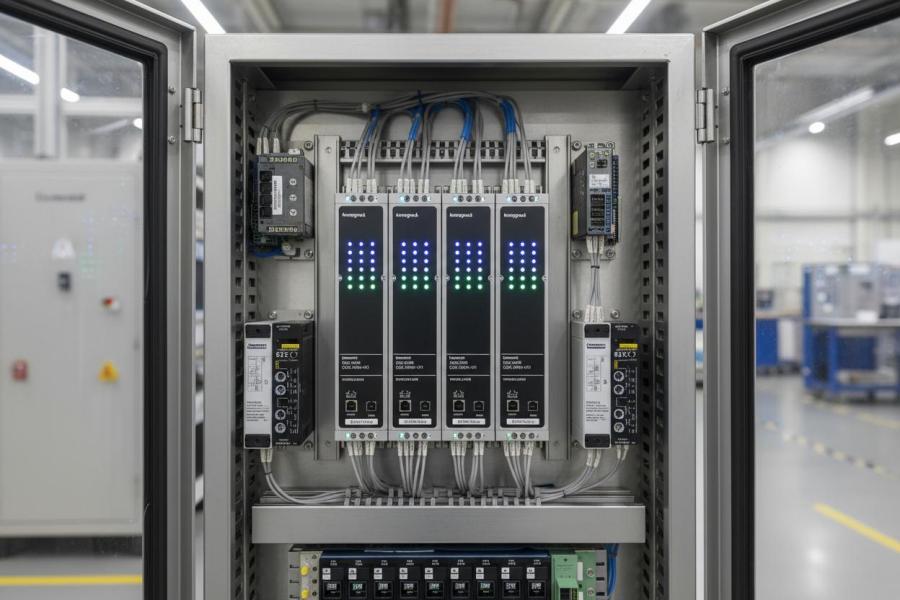
Honeywell Automation Remains Closely Connected to Industrial Control
Honeywell has a long history in process automation.
Its industrial automation portfolio has been used in applications where continuous process control, instrumentation, operator interfaces, safety, alarm management, and plant information need to work together.
A modern process automation environment can include:
Distributed control systems
Safety systems
Transmitters
Control valves
Process analyzers
Industrial networks
Operator stations
Historians
Asset-management software
Cybersecurity systems
Digital twins
The control system provides the central environment for coordinating many of these technologies.
This is particularly important in industries such as oil and gas, refining, chemicals, pharmaceuticals, power generation, and other continuous-process applications.
Honeywell DCS Technology and Modern Process Automation
One of the key differences between process automation and basic machine control is the importance of continuous variables.
A machine PLC may control whether a motor starts or stops.
A process control system may continuously regulate temperature, pressure, flow, and level.
For example, a process temperature loop can operate continuously.
The temperature transmitter measures the process.
The DCS receives the measurement.
The controller calculates the difference between the process value and the target.
The control output changes.
A valve or other actuator responds.
The process changes.
The sensor measures the new condition.
This cycle can continue throughout the entire production process.
The reliability of the automation system therefore directly affects process stability.
Industrial Automation Is Becoming More Data-Driven
The traditional process control model is changing because industrial facilities now generate far more data.
A modern plant can collect information from thousands of sensors.
Historically, much of this information was used primarily for real-time control.
Today, the same information can support:
Predictive maintenance
Energy optimization
Production analysis
Equipment diagnostics
Process optimization
Asset performance management
Cybersecurity monitoring
Digital-twin applications
Artificial intelligence
This creates a larger role for industrial software.
The automation system becomes both a control platform and a source of operational data.
Honeywell Automation and the Growth of Building Automation
Honeywell's automation activities also extend beyond traditional process industries.
Building automation has become an increasingly important area for industrial digitalization, particularly in large healthcare facilities, hospitality properties, commercial buildings, and data centers.
These facilities require automation for:
Heating
Cooling
Ventilation
Lighting
Energy management
Access control
Equipment monitoring
Environmental conditions
Data centers are particularly demanding because temperature and environmental conditions can directly affect computing equipment.
As data-center capacity expands, building automation systems increasingly need to integrate with energy-management and facility-monitoring systems.
This creates another automation environment where sensors, controllers, networks, software, and analytics have to work together.
Honeywell Automation and Data Center Growth
Data centers are becoming a significant automation application because modern facilities require highly reliable environmental control.
A data center can contain large cooling systems, pumps, fans, electrical distribution equipment, monitoring systems, and backup infrastructure.
Automation systems need to maintain appropriate operating conditions continuously.
If cooling performance changes, the system must identify the condition quickly.
This can involve monitoring:
Temperature
Humidity
Airflow
Cooling-water conditions
Pump status
Fan speed
Power consumption
Equipment alarms
The automation system can then provide operators with information about abnormal conditions.
As facilities become larger, automated monitoring becomes increasingly important.
Industrial Cybersecurity Becomes Part of Honeywell Automation
Connected automation creates another requirement: cybersecurity.
When control systems were isolated from enterprise networks, the potential attack surface was more limited.
Modern plants increasingly exchange data with enterprise applications, remote monitoring systems, cloud platforms, and external service providers.
This connectivity creates operational benefits but also requires stronger security practices.
Industrial cybersecurity needs to consider:
Controllers
Engineering workstations
Operator stations
Servers
Industrial networks
Remote access
User accounts
Software updates
Backup systems
Security monitoring
A cybersecurity strategy for a process plant must also consider operational continuity.
A security measure that works well in an office environment may have different consequences when applied to a real-time control system.
For example, restarting a business computer is inconvenient.
Restarting a critical industrial controller without proper planning can have much more serious consequences.
Honeywell Automation and Industrial AI
Artificial intelligence is increasingly being discussed as part of industrial automation.
However, AI has to be applied differently in an industrial environment than in a general software application.
A process plant cannot simply allow an AI model to change control parameters without appropriate engineering safeguards.
Industrial control requires predictable behavior.
AI can instead support engineers and operators by analyzing historical process information, detecting abnormal patterns, identifying potential equipment problems, or helping optimize operating conditions.
The DCS remains responsible for deterministic process control.
The AI layer can provide additional analysis.
This distinction is likely to remain important as industrial organizations adopt more AI-enabled automation technologies.
Process Automation Troubleshooting Requires Engineering Judgment
Honeywell control systems can contain large numbers of interconnected signals and control functions.
When a process variable becomes abnormal, engineers need to identify where the problem originates.
For example, if pressure begins increasing unexpectedly, several explanations are possible.
The transmitter may be faulty.
The process may actually be experiencing increased pressure.
The control valve may not be responding correctly.
The controller output may be incorrect.
Another upstream condition may have changed.
The communication path may be reporting an incorrect value.
A technician should therefore avoid immediately changing controller tuning.
A better diagnostic approach is to examine the complete process loop.
Compare the measurement with related instruments.
Check the actuator position.
Review controller output.
Examine historical trends.
Look for changes in upstream and downstream conditions.
Only after the evidence has been reviewed should the engineer modify the control strategy.
Honeywell Automation and Predictive Maintenance
Industrial maintenance is also changing.
Traditional maintenance often depends on scheduled inspections.
A pump may be serviced every defined number of operating hours.
A valve may be inspected according to a fixed maintenance schedule.
Digital automation can provide another approach.
If equipment condition data is collected continuously, maintenance teams can examine changes over time.
For example, a pump may show a gradual change in vibration, current, pressure, or flow behavior.
No single value necessarily proves that the pump is failing.
However, the trend may indicate that further inspection is appropriate.
This is where industrial analytics can support maintenance teams.
The objective is not to replace technicians.
It is to provide better information for maintenance decisions.
Honeywell Automation and Workforce Requirements
Another important issue for the automation industry is the shortage of experienced industrial personnel.
Modern automation systems are becoming more technically sophisticated at the same time that many experienced engineers and technicians are approaching retirement.
This creates a knowledge-transfer challenge.
Digital systems can help capture operational information, but they cannot completely replace engineering experience.
A technician troubleshooting a DCS fault still needs to understand process behavior.
An engineer commissioning a control loop still needs to understand instrumentation.
A cybersecurity specialist working with OT systems still needs to understand the operational consequences of a control-system change.
The future industrial workforce will therefore need a combination of automation, networking, software, cybersecurity, and process knowledge.
Honeywell's Changing Corporate Structure and Automation
Honeywell's planned separation of its aerospace and automation-related businesses has attracted attention because it represents a major organizational change.
For automation customers, the important issue is continuity of technology, service, engineering support, and product development.
Industrial control systems are typically long-life assets.
A plant may operate a control platform for many years.
Customers therefore evaluate automation suppliers not only on current products but also on long-term support, migration paths, cybersecurity, spare parts, engineering tools, and modernization options.
This makes corporate changes particularly relevant to industrial automation users.
What the Honeywell Transition Means for Industrial Automation
Honeywell's automation business is operating in a market where customers are demanding more from control systems.
Industrial operators want:
Better diagnostics
Improved cybersecurity
More data
Advanced analytics
AI-assisted optimization
Predictive maintenance
Energy efficiency
Modern operator interfaces
Longer equipment lifecycles
Easier system modernization
These requirements are pushing automation companies beyond traditional DCS hardware.
The competitive environment increasingly involves software and data architecture as well as controllers and field instruments.
Long-Tail Keywords for Honeywell Industrial Automation
The latest developments are relevant to search topics including Honeywell industrial automation, Honeywell DCS systems, Honeywell process automation, Honeywell automation technology, Honeywell control systems, Honeywell DCS troubleshooting, Honeywell industrial cybersecurity, Honeywell process control, industrial automation digitalization, and Honeywell automation modernization.
These keywords reflect the way industrial customers increasingly search for automation information: not only by product name, but also by application, troubleshooting requirement, modernization strategy, and system architecture.
The Future of Honeywell Process Automation
Honeywell's current transition comes at a time when industrial automation itself is changing rapidly.
Process control remains the foundation.
Instrumentation remains essential.
DCS technology remains critical.
But automation systems are becoming more connected to industrial software, analytics, cybersecurity, and AI.
The next generation of process automation will therefore require more than reliable controllers.
It will require reliable data, secure networks, intelligent diagnostics, flexible software, and clear migration strategies.
For industrial users, the most important factor will remain operational reliability.
New technology must ultimately work in real plants, under real production conditions, with real maintenance teams.
Honeywell's continued development of automation technologies takes place against this broader industry transition, where process control and digital intelligence are increasingly becoming parts of the same industrial automation ecosystem.