Siemens and Procter & Gamble Expand AI-Based Quality Inspection Across Global Manufacturing
Time:2026-09-21 Browse: 0
Siemens and P&G Scale Industrial AI for Real-Time Quality Inspection
Siemens and Procter & Gamble are expanding an AI-based quality inspection system across P&G manufacturing operations worldwide, marking another significant development in the use of industrial artificial intelligence, machine vision and edge computing in high-speed production environments.
The system, known as the Visual Inspection Cockpit, is designed to inspect products continuously while production lines operate at full speed. According to the companies, the solution has helped reduce scrap rates by approximately 10% to 20%, depending on the product, while new installations can be commissioned five to ten times faster than traditional customized vision systems.
The announcement is particularly relevant to manufacturers working with high-speed production lines where conventional inspection systems can become difficult to maintain. Products may change in shape, texture, packaging design or appearance, creating challenges for fixed-rule machine vision applications.
The new approach demonstrates how industrial AI is increasingly being integrated directly into manufacturing control architectures rather than operating as an isolated software application.
From Traditional Machine Vision to Industrial AI
Machine vision has been an important part of industrial automation for decades. Cameras, lighting systems, image-processing hardware and software can be used to identify missing components, incorrect labels, surface defects and dimensional problems.
However, traditional machine vision often depends heavily on predefined rules. Engineers may need to adjust thresholds, image-processing parameters and inspection recipes whenever products or production conditions change.
This can become particularly challenging in consumer goods manufacturing.
Materials can move, stretch, wrinkle or overlap while traveling through production equipment. Packaging can also contain complex graphics, different colors and low-contrast features. A vision system designed for one production condition may therefore require considerable engineering work before it can be used for another product.
The Siemens and P&G solution addresses this challenge by combining deep-learning models with industrial edge computing. Instead of sending all inspection data to a remote cloud environment, inspection processing is performed close to the production equipment.
This architecture allows quality decisions to be made with low latency and connected directly to manufacturing operations.
For industrial automation engineers, this is an important distinction. In a high-speed production environment, an inspection system does not simply need to identify a defect. It must also make the information available quickly enough for the control system to respond.
Why PLC Integration Matters
One of the most important aspects of the Siemens and P&G project is the integration between artificial intelligence, machine vision and industrial control.
The inspection system can communicate inspection results into the production process, allowing actions such as alarms or product rejection to be triggered automatically. Siemens and P&G specifically describe real-time PLC integration and individual product rejection as part of the system architecture.
This is where AI-based inspection becomes more than a conventional camera system.
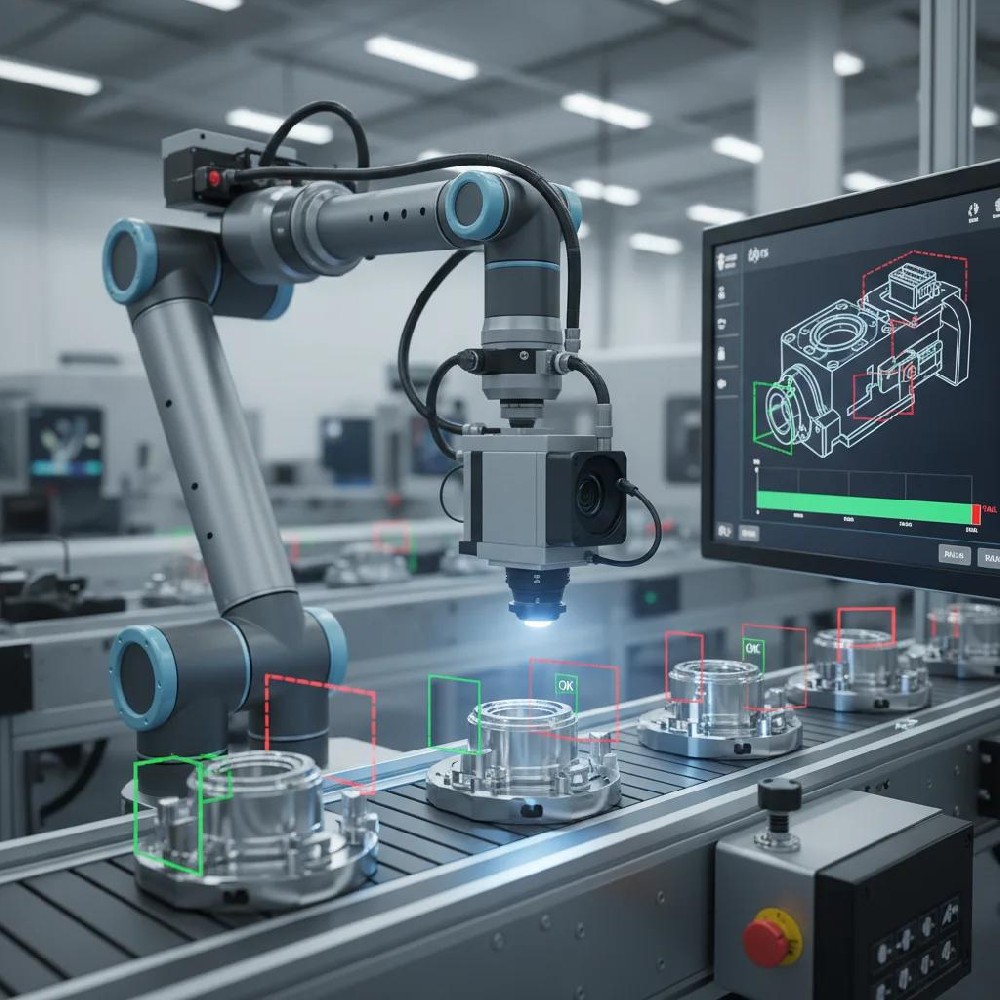
A typical automated inspection sequence can involve several stages. A camera captures an image, the AI model evaluates the product, the inspection result is generated and the control system determines whether the product should continue through the line or be rejected.
The PLC remains an important component because it coordinates the timing and physical response of the machinery.
For example, when a defective product is identified on a high-speed conveyor, the automation system may need to calculate the exact position of the product and activate a pneumatic ejector, servo mechanism or other rejection device at the correct moment.
The AI system therefore becomes another source of production intelligence within the automation architecture.
This trend could have broader implications for PLC engineers, system integrators and machine builders. Future inspection systems are increasingly likely to be designed as part of an integrated control environment rather than as independent add-ons.
Edge Computing Moves AI Closer to the Machine
Another important element of the project is Siemens Industrial Edge.
Edge computing processes data closer to where it is generated. In manufacturing, this can mean running industrial AI applications on industrial PCs located close to machines, cameras and controllers.
The Siemens and P&G system combines P&G's deep-learning models with Siemens Industrial Edge technology, industrial PCs and AI hardware and software. Inspection results can then be processed close to the production equipment.
This architecture has several practical advantages.
First, low-latency processing can support real-time production decisions.
Second, manufacturers can reduce the amount of raw camera data that needs to be transmitted to remote systems.
Third, the inspection application can become part of a broader industrial data architecture.
This is particularly important as manufacturers attempt to connect PLCs, HMIs, SCADA systems, MES platforms, industrial PCs and cloud services.
Instead of treating these systems as separate layers, industrial automation is increasingly moving toward architectures where operational data can travel between machine-level control and higher-level analytics.
Reducing Scrap Through Automated Inspection
One of the most significant reported results from the Siemens and P&G deployment is the reduction in scrap.
The companies report that scrap rates have been reduced by 10% to 20%, depending on the product.
Reducing scrap is important for several reasons.
From a manufacturing perspective, fewer defective products mean less material waste and fewer production resources consumed by products that cannot be sold.
From an automation perspective, better inspection can also provide information about process conditions.
If a particular type of defect begins appearing more frequently, production teams can investigate whether the cause is related to equipment settings, material variation, temperature, mechanical alignment or another process parameter.
This creates a feedback loop between quality inspection and production engineering.
In a conventional production environment, quality inspection may simply identify defective products after they have already been manufactured.
In a more connected industrial environment, inspection data can become part of continuous process improvement.
Faster Commissioning for New Production Lines
Another reported advantage is faster commissioning.
Siemens and P&G state that new deployments can be commissioned five to ten times faster than traditional bespoke vision systems.
Commissioning time is a major consideration for manufacturers operating multiple production sites.
A traditional customized machine-vision project may require engineers to configure cameras, lighting, inspection rules, communication interfaces and product-specific parameters.
If the same approach has to be repeated for multiple plants, engineering resources can become a bottleneck.
A standardized industrial AI platform can potentially make deployment more repeatable.
The same general architecture can be adapted to different production lines while maintaining a common operational framework.
For multinational manufacturers, this is especially important because automation systems may be deployed across different factories, countries and production environments.
What This Means for Industrial Automation
The Siemens and P&G announcement highlights a broader change taking place in industrial automation.
AI is moving from experimental demonstrations toward practical applications connected to real production equipment.
Machine vision is one of the areas where this transition is particularly visible because inspection generates large amounts of visual data and many manufacturing defects are difficult to describe using simple fixed rules.
The combination of AI, edge computing, industrial PCs, cameras and PLCs provides a path toward more adaptive automation.
This does not mean that traditional PLC control is being replaced.
Instead, the PLC, sensors, cameras, drives and AI systems can perform different roles within a common automation architecture.
The PLC can continue providing deterministic control, while AI can contribute more advanced pattern recognition and inspection capabilities.
The Future of AI-Based Factory Inspection
The next stage of industrial AI will likely focus on how easily these technologies can be maintained and scaled.
A successful AI inspection system must not only detect defects during an initial deployment. It also needs to remain reliable when products, materials, lighting conditions and machine settings change.
Manufacturers will therefore need to consider model management, data quality, camera calibration, industrial networking, PLC communication and cybersecurity alongside AI performance.
For system integrators and automation engineers, this creates a new intersection between traditional control engineering and artificial intelligence.
The Siemens and P&G project is a concrete example of this transition. Rather than treating AI as a separate digital technology, the system places AI-based inspection directly inside the manufacturing workflow.
As industrial companies continue to invest in smart manufacturing, edge computing and connected control systems, the integration of AI with PLC-based automation and machine vision is likely to remain an important area of development.
The key development is not simply that factories are using AI. It is that AI is increasingly becoming part of the actual control and quality processes that keep production lines running.