Emerson to Automate Europe’s First Greenfield Sustainable Aviation Fuel Facility
Time:2026-09-22 Browse: 0
Industrial process automation is playing an increasingly important role in the development of new energy and sustainable fuel infrastructure. Emerson has recently been selected to provide automation technologies for a new sustainable aviation fuel facility being developed by SkyNRG in Delfzijl, the Netherlands.
The facility is planned as Europe’s first dedicated greenfield production plant for sustainable aviation fuel. Emerson will provide an integrated control and safety system based on its DeltaV automation technology to support process control, safety functions, commissioning, asset management, and long-term plant operation.
The project highlights how distributed control systems, safety instrumented systems, industrial communication, asset management, and digital automation are being integrated into new process facilities from the beginning of the engineering phase.
A New Generation of Process Automation Projects
Greenfield projects provide an opportunity to design automation architecture from the beginning rather than modifying an existing control system.
This distinction is important.
Brownfield facilities often contain multiple generations of PLCs, DCS controllers, field instruments, communication systems, safety systems, and operator interfaces.
Engineers working on modernization projects must consider existing equipment, plant shutdown schedules, legacy protocols, existing wiring, and historical engineering decisions.
A greenfield facility does not have the same limitations.
Automation engineers can design the control system, safety system, field instrumentation, industrial network, asset management platform, and operator environment as an integrated architecture.
This is the approach being applied to the SkyNRG sustainable aviation fuel project.
Emerson's DeltaV integrated control and safety system is intended to provide a unified automation environment for the new facility.
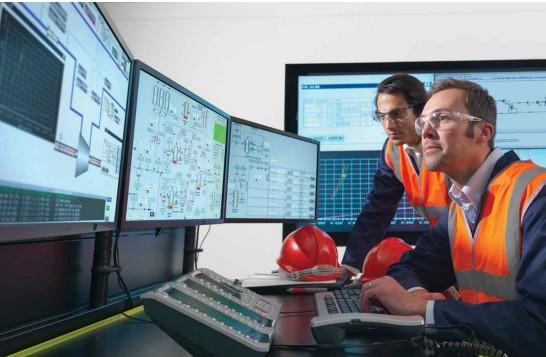
DeltaV DCS and Safety Instrumented System
The automation architecture will include Emerson's DeltaV Distributed Control System and DeltaV Safety Instrumented System.
A DCS is commonly used in process industries where continuous monitoring and control are required.
Process variables such as temperature, pressure, flow, level, composition, and equipment status must be continuously monitored.
Controllers evaluate these signals and adjust valves, pumps, heaters, compressors, and other equipment to maintain the desired operating conditions.
A safety instrumented system has a different function.
Its purpose is to help protect the process and personnel by responding to potentially hazardous conditions.
If a process reaches a dangerous state, the safety system can initiate predefined protective actions, such as shutting down equipment or isolating a process section.
Combining process control and safety technologies within a coordinated automation architecture can simplify engineering and operation.
For a complex fuel-production facility, this type of integrated approach is particularly important because the plant must manage multiple process units and potentially hazardous materials.
Automation for Sustainable Aviation Fuel Production
The SkyNRG facility is expected to produce approximately 100,000 tonnes of sustainable aviation fuel per year once fully operational.
The plant will use residual fats and greases as feedstock and convert these materials into sustainable aviation fuel.
The resulting fuel is designed as a drop-in fuel that can be blended with conventional aviation fuel without requiring modifications to aircraft or existing fuel infrastructure.
From an automation perspective, the production process presents several challenges.
Feedstock properties can vary.
Process temperatures and pressures must be tightly controlled.
Hydrogen is required for the production process.
Equipment must operate continuously and safely.
The process also includes multiple interconnected units.
Automation therefore needs to provide both detailed process control and plant-wide visibility.
Managing Multiple Process Units
The automation system will manage several major areas of the facility.
These include the hydroprocessed esters and fatty acids process used for sustainable aviation fuel production, a feedstock pre-treatment unit, and an on-site hydrogen production unit.
Each process section has its own control requirements.
For example, feedstock pre-treatment may require control of temperature, flow, pressure, and material quality.
The main fuel-production process involves chemical reactions that depend on controlled operating conditions.
The hydrogen production system also requires precise control of process parameters.
A centralized DCS allows operators to monitor these different areas through a coordinated control environment.
Instead of managing every piece of equipment independently, operators can view process information through integrated human-machine interfaces.
This can help operators understand relationships between process units and respond more quickly to abnormal conditions.
Safety Automation Is a Core Part of the Architecture
Process safety is one of the most important aspects of industrial automation in fuel and chemical facilities.
A modern process plant cannot depend only on normal control logic to manage every possible abnormal situation.
Control systems are designed to keep the process operating normally.
Safety systems provide an additional layer of protection when abnormal conditions exceed defined limits.
The SkyNRG project will use Emerson's DeltaV Safety Instrumented System together with fire and gas detection capabilities.
This type of architecture provides multiple levels of protection.
Field instruments continuously measure process conditions.
The DCS controls normal operation.
The safety system monitors defined safety conditions and can initiate protective actions.
Fire and gas systems provide additional detection capabilities.
The result is a layered approach to industrial process safety.
Digital Automation Starts Before Plant Startup
One important characteristic of the project is that digital automation is being incorporated during the development of the greenfield facility.
This means automation is not treated simply as equipment that is installed near the end of construction.
Instead, the control architecture becomes part of the engineering process.
Digital engineering can support configuration, commissioning, operator training, system testing, and maintenance.
When automation data is structured correctly from the beginning, it can also support long-term asset management.
This is increasingly important as industrial plants become more complex.
A new facility may contain thousands of instruments, valves, motors, analyzers, controllers, and other assets.
Maintaining accurate information about these assets can significantly affect plant reliability.
Asset Management and Predictive Maintenance
Emerson will also provide AMS Device Manager plant asset management software for the project.
Asset management systems can collect information from intelligent field devices and provide engineers with diagnostic information.
This can help maintenance teams identify potential problems before equipment failure results in an unplanned shutdown.
For example, an intelligent field device may provide information about its operating condition or diagnostic status.
Maintenance engineers can use this information to prioritize inspection and maintenance activities.
Instead of treating every instrument equally, maintenance teams can focus resources on assets showing abnormal behavior.
This approach supports the broader transition from reactive maintenance toward condition-based and predictive maintenance.
Reducing Risk During Commissioning
Commissioning is often one of the most challenging phases of a new industrial facility.
Hundreds or thousands of devices need to be tested.
Control loops must be verified.
Safety functions must be validated.
Communication systems need to be checked.
Operator interfaces must be tested.
Interlocks must operate correctly.
Automation engineering therefore has a direct influence on project schedules.
Emerson's integrated automation approach is designed to simplify commissioning by providing a coordinated control and safety environment.
The use of modular production units also creates opportunities for standardized automation approaches.
Instead of treating every process section as a completely separate system, engineers can develop repeatable configurations and integrate them into the overall plant architecture.
Why DCS Technology Remains Important
The increasing use of AI and edge computing in manufacturing sometimes creates the impression that traditional DCS platforms are becoming less important.
The SkyNRG project demonstrates why this is not necessarily the case.
Advanced digital technologies are being added to process automation rather than simply replacing DCS technology.
The DCS remains responsible for core process control.
Safety systems remain responsible for defined protective functions.
Field devices continue to generate process data.
Asset management software analyzes equipment information.
Digital technologies connect these components and make their data more useful.
For process industries such as oil and gas, chemicals, pharmaceuticals, power generation, and sustainable fuels, this combination is likely to remain important.
What the Project Means for Industrial Automation
The SkyNRG project demonstrates a wider trend in industrial automation: new energy infrastructure is being designed with automation and digitalization as fundamental components.
Sustainable fuel production requires more than a new chemical process.
It also requires reliable control systems, safety systems, instrumentation, industrial networks, asset management, cybersecurity, and skilled operators.
The automation architecture must therefore support the entire lifecycle of the facility.
It needs to work during commissioning.
It needs to support normal production.
It needs to help operators respond to abnormal situations.
It needs to provide maintenance information.
It must also remain flexible enough to accommodate future changes.
For automation suppliers and industrial system integrators, greenfield projects such as this create demand for integrated control and safety technologies.
For plant operators, the objective is to create facilities that can achieve reliable production while maintaining high safety and operational standards.
The Future of Process Automation
The development of sustainable aviation fuel facilities illustrates how process automation is expanding into emerging industrial sectors.
DCS technology is no longer limited to traditional oil, gas, and chemical plants.
It is also being applied to new energy systems, sustainable fuels, hydrogen production, carbon management, and other emerging industrial processes.
As these facilities become larger and more complex, integrated automation will become increasingly important.
The SkyNRG project combines process control, safety instrumentation, fire and gas detection, field device diagnostics, and digital asset management within a new greenfield facility.
This approach represents a practical model for modern process automation.
The future of industrial automation will not be defined by a single technology. Instead, successful facilities will combine reliable control systems with intelligent instrumentation, digital engineering, safety automation, asset management, and increasingly advanced analytical capabilities.
For process industries, the result is a more connected automation environment designed not only to control production, but also to support safe commissioning, reliable operation, efficient maintenance, and long-term plant performance.