Siemens and Procter & Gamble Expand AI-Based Quality Inspection Across Global Manufacturing
Time:2026-09-22 Browse: 0
The integration of artificial intelligence into industrial automation is moving from pilot projects to large-scale production environments. A recent development involving Siemens and Procter & Gamble demonstrates how Industrial AI, edge computing, machine vision, and PLC-based production control are increasingly being combined to improve quality inspection on high-speed manufacturing lines.
Siemens and Procter & Gamble are expanding the deployment of an AI-based quality inspection solution across P&G manufacturing operations worldwide. The system is designed to inspect products in real time while production continues at full line speed. According to the companies, the solution has already helped reduce scrap rates by approximately 10 to 20 percent in certain applications, while new inspection deployments can be commissioned significantly faster than traditional customized machine vision systems.
The development is particularly relevant to manufacturers operating complex production lines where product materials, packaging designs, colors, surface characteristics, and production conditions can change frequently.
AI-Based Inspection Moves Closer to the Production Line
Traditional machine vision has been an important part of industrial automation for many years. Cameras, lighting systems, image-processing software, PLCs, sensors, and industrial computers are commonly combined to identify defects and remove non-conforming products.
However, conventional vision inspection can become difficult to maintain when production conditions change.
A vision system may need to be adjusted when a product changes shape, when packaging artwork is redesigned, or when materials behave differently at high production speeds. This is especially challenging in consumer goods manufacturing, where manufacturers can operate numerous production lines and product variations.
The Siemens and P&G solution uses Industrial AI to address some of these challenges.
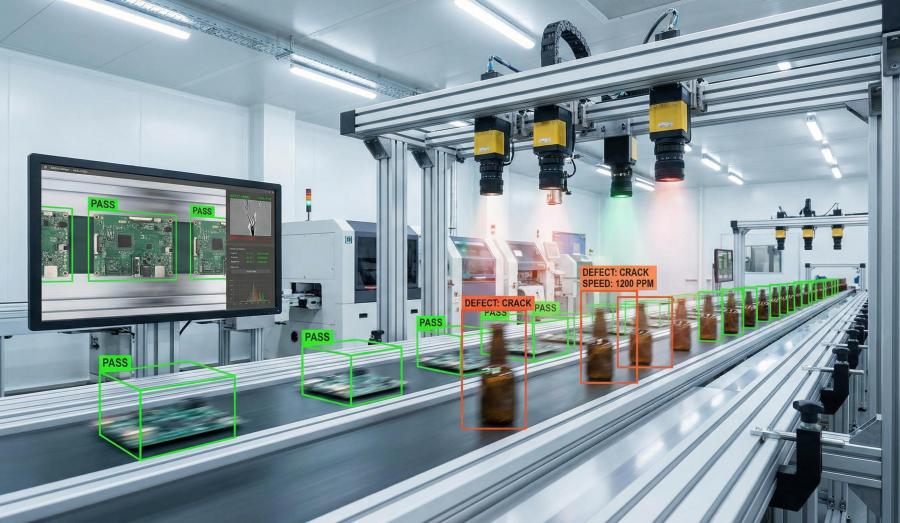
The Visual Inspection Cockpit combines artificial intelligence with industrial edge computing. Instead of relying only on traditional image-processing rules, AI models can be used to recognize more complicated visual characteristics.
This approach can be particularly useful when defects are difficult to define using simple thresholds.
For example, production materials may wrinkle, overlap, stretch, or change appearance during high-speed processing. Low-contrast defects may also be difficult to detect using conventional rule-based inspection.
AI-based inspection can analyze these variations while remaining connected to the manufacturing control environment.
Industrial Edge Computing Supports Real-Time Inspection
One of the most important aspects of the project is the use of industrial edge computing.
In conventional industrial automation architectures, production data may be transferred to centralized systems for analysis. However, applications such as machine vision and quality inspection often require extremely fast decisions.
A defective product cannot remain on the production line while a remote server processes an image.
Edge computing moves data processing closer to the machine.
In the Siemens and P&G application, inspection results are processed close to the production equipment using Siemens Industrial Edge technology. This architecture allows the inspection system to operate within the production environment while maintaining integration with manufacturing equipment.
For industrial users, this approach demonstrates an important direction for factory automation.
AI does not necessarily replace the existing PLC, industrial controller, sensor network, or machine vision system. Instead, AI can become another layer within the automation architecture.
Cameras collect visual information.
Industrial computers process images and AI models.
The edge platform evaluates inspection results.
The PLC and machine control system can then coordinate production actions.
A reject mechanism can remove defective products from the line, while production data can be stored for further analysis.
This creates a connection between artificial intelligence and conventional industrial control.
PLC Integration Remains Important
Although AI is the main focus of the new inspection technology, PLC integration remains critical.
A manufacturing inspection system cannot simply identify a defect. It must also communicate the inspection result to the production equipment at the correct moment.
Consider a high-speed packaging line.
A camera may identify a defective package. The automation system must determine which physical product corresponds to that image and activate the appropriate rejection mechanism.
The timing between image acquisition, AI inference, PLC communication, and mechanical rejection therefore becomes extremely important.
This is where industrial automation engineering continues to play a central role.
PLCs provide deterministic control for machines and production processes. Industrial networks connect controllers with sensors, actuators, drives, remote I/O, and other equipment.
AI can provide additional intelligence, but it still needs to operate within the established control architecture.
The Siemens and P&G project illustrates how these technologies can work together rather than being treated as separate systems.
Reducing Scrap Through Earlier Defect Detection
Quality inspection has a direct relationship with production efficiency.
If a manufacturing defect is discovered only after a production batch has been completed, a large amount of material may already be affected.
Real-time inspection provides an opportunity to detect problems earlier.
For example, if a machine begins producing packages with an abnormal visual characteristic, an AI inspection system can identify the change while production continues.
The system can generate an alert, trigger a rejection process, or provide data that allows operators and engineers to investigate the production condition.
The reported 10 to 20 percent reduction in scrap for certain applications demonstrates the potential economic impact of this approach.
The value is not limited to material savings.
Reducing scrap can also reduce machine downtime, rework, energy consumption, labor requirements, and production interruptions.
For manufacturers operating continuously at high production rates, even a relatively small improvement in quality performance can have a significant effect on overall operating costs.
Why Industrial AI Is Different From Generic AI
Industrial AI has different requirements from many consumer AI applications.
A factory cannot tolerate unpredictable system behavior in a safety-critical or high-speed production process.
Industrial AI must work with sensors, PLCs, industrial PCs, communication networks, cameras, drives, robots, and manufacturing equipment.
It must also operate under real-world conditions.
Factories can contain dust, vibration, temperature changes, changing illumination, mechanical movement, and electromagnetic interference.
The AI system therefore needs to be integrated into an industrial environment rather than simply connected to a cloud platform.
This is one reason edge computing is becoming increasingly important in manufacturing automation.
Processing data close to the production equipment can reduce communication latency and provide a more predictable architecture for real-time applications.
A Broader Trend Toward Intelligent Manufacturing
The Siemens and P&G development reflects a broader transition in industrial automation.
For decades, automation focused primarily on repeatability.
A PLC executes a programmed sequence.
A sensor detects a condition.
A drive controls motor speed.
A robot follows programmed motion.
A DCS controls a process.
The next stage adds greater analytical capability.
AI systems can interpret complex information and identify patterns that may be difficult to capture using traditional control logic.
This does not mean that traditional automation technology is becoming obsolete.
Instead, modern factories are increasingly combining multiple technologies.
PLC systems remain responsible for machine control.
DCS platforms remain important for continuous and batch processes.
SCADA systems provide monitoring and supervisory functions.
Industrial Ethernet connects equipment.
Machine vision provides visual information.
Industrial PCs provide computing resources.
AI models add advanced analytical capabilities.
Edge platforms provide an environment for processing data near the production equipment.
The resulting architecture is more connected and software-driven than traditional automation systems.
Implications for Machine Builders and System Integrators
For machine builders, AI-based inspection creates opportunities to develop more flexible machines.
Instead of designing a dedicated vision system for every product variation, machine builders can increasingly develop platforms that can be configured or trained for different inspection requirements.
System integrators also need to understand both automation engineering and data technologies.
Knowledge of PLC programming alone may not be sufficient for future smart manufacturing projects.
Engineers may increasingly need to understand industrial networking, edge computing, machine vision, data management, cybersecurity, and AI model deployment.
This does not eliminate the importance of conventional automation skills.
In fact, the opposite may be true.
The more technologies are integrated into a production system, the more important it becomes to understand the underlying control architecture.
The Future of AI-Powered Quality Control
The expansion of AI-based quality inspection across P&G manufacturing operations represents a significant step toward industrial-scale AI adoption.
The important point is not simply that artificial intelligence is being used in a factory.
The more important development is the integration of AI with existing industrial automation infrastructure.
AI can inspect products.
Edge computers can process data locally.
PLCs can coordinate machine actions.
Industrial networks can connect the equipment.
Manufacturing systems can collect production information.
Together, these technologies create a more intelligent quality-control environment.
As manufacturers continue to pursue higher production efficiency, lower scrap rates, and more flexible production, AI-based machine vision is likely to become an increasingly important part of industrial automation.
For automation engineers, machine builders, and industrial equipment suppliers, the trend also highlights a changing definition of factory intelligence. The future factory is not simply a collection of automated machines. It is an interconnected system in which control, sensing, computing, and artificial intelligence work together in real time.