ABB Pluto Safety PLCs Begin Shipping for Industrial Machine Safety Applications
Time:2026-09-24 Browse: 0
Published: September 2026
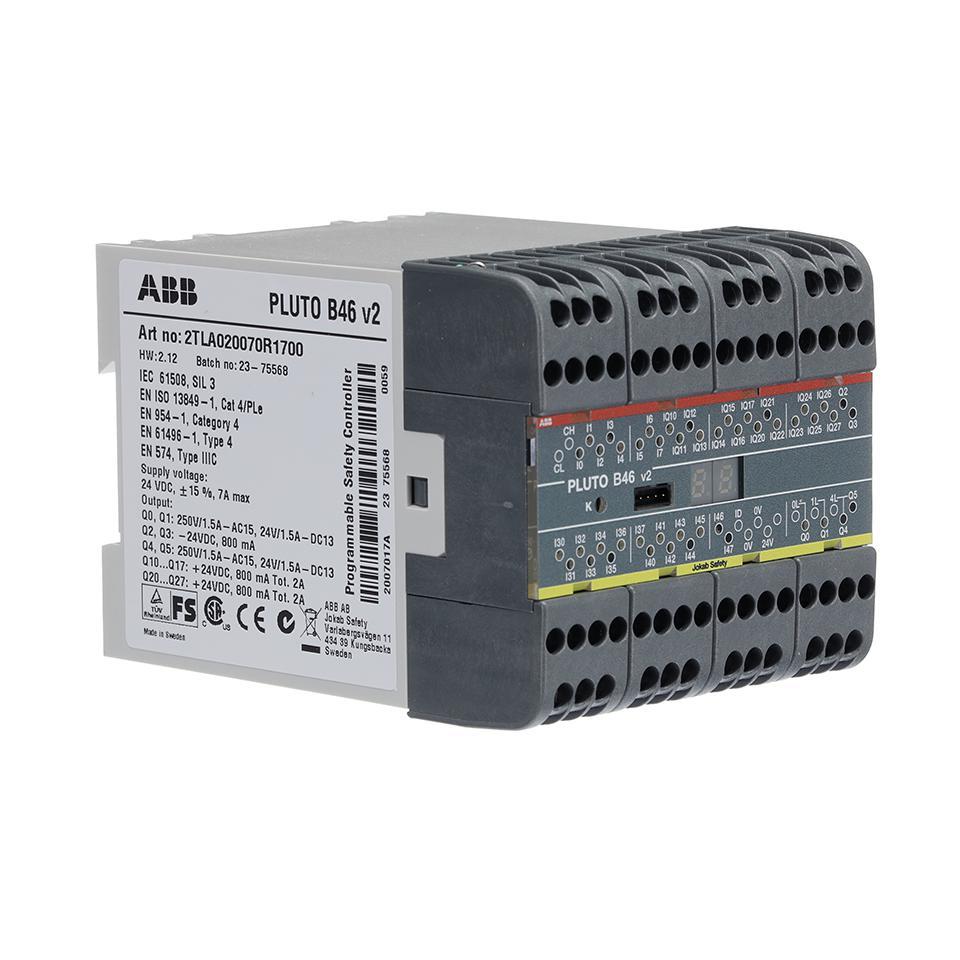
New ABB Pluto Safety programmable logic controllers are now being shipped for industrial machine safety applications, bringing a compact safety PLC platform to automation engineers and machine builders.
The announcement, made in September 2026, highlights the continuing development of programmable safety control systems for industrial machinery. ABB's Pluto Safety family is designed to combine safety control, communication, programming, and monitoring functions within a dedicated PLC-based architecture.
Safety PLCs are increasingly important in modern industrial automation because machines often contain moving mechanisms, high-energy equipment, automated material handling systems, robotic cells, conveyors, motors, presses, and other potentially hazardous equipment.
A safety control system provides a structured method for monitoring safety devices and initiating defined protective actions when an unsafe condition is detected.
What Is a Safety PLC?
A safety PLC is a programmable controller designed and certified for safety-related applications.
Traditional PLCs are primarily used for machine and process control. They execute logic that controls motors, valves, sensors, actuators, and other equipment.
A safety PLC performs similar computational functions but is designed according to additional functional safety requirements.
Safety PLCs can monitor devices such as emergency-stop buttons, safety switches, light curtains, safety mats, two-hand controls, and other safety sensors.
When the required safety conditions are not satisfied, the controller can initiate a predefined safe response.
For example, a machine may be required to stop when an operator opens a safety guard. The safety PLC can monitor the guard switch and control the appropriate safety outputs.
The actual safety function depends on the machine risk assessment and safety design.
ABB Pluto Safety PLCs for Industrial Machines
The ABB Pluto Safety platform includes different types of safety PLCs designed for various machine safety applications.
The product family includes controllers for smaller safety systems as well as models that support communication for larger applications. The range also includes gateways for communication with other control systems and encoders used for safe position determination.
Some models include analog inputs, allowing the platform to support applications that require more than simple digital safety signals.
This flexibility is important because industrial machines can vary significantly in size and complexity.
A simple automated machine may only require a few emergency-stop devices and safety switches.
A larger production line may contain multiple machines, robotic systems, conveyors, safety zones, motors, drives, and interconnected safety functions.
A modular safety PLC family allows engineers to select hardware appropriate to the scale of the application.
Pluto Manager Software Simplifies Configuration
ABB's Pluto Safety PLCs are programmed using Pluto Manager software.
The programming environment is designed to support both function blocks and ladder logic.
The system also includes TÜV-approved function blocks intended for safety applications.
For automation engineers, familiar programming concepts can simplify the transition between standard PLC control and safety control.
However, safety PLC programming still requires appropriate functional safety engineering.
A safety application cannot be treated simply as a conventional PLC program.
The safety function must be based on a risk assessment, defined safety requirements, appropriate hardware, validated logic, and documented testing.
Programming software is only one part of the complete safety lifecycle.
Communication Between Pluto Safety Controllers
One feature highlighted for the Pluto system is the ability for up to 32 Pluto units to exchange data without requiring separate communication configuration or programming.
This capability can be useful for machines or production systems with multiple safety controllers.
Large automated systems are often divided into multiple machine sections or safety zones.
Each zone may contain its own safety controller while still requiring communication with other zones.
For example, a production line could have separate safety control for material feeding, processing, robotic handling, and product discharge.
Safety communication between these areas can allow the system to coordinate protective actions.
If one machine section enters a safety condition, related equipment may need to respond according to the defined safety architecture.
Simplifying communication between safety controllers can reduce engineering effort while supporting distributed machine safety designs.
Functional Safety and PL e / SIL3
The Pluto Safety platform is specified for applications requiring PL e and SIL3 levels.
Performance Level and Safety Integrity Level are two different functional safety frameworks used to evaluate safety-related control systems.
PL e is a performance level defined under machinery functional safety standards.
SIL3 is a safety integrity level used within the IEC 61508 family and related standards.
The exact level required for a particular machine depends on the hazard analysis and risk assessment.
Engineers must determine the required safety performance based on factors such as severity of injury, frequency of exposure, and the possibility of avoiding the hazard.
The controller itself does not automatically make an entire machine PL e or SIL3 compliant.
The complete safety-related system must be designed, implemented, validated, and maintained according to the applicable standards.
This distinction is particularly important for machine builders and system integrators.
Connecting Multiple Safety Sensors
ABB states that Pluto can work with common types of safety devices and can support multiple safety sensors connected to a single input while maintaining the required safety level under appropriate system configurations.
This type of architecture can help reduce the amount of wiring required in some machine applications.
Safety systems traditionally require careful consideration of input circuits, diagnostic coverage, redundancy, short-circuit detection, and fault behavior.
Modern safety PLC architectures can integrate these requirements into configurable control systems.
However, the final wiring design still needs to be evaluated against the applicable safety requirements for the machine.
Safety PLCs and Industrial Automation
The growth of industrial automation is increasing the importance of safety control.
Modern production equipment is becoming more automated and interconnected. Robots, automated guided systems, servo drives, conveyors, CNC machines, packaging equipment, and high-speed manufacturing systems can all operate with limited direct human intervention.
As machine speed and automation increase, safety systems must keep pace.
A modern safety architecture can integrate emergency-stop functions, protective doors, light curtains, safety scanners, safe motion functions, and other protective devices.
Safety PLCs provide a programmable platform for coordinating these functions.
This is different from traditional hardwired safety relay systems, which may become difficult to modify when machines become more complex.
A safety PLC can allow engineers to implement more sophisticated safety logic while maintaining a structured and documented control architecture.
Safety PLC Versus Standard PLC
Standard PLCs and safety PLCs can coexist in the same automation system, but they serve different purposes.
A standard PLC may control production sequences, motors, valves, actuators, temperature loops, machine cycles, and communication with HMIs or SCADA systems.
A safety PLC is responsible for safety-related functions defined by the machine's safety requirements.
In some architectures, standard control and safety control may exchange selected information while remaining logically separated.
For machine builders, this separation can help maintain a clear distinction between production control and protective functions.
A machine might continue its normal production sequence through a standard PLC while the safety controller independently monitors emergency stops, guard switches, and other safety devices.
When a safety condition occurs, the safety system can initiate the defined protective response.
Applications for Machine Builders
Safety PLC technology is particularly relevant to OEM machine builders.
Machine builders often need to develop equipment that can be deployed in different factories and industries.
A programmable safety architecture can make it easier to adapt safety functions to different machine configurations.
Potential applications include packaging machinery, material handling systems, conveyor systems, automated assembly equipment, robotic work cells, manufacturing machines, and production lines.
For OEMs, another important consideration is documentation.
A machine's safety functions should be documented so that operators, maintenance engineers, and integrators understand how the system behaves under abnormal conditions.
The safety program, wiring diagrams, device lists, validation records, and related technical documentation can become important parts of the machine's lifecycle information.
The Role of Safety in Smart Manufacturing
The development of safety PLCs also reflects a broader change in industrial automation.
Factories are becoming more connected, but connectivity must be balanced with safety and cybersecurity.
Modern machines may communicate with PLCs, HMIs, SCADA systems, MES platforms, cloud services, robots, drives, and industrial networks.
This creates opportunities for greater production visibility but also increases system complexity.
Safety functions need to remain reliable even as production control architectures become more sophisticated.
For this reason, safety engineering remains a fundamental part of Industry 4.0.
Digital transformation does not eliminate traditional safety requirements. Instead, it creates new engineering challenges involving connected machines, software configuration, network communication, diagnostics, and lifecycle management.
Why the New ABB Pluto Safety PLC Availability Matters
The start of shipping for the ABB Pluto Safety PLC family provides machine builders and industrial automation engineers with another option for programmable machine safety applications.
The platform combines safety PLC hardware, programming software, safety function blocks, communication capabilities, and support for different safety devices.
For smaller machines, a compact safety PLC can provide a more flexible alternative to extensive hardwired safety logic.
For larger systems, multiple controllers can be coordinated as part of a distributed safety architecture.
The appropriate solution will depend on machine complexity, safety requirements, I/O requirements, communication architecture, environmental conditions, and applicable regulations.
As industrial machinery becomes increasingly automated, safety PLCs will continue to be an important component of modern control architectures.
For engineers working with PLCs, HMIs, robotics, motion control, industrial networks, and machine automation, understanding the relationship between standard control and functional safety is becoming increasingly important.
The ABB Pluto Safety announcement is therefore relevant beyond the launch of another PLC family. It reflects the continuing evolution of machine control toward programmable, distributed, and integrated safety architectures.
For industrial automation projects, the objective is not simply to make a machine operate automatically. The control architecture must also provide predictable behavior, reliable fault handling, appropriate protective functions, and a documented approach to functional safety throughout the machine lifecycle.
SEO Keywords: ABB Pluto Safety PLC, safety PLC, programmable logic controller, industrial automation, machine safety, functional safety, PLC control system, safety controller, PL e, SIL3, industrial machine safety, PLC programming, machine automation, safety control system, industrial PLC