Emerson to Automate Europe’s First Greenfield Sustainable Aviation Fuel Facility with DeltaV DCS
Time:2026-09-24 Browse: 0
Published: September 2026
Emerson has been selected to provide automation technologies for a new sustainable aviation fuel production facility being constructed in Delfzijl, the Netherlands. The project is being developed by SkyNRG, with Technip Energies involved in the project, and Emerson will provide an integrated control and safety system based on its DeltaV automation technology.
The facility is planned as Europe's first dedicated greenfield production facility for sustainable aviation fuel. Once fully operational, the plant is expected to produce approximately 100,000 tonnes of sustainable aviation fuel each year.
For the industrial automation sector, the project is significant because it demonstrates how distributed control systems, safety instrumented systems, plant asset management software, and digital commissioning technologies can be integrated into a new process facility from the beginning.
The plant is currently under construction in Delfzijl and is expected to become operational in 2028.
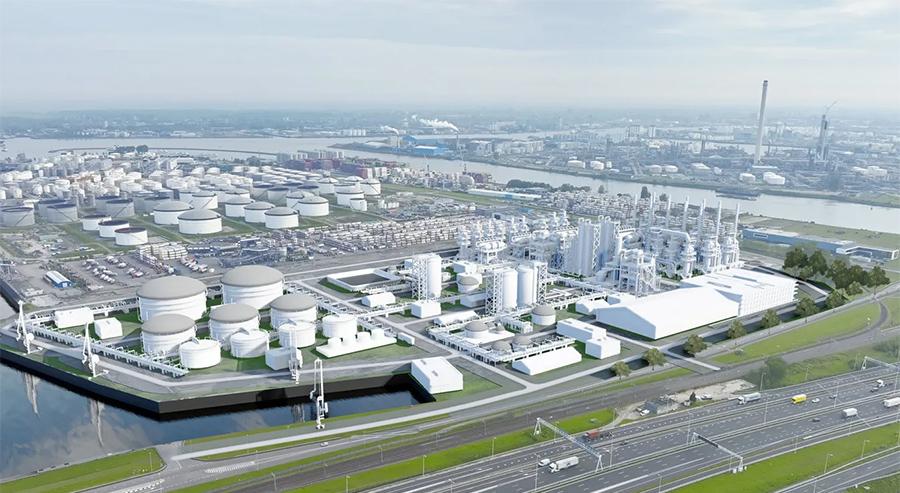
A New Generation of Sustainable Fuel Production
Sustainable aviation fuel, commonly known as SAF, is attracting increasing attention as the aviation industry works to reduce the carbon intensity associated with conventional aviation fuels.
The SkyNRG facility will convert residual fats and greases into sustainable aviation fuel. The resulting fuel is designed as a drop-in aviation fuel, meaning it can be blended with conventional jet fuel without requiring fundamental modifications to aircraft or existing fueling infrastructure.
From an automation perspective, producing SAF involves multiple interconnected process units. The plant will include a hydroprocessed esters and fatty acids process, a feedstock pre-treatment unit, and an on-site hydrogen plant.
Each process area requires monitoring and control of variables such as pressure, temperature, flow, level, equipment status, and safety conditions.
This makes the automation architecture a critical part of plant operation.
DeltaV Distributed Control System for Process Control
Emerson will provide its DeltaV Distributed Control System as part of the integrated control and safety system.
A DCS is commonly used in process industries to coordinate large numbers of continuous and batch process operations. Controllers receive data from field instruments and execute control strategies that regulate the process.
In a modern process plant, the DCS does much more than simply turn equipment on and off.
It can manage control loops, operator graphics, alarms, trends, process sequences, equipment states, and communication with other plant systems.
For a new SAF facility, the DCS must coordinate multiple process areas while providing operators with a consistent view of plant conditions.
A well-designed control architecture can also simplify commissioning and provide a foundation for future plant optimization.
Safety Instrumented Systems Add an Independent Protection Layer
The automation project will also include a DeltaV Safety Instrumented System.
Safety instrumented systems are designed to perform specific safety functions when predefined hazardous conditions occur. Depending on the process and safety design, these functions can include shutting down equipment, isolating process sections, preventing unsafe operating conditions, or initiating emergency responses.
The safety system operates as part of the overall process safety architecture rather than replacing normal process control.
In a complex production facility, this distinction is important.
The DCS is responsible for normal process operation, while the safety instrumented system provides dedicated protective functions based on defined safety requirements.
The project also includes fire and gas detection capabilities. These systems can provide information about potentially hazardous conditions and initiate appropriate protective actions according to the plant's safety design.
Integrating process control and safety technologies into a coordinated automation architecture can reduce engineering complexity and improve visibility during commissioning and operation.
Plant Asset Management and Intelligent Field Devices
Another component of the project is Emerson's AMS Device Manager plant asset management software.
Industrial plants contain large numbers of field devices, including pressure transmitters, temperature instruments, flow meters, valve positioners, analyzers, and other intelligent devices.
These devices generate information beyond the primary process measurement.
Modern smart instruments can provide diagnostic information that helps maintenance teams understand device health, configuration status, and potential problems.
Plant asset management software can collect and organize this information so engineers can identify issues before they develop into larger operational problems.
For example, a maintenance engineer may be able to identify an instrument diagnostic condition before the device causes a process control problem.
This approach supports the wider move from reactive maintenance toward condition-based and predictive maintenance.
Digital Automation in a Greenfield Plant
One of the interesting aspects of the project is that the facility is being designed as a greenfield plant.
A greenfield project does not have to work around an existing legacy automation architecture in the same way that a brownfield modernization project does.
This provides an opportunity to establish automation standards during the original engineering phase.
Control system architecture, instrumentation, industrial networking, cybersecurity, alarm management, data structures, asset management, and operator interfaces can be designed as part of a coordinated system.
For a large process facility, decisions made during the engineering stage can influence the plant for decades.
This is why automation architecture is increasingly considered a strategic engineering decision rather than simply an equipment procurement decision.
Modular Automation and Commissioning
The SkyNRG project will include multiple modular production units.
Integrating modular equipment into a plant automation system can create engineering challenges because different suppliers may use different control technologies, communication protocols, documentation standards, and operating philosophies.
Emerson said its automation architecture will integrate the plant's modular production units while simplifying commissioning.
Another technology included in the project is DeltaV Electronic Marshalling with distributed CHARMs.
Electronic marshalling can reduce traditional field wiring requirements and provide flexibility when engineering changes occur later in a project.
This flexibility can be valuable during complex greenfield projects because process designs can evolve during engineering and construction.
Late-stage changes are common in major industrial projects. A flexible I/O and control architecture can reduce the amount of physical rewiring required when signal assignments or system configurations change.
Hydrogen Production and Process Automation
The plant will also include an on-site hydrogen production system based on Technip Energies' technology.
Hydrogen is an important input for the hydroprocessing process used to produce sustainable aviation fuel.
The hydrogen plant introduces another process system that must be integrated into the wider facility.
Pressure, temperature, gas flow, process conditions, equipment status, and safety parameters must be continuously monitored and controlled.
This illustrates why DCS technology is particularly relevant to complex process facilities.
Rather than treating each process unit as an isolated system, an integrated control architecture can provide a common operational environment for multiple production areas.
Operators can monitor plant conditions through centralized interfaces while control strategies remain distributed across the appropriate control infrastructure.
Why Automation Matters to Sustainable Aviation Fuel
The production of sustainable aviation fuel involves complex chemical and process operations.
Automation can contribute to consistent production by maintaining process parameters within specified operating ranges.
Temperature, pressure, flow, level, and composition are all important variables in process manufacturing.
If these parameters are not properly controlled, production efficiency, product quality, equipment reliability, and safety can be affected.
This makes industrial automation a fundamental technology supporting the scale-up of alternative fuel production.
The SkyNRG project therefore represents not only an investment in sustainable aviation fuel but also an example of how modern DCS and safety automation technologies can support new industrial processes.
ReFuelEU Aviation and the European Market
The facility is also being developed within the context of Europe's changing aviation fuel requirements.
The European Union's ReFuelEU Aviation regulation establishes minimum shares of sustainable aviation fuel for jet fuel supplied at EU airports. The requirement began with a minimum SAF share of 2% from 2025 and is scheduled to increase over time, reaching 70% by 2050.
Such regulatory requirements create a need for additional SAF production capacity.
The Delfzijl facility is intended to contribute to this broader market development once it becomes operational.
For industrial automation suppliers, projects associated with energy transition are creating new applications for control systems, safety systems, instrumentation, process analytics, and industrial software.
What This Project Means for DCS and Process Automation
The SkyNRG project demonstrates several important trends in modern process automation.
First, new industrial facilities are increasingly designed around integrated automation architectures rather than isolated control systems.
Second, safety systems are being engineered alongside process control systems from the earliest project stages.
Third, intelligent field instrumentation and asset management software are becoming important sources of maintenance and operational information.
Fourth, flexible I/O and modular automation technologies can help project teams manage changes during engineering and commissioning.
Finally, digital automation is becoming part of the basic infrastructure of new industrial facilities.
The sustainable aviation fuel sector is still developing, and individual plants will have different process requirements. However, the SkyNRG project shows how automation technology can be integrated into a new industrial process from the design stage through commissioning and long-term operation.
For engineers working with DCS, PLC, SIS, SCADA, instrumentation, and industrial communication systems, projects such as this demonstrate the continuing evolution of process automation. Modern automation is increasingly expected to provide not only control, but also safety, diagnostics, data visibility, lifecycle management, and flexibility for future plant development.
As sustainable fuel production expands, these requirements are likely to remain important across new energy and process manufacturing projects.
SEO Keywords: sustainable aviation fuel, SAF plant automation, Emerson DeltaV DCS, distributed control system, process automation, industrial automation, safety instrumented system, SIS, industrial control system, SkyNRG, Netherlands automation, DCS automation, plant asset management, greenfield automation project