Schneider ATS22D47Q Soft Starter Troubleshooting Guide for Overload Trips
Time:2026-10-10 Browse: 0
Why Schneider ATS22D47Q Overload Faults Occur
Schneider ATS22D47Q overload trips during motor acceleration or normal operation should be investigated by comparing the configured motor current, measured phase currents, and actual load conditions. The ATS22D47Q is a 47 A Altistart 22 soft starter intended for three-phase asynchronous motors. An overload indication does not automatically mean the soft starter has failed; an incorrect current setting, excessive starting duration, mechanical resistance, or supply imbalance may produce similar symptoms.
Effective Troubleshooting begins by identifying when the fault occurs. A trip immediately after a start command points toward a different diagnostic path from a trip that develops after several minutes of operation.
ATS22D47Q Fault Diagnosis: Separate Starting Problems from Running Overloads
Consider a representative maintenance scenario in which a pump motor starts successfully after maintenance but trips when the process reaches normal operating conditions. The initial observation alone cannot distinguish between an incorrect overload setting and a pump-related mechanical problem.
The first Fault Diagnosis task is to record the operating sequence:
Does the trip occur before the motor reaches full speed?
Does the motor run normally without process load?
Are the three phase currents reasonably balanced?
Does the displayed fault correspond to motor thermal protection, supply conditions, or another diagnostic category?
Has the motor, pump, coupling, or protection configuration changed recently?
This sequence helps narrow the cause without replacing components unnecessarily.
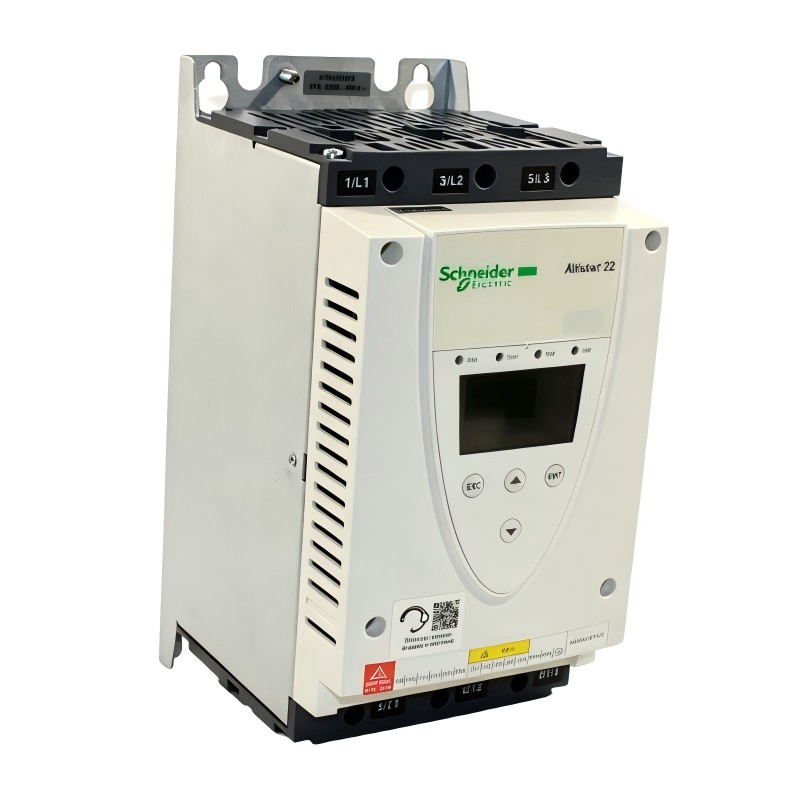
Schneider ATS22D47Q Motor Current and Thermal Protection Checks
Start by comparing the motor nameplate rated current with the configured motor-current value. The ATS22D47Q has a 47 A starter rating, but this does not mean every connected motor should be configured for 47 A. The protection setting must reflect the actual motor and the applicable installation arrangement.
Next, measure the three phase currents with an appropriately rated instrument. Record the readings during acceleration and after the motor reaches stable operation. If one phase differs significantly from the others, inspect the supply connections, contactor poles, cable terminations, and motor windings before changing the protection parameters.
For example, readings of 28 A, 29 A, and 41 A under comparable operating conditions would warrant investigation of current imbalance and connection integrity. These are illustrative diagnostic values, not measured results from a verified ATS22D47Q field repair.
If all three currents are consistently high, check whether the driven machine is overloaded, the pump is operating outside its intended duty point, or the acceleration ramp is excessively long. Repeatedly raising the current limit can hide the underlying problem and expose the motor to overheating.
Schneider ATS22D47Q Troubleshooting: A Practical Fault Isolation Case
In a representative pump-system investigation, the starter repeatedly trips during a loaded start even though the motor runs under lighter conditions. Replacing the starter immediately would be premature.
The investigation should proceed through three observations.
First, compare loaded and unloaded behavior. If the motor starts normally with the mechanical load removed, the fault may be associated with the driven equipment or the additional torque required during acceleration.
Second, inspect the electrical supply. Measure line-to-line voltage at appropriate test points and check for voltage imbalance or excessive voltage drop during starting. Confirm that all power connections are secure, with the system isolated before physical inspection.
Third, review the acceleration and protection settings. A ramp that is too long may increase the time spent at elevated current, while a ramp that is too short may not provide sufficient acceleration torque for the load. The correct setting depends on the motor, the mechanical system, and the manufacturer's limits.
If the measurements identify excessive mechanical resistance, correct the mechanical issue and repeat the commissioning test. If current imbalance remains after checking the supply and connections, further motor and power-circuit testing is required.
ATS22D47Q Control Circuit and PLC Interlock Fault Diagnosis
An ATS22D47Q overload trip can also be confused with a PLC control problem when the machine stops unexpectedly. These conditions must be separated.
Check the 230 V AC control supply, the 24 V DC logic input circuit, and the PLC's start-command sequence. Verify whether the starter has actually registered a trip or whether the PLC has removed the run command because an interlock has opened.
If Modbus is used, examine the communication status and fault information available through the configured interface. A communication interruption and a motor overload are different conditions, even if both eventually stop the machine.
For reliable System Configuration, document the PLC command state, starter status, fault indication, and measured motor current at the time of the event. This evidence is more useful than changing several parameters simultaneously.
Schneider ATS22D47Q Repair Decisions and Recovery Validation
After identifying the cause, correct the specific issue rather than resetting the starter repeatedly. Restore damaged connections, resolve supply problems, correct the motor-current configuration, or remove excessive mechanical loading as appropriate. Any internal electronic repair should be performed by qualified personnel using manufacturer-approved procedures.
Before restarting, inspect the motor circuit and verify that the original cause has been addressed. Perform a controlled start and compare the new current measurements, acceleration time, and fault history with the original observations.
A successful recovery should be supported by recorded evidence: stable operation, acceptable phase-current balance, no recurring overload trip, and correct PLC running and fault feedback. Do not report a reduction in current or an extended operating period unless it has actually been measured.
Schneider ATS22D47Q Overload Troubleshooting: Long-Tail Search Questions
Engineers investigating a Schneider ATS22D47Q overload trip, Altistart 22 motor-current setting, or soft starter fault diagnosis should prioritize the following checks:
Why does the ATS22D47Q trip during motor acceleration?
How can an incorrect motor-current setting cause overload protection to operate?
What measurements help identify three-phase voltage or current imbalance?
How can PLC interlock faults be distinguished from a genuine starter trip?
When should the starter be repaired rather than replaced?
The diagnostic conclusion should be based on the displayed fault, electrical measurements, motor data, and load behavior. The Schneider Electric Altistart 22 user manual remains the reference for the exact fault definitions, parameter limits, and model-specific recovery procedure.