ABB Robotics Showcases Industrial Physical AI Innovations at WAIC 2026 to Redefine Robot Capabilitie
Time:2026-07-24 Browse: 27
ABB Robotics has showcased its latest advances in industrial Physical AI during the 2026 World Artificial Intelligence Conference (WAIC), highlighting how artificial intelligence, digital twins, and robotic automation are transforming high-precision manufacturing.
During the event, ABB Robotics and NVIDIA jointly released the industry white paper “Industrial Physical AI Empowering High-Precision Manufacturing”, which explores how Physical AI can accelerate the next generation of intelligent manufacturing. The report analyzes the role of AI-driven robotics in improving production accuracy, deployment efficiency, and automation flexibility.
Physical AI Becomes a Key Driver for Advanced Robot Applications
ABB stated that robot vision technology has become one of the most important entry points for implementing Physical AI in industrial environments. By combining robotic vision, digital simulation, and real-world manufacturing operations, companies can establish a standardized engineering process for faster and more reliable AI deployment.
Physical AI enables robots to understand, learn, and adapt to complex production environments by using data generated from virtual simulations and real manufacturing scenarios. This approach allows industrial robots to handle more flexible and precise tasks compared with traditional automation systems.
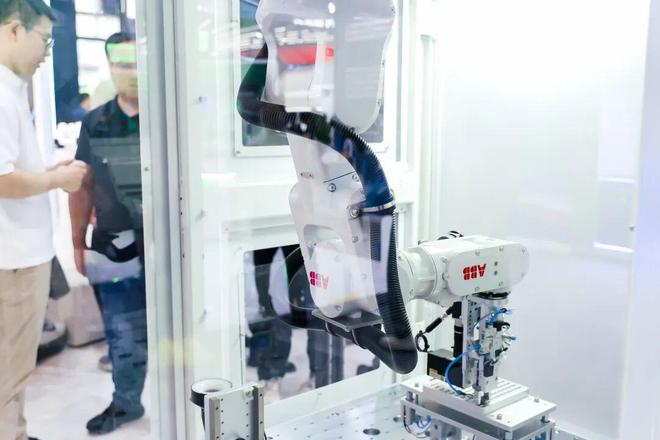
ABB and NVIDIA Improve Sim-to-Real Robot Deployment Efficiency
According to ABB Robotics, the cooperation between ABB and NVIDIA focuses on solving the long-standing challenge of transferring AI models from simulation environments into real production lines, commonly known as the “Sim-to-Real” gap.
ABB Robotics Global President Marc Segura explained that in projects involving ABB and NVIDIA technologies, including applications deployed at Foxconn facilities, robot positioning accuracy has been improved to within 0.1 mm. Through multi-modal data alignment in virtual environments, simulation accuracy has reached approximately 99%, significantly improving the efficiency of moving AI models from digital environments to real industrial applications.
By using digital training environments, manufacturers can simulate different production conditions, including lighting variations, material defects, and complex operating scenarios. After deployment to real production lines, robots require only limited calibration to perform advanced assembly tasks, helping reduce commissioning time and operational costs.
RobotStudio and NVIDIA Omniverse Enable High-Accuracy Digital Simulation
The latest progress follows the strategic cooperation announced between ABB Robotics and NVIDIA earlier in 2026. The two companies are integrating ABB RobotStudio software programming and simulation solutions with NVIDIA Omniverse technologies to create high-precision physical simulations for industrial robotics.
The combination is designed to help manufacturers build realistic digital environments where robot movements, production processes, and visual systems can be tested before physical deployment.
This technology provides manufacturers with improved production planning capabilities, reduced engineering risks, and faster automation implementation.
ABB Demonstrates Physical AI Applications at WAIC 2026
At WAIC 2026, ABB Robotics presented two demonstration workstations based on Physical AI technology.
The first system, a Sim2Real digital twin closed-loop workstation, creates a highly realistic virtual replica of products, robots, vision systems, and workstation operations. The digital twin allows engineers to validate and optimize robotic processes in a simulated environment before applying them to actual production lines.
The second demonstration, an AI-guided clip assembly workstation, uses large volumes of synthetic image data generated from digital twins to train AI vision models. After training, the vision system integrates with robot motion control, allowing robots to accurately complete complex assembly operations in real manufacturing conditions with minimal adjustment.
Physical AI Accelerates the Future of Intelligent Manufacturing
ABB emphasized that China has become one of the world's largest robotics markets and a major center for Physical AI deployment and ecosystem development.
Han Chen, Senior Vice President of ABB Group and President of ABB Robotics China, stated that ABB is responding to customer demands for higher precision, greater flexibility, and simplified deployment. The company is also working with ecosystem partners to accelerate Physical AI research and industrial applications, helping manufacturers benefit from advanced automation technologies developed and validated in real production environments.
The development of Physical AI represents a significant shift in industrial automation. By combining artificial intelligence, robotics, simulation technology, and real-time manufacturing data, ABB aims to help factories achieve smarter, more flexible, and more efficient production systems.
Industry Impact
The introduction of Physical AI solutions is expected to influence multiple industrial sectors, including automotive manufacturing, electronics assembly, semiconductor production, and precision engineering.
For industrial automation users, technologies such as AI vision, digital twins, and intelligent robot programming may reduce engineering complexity while improving production consistency and scalability.
As manufacturers continue moving toward smart factories, ABB’s collaboration with NVIDIA demonstrates the growing importance of AI-powered robotics in the future of industrial automation.