Emerson Launches DeltaV Automation Platform for AI-Scale Data Centers as Industrial Control Moves In
Time:2026-08-14 Browse: 18
Published: August 2026
Emerson Expands Industrial Automation Into AI-Scale Data Centers
Emerson has introduced a new DeltaV Automation Platform for AI-scale data centers, highlighting a major shift in the role of industrial automation as artificial intelligence continues to drive rapid expansion in computing infrastructure.
Announced on August 3, 2026, the new platform is designed to provide unified monitoring and control of critical data center infrastructure, bringing thermal, mechanical, electrical and power systems together within a scalable automation architecture. Emerson says the platform is intended to address the increasing complexity and compressed project schedules associated with large AI-focused data center developments.
The announcement is significant for the industrial automation industry because it demonstrates how technologies traditionally associated with process plants are increasingly being applied outside conventional manufacturing environments. PLCs, DCS platforms, industrial networking, process control strategies and real-time monitoring are becoming important components of the infrastructure supporting high-density computing.
For automation engineers, system integrators and industrial equipment suppliers, this development represents a broader expansion of the addressable market for PLC and DCS technologies.
Why AI Data Centers Need Industrial Automation
Modern AI data centers are fundamentally different from traditional office-oriented data centers.
Artificial intelligence workloads require large amounts of computing power, which creates substantial electrical demand and heat generation. As GPU and accelerator densities increase, cooling systems become more dynamic and more difficult to manage. Power distribution, cooling equipment, pumps, chillers, fans and other mechanical systems must respond continuously to changing loads.
A failure in one subsystem can affect the performance or availability of the entire facility.
This creates a control challenge that is familiar to engineers working in process automation. Industrial plants have long depended on coordinated control of multiple systems, continuous monitoring, alarm management, redundancy and deterministic control. The same principles can now be applied to large-scale digital infrastructure.
Emerson's new approach brings PLC and DCS technologies together to provide a unified automation layer for data center infrastructure. The company's platform combines DeltaV DCS capabilities with DeltaV PLCs, allowing localized equipment control to work within a broader centralized control architecture.
This architecture can be particularly relevant for cooling and power management, where rapid changes in computing demand can create corresponding changes in thermal and electrical loads.
PLC and DCS Integration Becomes More Important
One of the most interesting aspects of Emerson's announcement is the emphasis on combining PLC and DCS technologies rather than treating them as competing architectures.
PLCs remain highly effective for fast, localized control. They can manage equipment such as pumps, fans, electrical systems and packaged mechanical equipment. DCS platforms, meanwhile, are well suited to centralized coordination, operator supervision, alarm management and system-wide process control.
In a large AI data center, both approaches can be useful.
A PLC may execute local control logic for a cooling skid, electrical subsystem or mechanical package, while the DCS provides a higher-level operational view and coordinates multiple systems.
Emerson states that its DeltaV PLCs can integrate with the DeltaV DCS to provide a unified automation environment. The platform also supports industrial communication technologies including BACnet, EtherNet/IP and PROFINET, allowing equipment-level systems to communicate with the wider control architecture.
For system integrators, this approach can reduce the need to build multiple isolated control environments.
Instead of maintaining separate control databases and independent operator interfaces for different facility subsystems, engineers can work toward a more centralized architecture.
Cooling Control Is Becoming a Critical Automation Application
Cooling is one of the most important areas where industrial automation can influence AI data center performance.
Traditional data center cooling strategies often depend on relatively predictable loads. AI computing environments can introduce much greater variability. Workloads can increase or decrease rapidly, resulting in changing heat loads across racks and rooms.
Cooling equipment therefore needs to respond accurately.
Overcooling wastes energy and water, while insufficient cooling can create thermal problems and potentially affect computing equipment. This makes precise control increasingly important.
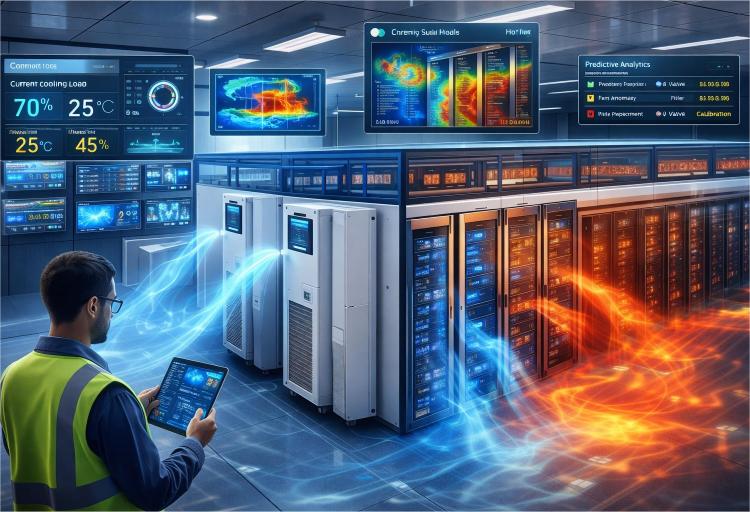
Emerson's DeltaV data center architecture is designed to coordinate equipment such as chillers, cooling towers, pumps, fans and air-handling systems. The company describes the system as capable of providing equipment-level and facility-wide control while responding to changing thermal requirements.
From an automation perspective, this is an important development.
It moves data center cooling away from being viewed purely as a building-management problem and toward a more sophisticated industrial control problem involving sensors, controllers, control loops, alarms, redundancy and optimization.
Automation Architecture Must Scale With Data Center Expansion
Another challenge is project speed.
AI infrastructure is being deployed at a scale that puts pressure on engineering, construction and commissioning teams. Large facilities may contain thousands of monitoring and control points across electrical, mechanical and thermal systems.
Emerson says its new platform is designed to help accelerate project delivery by separating hardware and software activities and standardizing equipment-level and facility-wide control.
Standardization is especially important for organizations building multiple data centers.
Once a validated control architecture has been developed, engineers can potentially reuse control strategies, templates, graphics, alarm structures and configuration practices across multiple facilities.
This is similar to how industrial manufacturers standardize PLC programs and DCS engineering libraries across multiple plants.
The result can be a more repeatable engineering process and potentially lower commissioning risk.
Industrial AI Is Moving From Analytics Toward Control
The new Emerson platform also reflects a larger change taking place throughout the automation industry.
Industrial AI is no longer limited to dashboards and predictive analytics.
Automation companies are increasingly working toward systems where AI can support engineering, optimization, maintenance and eventually more autonomous operation.
Emerson describes AI-enabled capabilities within its DeltaV Automation Platform as a way to provide actionable insights and support the development of autonomous operations.
The important point is that AI does not replace the underlying control system.
Instead, AI can operate above established control architectures, using real-time operational data to identify patterns, recommend actions or optimize system performance.
For PLC and DCS engineers, this suggests that future automation projects will increasingly require knowledge of both traditional control engineering and data-driven technologies.
What This Means for PLC and DCS Suppliers
The expansion of industrial automation into AI data centers creates new opportunities for PLC, DCS, HMI, SCADA, industrial networking and instrumentation suppliers.
Data centers require many of the same technologies found in industrial plants:
PLC controllers
DCS platforms
Remote I/O
Industrial Ethernet
Sensors and transmitters
HMI systems
SCADA software
Power monitoring
Temperature monitoring
Control valves
Variable frequency drives
Redundant control systems
Industrial cybersecurity solutions
This means companies traditionally serving manufacturing, oil and gas, chemical processing or power industries may increasingly find opportunities in data center automation.
For international automation suppliers and system integrators, understanding this market transition could become increasingly important.
Reliability Remains the Core Requirement
Despite the focus on AI, the fundamental requirement has not changed: industrial automation must remain reliable.
A data center cannot simply depend on experimental software to operate critical infrastructure.
Power and cooling systems require predictable behavior, redundancy, alarm handling and well-defined operating procedures.
This is one reason industrial-grade PLC and DCS technology is attractive for large-scale data center applications.
Emerson's existing DeltaV architecture includes redundant capabilities and long-standing experience in mission-critical industrial environments. Its data center offering builds on this industrial automation foundation while adapting it to the specific requirements of AI infrastructure.
The Broader Trend Toward Industrialized Data Center Control
Emerson's announcement is part of a larger movement in which data centers are becoming more like industrial facilities.
The growing importance of power management, thermal control, energy optimization and continuous operation means data center operators increasingly need sophisticated automation architectures.
At the same time, AI workloads are increasing pressure on infrastructure teams to improve efficiency without sacrificing reliability.
This creates a natural connection between industrial automation and digital infrastructure.
The future data center may therefore look less like a conventional building-management environment and more like a highly automated industrial facility, with PLCs controlling local equipment, DCS systems coordinating operations, sensors generating real-time data and AI systems assisting with optimization.
Conclusion
Emerson's August 2026 launch of the DeltaV Automation Platform for AI-scale data centers demonstrates how quickly industrial automation is expanding into new markets.
The combination of PLC and DCS control, centralized monitoring, real-time data, precise cooling control and AI-enabled optimization provides a model for managing increasingly complex digital infrastructure.
For the global PLC and DCS market, the development is worth watching closely.
As AI computing continues to expand, the demand for reliable power, cooling and infrastructure control will also increase. Industrial automation technologies that have been proven in factories and process plants may become an increasingly important part of the next generation of AI infrastructure.
For automation engineers, distributors and system integrators, the message is clear: the future of industrial automation is no longer limited to the factory floor.
It is increasingly connected to the infrastructure powering the digital economy.