Siemens Reports Record 2026 Industrial Performance as AI and Automation Demand Accelerate
Time:2026-08-14 Browse: 22
Published: August 2026
Siemens Records Strong Growth as Industrial AI Gains Momentum
Siemens has reported a record third quarter for fiscal 2026, highlighting the continuing strength of industrial automation, digitalization and artificial intelligence investment.
In results released on August 6, 2026, Siemens reported third-quarter orders of €27.9 billion, a comparable increase of 14 percent. Revenue increased 8 percent on a comparable basis to €20.8 billion, while profit from the Industrial Business rose 25 percent to approximately €3.5 billion. The company also raised its outlook.
The results provide an important indication of the direction of the global automation market.
Industrial AI, smart infrastructure, semiconductor production, data center investment and advanced manufacturing are increasingly influencing demand for automation technologies.
For companies involved in PLCs, industrial controllers, HMI, SCADA, motion control, industrial networking and digital manufacturing, Siemens' latest performance is another indication that automation is becoming increasingly connected to broader digital infrastructure investment.
AI Is Becoming a Major Driver of Industrial Automation
Artificial intelligence has quickly moved from an experimental technology to an important investment area for industrial companies.
Factories are generating enormous volumes of operational data from PLCs, sensors, robots, drives, vision systems and production equipment.
Historically, this data was mainly used for monitoring and troubleshooting.
The current generation of industrial AI systems aims to use the same data for optimization, prediction, engineering assistance and autonomous decision support.
Siemens has been investing heavily in this direction.
Earlier in 2026, Siemens and NVIDIA announced an expanded partnership focused on building an Industrial AI Operating System designed to apply AI across the industrial lifecycle, including design, engineering, manufacturing, operations and supply chains. Siemens also announced Digital Twin Composer and additional industrial copilots.
This strategy helps explain why industrial AI is becoming closely associated with automation rather than being treated as a separate software category.
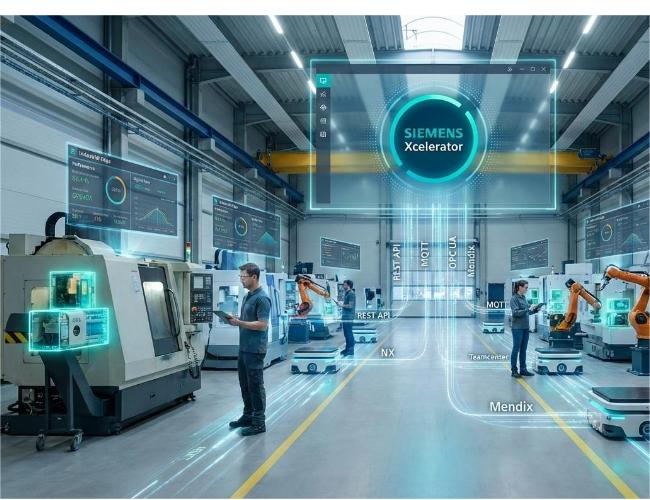
From PLC Data to Industrial Intelligence
At the center of any modern automated factory is still the controller.
Whether the system uses Siemens SIMATIC PLCs, distributed controllers, motion controllers or other industrial control platforms, controllers remain responsible for executing deterministic control logic.
The difference is that the controller is no longer isolated.
Industrial networks connect PLCs with HMIs, SCADA platforms, edge computers, MES systems, historians and cloud or enterprise applications.
This creates a continuous data chain from the physical process to higher-level software.
AI can then operate on this contextualized information.
For example, a machine controller can provide information about cycle time, motor load, temperature, pressure and operating status. An industrial AI system can analyze this information over time and identify patterns that may indicate abnormal behavior.
The result is not a replacement for PLC control.
Instead, AI becomes another layer within the automation architecture.
This distinction is important for industrial customers because safety, deterministic control and reliability remain essential requirements.
Siemens Is Moving Toward Software-Defined Automation
One of the strongest trends in industrial automation in 2026 is the transition toward software-defined systems.
Traditional automation architectures are often closely tied to specific hardware.
Software-defined automation attempts to separate some automation functions from fixed hardware dependencies, allowing systems to become more flexible, scalable and easier to update.
Siemens has been positioning industrial AI, digital twins, edge computing and software-defined automation as components of a more flexible industrial architecture.
At AUTOMATE 2026, Siemens highlighted the convergence of Industrial AI, digital twins, software-defined automation and the industrial metaverse as technologies supporting more adaptive manufacturing.
For PLC engineers, this does not mean that hardware controllers will disappear.
Instead, the role of hardware and software is becoming more clearly separated.
Real-time control still requires dependable controllers and I/O infrastructure, while higher-level intelligence can increasingly run on industrial edge systems, servers or other computing platforms.
Digital Twins Are Becoming More Practical
Digital twins are another important part of Siemens' strategy.
A digital twin is essentially a digital representation of a physical product, machine, process or facility.
When connected to real operational data, the digital twin can be used to simulate behavior, test modifications and evaluate possible improvements before changes are made to the physical system.
Siemens announced Digital Twin Composer in 2026 as part of its broader Industrial AI strategy. The company has also described how AI and digital twins can work together to simulate improvements and support manufacturing decisions.
For automation engineers, this could significantly influence future commissioning workflows.
Instead of testing every control change directly on a production machine, engineers may increasingly test logic, machine behavior and process changes within virtual environments first.
This could help reduce commissioning time and identify certain problems before they reach the production floor.
AI Is Also Changing Engineering Work
Another major change is the use of AI in engineering itself.
Traditionally, creating a PLC program or automation project requires engineers to manually configure hardware, create tags, build logic, define interfaces and generate documentation.
AI-assisted engineering tools are beginning to automate parts of this workflow.
Siemens has introduced AI engineering capabilities designed to assist with industrial engineering tasks, including generating PLC tags and creating project structures from machine descriptions.
This could eventually change how automation engineers spend their time.
Instead of manually creating every repetitive configuration element, engineers may increasingly focus on architecture, validation, safety, process understanding and final commissioning.
Human engineering knowledge will remain important because AI-generated automation logic still needs to be reviewed and validated against the real process.
Industrial Edge Connects AI With the Factory Floor
Another important element is edge computing.
Industrial Edge technology allows applications to run closer to machines rather than sending every piece of data to a remote cloud environment.
Siemens expanded its Industrial Edge ecosystem in 2026 with broader AI integration, enhanced cybersecurity capabilities and additional industrial applications. The company said its Industrial AI Suite became generally available and that the platform was designed to support AI lifecycle management and IT/OT integration.
This is particularly relevant for factories where latency, network reliability and data governance matter.
An edge system can collect information from PLCs and industrial devices, process the data locally and provide results to operators or higher-level systems.
This architecture can reduce unnecessary data movement while enabling advanced analytics closer to the production process.
AI Infrastructure Is Also Increasing Automation Demand
Siemens' latest results also demonstrate how industrial automation is benefiting from the rapid growth of AI infrastructure.
The company has reported strong demand related to data centers, semiconductor manufacturing and electrification.
This creates a feedback loop.
AI requires more data centers and semiconductor capacity.
Those facilities require more power infrastructure, electrical equipment and automation.
Manufacturing more advanced electronics also requires highly automated production environments.
Automation companies therefore benefit from multiple parts of the AI value chain.
This helps explain why industrial automation is increasingly connected with markets that previously appeared separate from traditional manufacturing.
What This Means for PLC Suppliers
For PLC suppliers and distributors, the changing market creates several opportunities.
Customers increasingly want controllers that can communicate with modern industrial networks and integrate with edge, SCADA and enterprise systems.
Important considerations include:
High-speed industrial communication
OPC UA and modern data interfaces
Industrial Ethernet
Edge connectivity
Cybersecurity
Remote diagnostics
Redundant architectures
High-performance motion control
AI-ready data collection
Integration with MES and SCADA
The PLC itself remains essential, but the surrounding ecosystem is becoming increasingly important.
A controller that simply executes logic is no longer enough for many advanced applications.
Customers want automation systems that can produce useful data and make that data available to other parts of the organization.
What This Means for DCS and Process Automation
The same trend applies to DCS systems.
Modern process plants are increasingly looking for ways to combine traditional process control with advanced analytics, AI and enterprise-level information.
DCS platforms continue to provide the deterministic control, alarm management and operator interaction required for complex processes.
At the same time, software layers can provide advanced optimization, predictive maintenance and data analysis.
This creates a more layered architecture in which the DCS remains the operational foundation while AI and analytics provide additional intelligence.
The Future of Industrial Automation Is More Connected
Siemens' latest results should therefore be viewed as more than a financial announcement.
They reflect a broader transformation taking place across the automation industry.
PLC, DCS, SCADA, industrial networking, robotics, digital twins, edge computing and AI are increasingly becoming parts of the same technology ecosystem.
The factory of the future will not rely on one technology.
Instead, it will depend on the interaction between reliable control hardware and increasingly intelligent software.
The challenge for automation companies will be to make this technology useful without making industrial systems unnecessarily complicated.
Conclusion
Siemens' record third-quarter performance in fiscal 2026 provides another strong indication that industrial automation remains a critical technology investment area.
AI is becoming one of the most important forces shaping the industry, but the fundamental role of automation controllers has not disappeared.
Instead, PLCs and DCS systems are becoming connected to larger digital ecosystems involving edge computing, digital twins, industrial AI and enterprise software.
For international automation suppliers, system integrators and industrial customers, this transition creates both opportunities and challenges.
The next generation of automation will not simply be about controlling machines.
It will be about connecting machines, understanding operational data and using intelligent software to improve how industrial systems are designed, operated and maintained.