Honeywell Introduces Experion Cognition to Advance AI-Powered Autonomous Industrial Operations
Time:2026-08-16 Browse: 20
Published: August 2026
Artificial intelligence is rapidly changing the industrial automation industry, and control systems are becoming one of the most important areas where AI can deliver practical value. In June 2026, Honeywell introduced Experion Cognition, an AI-enabled control system platform designed to support more autonomous industrial operations.
The new technology represents another step in the evolution of Distributed Control Systems (DCS). Instead of limiting AI to data analysis or separate software applications, Honeywell is integrating AI capabilities more directly into the industrial control environment.
For process industries such as oil and gas, chemicals, refining, petrochemicals and energy, this development could have a significant impact on how operators interact with DCS platforms and manage complex production processes.
Honeywell Moves AI Closer to the DCS Control Environment
Traditional DCS platforms are designed to monitor processes, execute control strategies, manage alarms and provide operators with a real-time view of plant conditions.
The operator remains a critical part of the decision-making process.
When an abnormal process condition occurs, the control system generates alarms and provides information. Operators then analyze the available data and determine what action should be taken.
As industrial plants become more complex, however, the amount of information available to operators continues to increase.
Large process facilities can generate thousands of signals from sensors, controllers, valves, motors, pumps, compressors and other equipment.
This creates a challenge.
Operators need to identify the most important information quickly while avoiding unnecessary alarms and data overload.
Honeywell's Experion Cognition approach is designed to use AI to help analyze this information and support faster operational decisions.
The technology is intended to make recommendations and automated decisions that can help optimize production and improve safety.
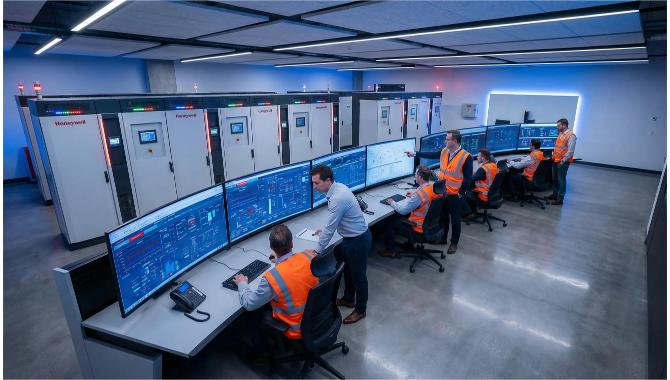
From Operator Assistance to Autonomous Operations
The development of AI-powered control technology reflects a broader transition in industrial automation.
For many years, automation focused primarily on replacing manual control actions.
PLC systems automated machine sequences.
SCADA systems provided monitoring and supervisory control.
DCS platforms automated complex process control.
The next stage is increasingly focused on making these systems more intelligent.
AI can analyze large amounts of operational data and identify relationships that may not be immediately obvious to a human operator.
This creates the possibility of a control environment in which the system can recommend actions before an issue develops into a major process disturbance.
The ultimate objective is not necessarily to remove operators.
Instead, AI can help operators understand plant conditions faster and make better-informed decisions.
This distinction is particularly important in critical process industries where human oversight remains essential.
Experion Cognition Demonstrated at an Industrial Facility
Honeywell demonstrated Experion Cognition through a live proof of concept at Borouge International's facility in Ruwais, Abu Dhabi.
Borouge operates a major petrochemical manufacturing complex, making the facility a relevant environment for testing advanced process automation technologies.
A petrochemical plant contains highly interconnected processes.
Changes in temperature, pressure, flow or composition can influence multiple parts of the production system.
An automation platform therefore needs to consider more than individual process variables.
It must understand the relationships between different parts of the plant.
This is where AI-based operational support can potentially provide additional value.
Instead of looking at thousands of signals independently, an AI-enabled system can analyze process conditions in context and help identify potential causes, consequences and corrective actions.
Why AI Is Important for Modern DCS Systems
The role of a DCS is expanding.
Historically, the primary purpose of a DCS was to provide reliable process control.
Modern industrial organizations now expect much more from their automation infrastructure.
They want real-time operational data.
They want predictive maintenance.
They want energy optimization.
They want improved production efficiency.
They also want better cybersecurity and stronger integration with enterprise systems.
Artificial intelligence can connect many of these requirements.
However, AI cannot operate effectively without access to high-quality industrial data.
This is why the integration of AI with DCS platforms is important.
A DCS already has access to process measurements, equipment status, alarms, historical information and control actions.
This makes the DCS a valuable source of operational context for industrial AI.
AI Can Help Operators Handle Complex Alarm Environments
Alarm management is one area where AI could become particularly valuable.
Large process plants can generate significant numbers of alarms during abnormal operating conditions.
When several alarms occur at the same time, operators need to determine which events are primary causes and which are secondary consequences.
An AI-enabled control system could help analyze the sequence of events and provide operators with more meaningful information.
Instead of treating every alarm as an independent event, the system can potentially identify relationships between alarms.
This could help operators focus on the most important process conditions.
Better alarm management can also reduce unnecessary operator workload.
The objective is not simply to reduce the number of alarms.
The larger goal is to improve the quality of information presented to operators.
Process Optimization Is Another Major Application
AI-powered DCS technology can also support process optimization.
Industrial plants continuously balance multiple objectives.
They need to maintain product quality while controlling energy consumption, equipment performance, production rates and environmental requirements.
These variables are often interconnected.
Increasing production may increase energy consumption.
Reducing operating temperatures may save energy but affect product quality.
Changing process conditions may improve one part of the plant while creating additional constraints elsewhere.
AI can help analyze these relationships.
An intelligent control platform may identify operating conditions that provide a better overall balance.
This can support continuous optimization rather than relying only on predefined control strategies.
AI Does Not Replace Traditional Control Logic
An important point for automation engineers is that AI-enabled control does not eliminate conventional control technology.
PLC and DCS control logic remains fundamental.
Deterministic control is still required for critical process functions.
The difference is that AI can operate at a higher level of decision support and optimization.
A conventional DCS may execute a control loop according to predefined parameters.
An AI-enabled system can potentially analyze long-term process behavior and recommend adjustments to improve performance.
This creates a layered automation architecture.
The traditional control layer maintains reliable process operation.
The AI layer provides additional intelligence.
Operators remain responsible for supervising the system and validating important decisions.
Implications for Process Automation Engineers
The introduction of AI into DCS environments is likely to change the role of process automation engineers.
Engineers will continue to need expertise in instrumentation, control loops, PLCs, DCS systems, industrial networking and process engineering.
However, they may increasingly need knowledge of industrial data and AI technologies.
Understanding how operational data is structured will become more important.
Engineers may also need to understand how AI recommendations interact with existing control strategies.
This means the future process automation engineer may work across multiple technical layers.
The engineer may configure the DCS, analyze process data, evaluate AI recommendations and verify that automation changes remain consistent with plant requirements.
Industrial AI Requires High-Quality Data
One of the biggest challenges facing industrial AI is data quality.
AI models are only as useful as the information available to them.
Industrial facilities may contain decades of historical data, but that data is not always clean or consistently structured.
Sensors can fail.
Tags can change.
Historical systems may use different naming conventions.
Different production units may also collect information in different formats.
Before AI can deliver reliable operational recommendations, industrial organizations need to establish a strong data foundation.
This is another reason why modern DCS platforms are important.
The control system provides a structured operational environment where real-time data can be collected and contextualized.
Cybersecurity Becomes Even More Important
As AI becomes integrated with industrial control systems, cybersecurity will become increasingly important.
A conventional DCS already requires strong protection because it controls physical processes.
Adding AI and additional connectivity creates new communication paths and potentially new attack surfaces.
Industrial organizations therefore need to maintain clear separation between critical control functions and external applications.
Access control, network segmentation, authentication and secure data exchange remain essential.
AI should enhance industrial operations without compromising the reliability of the control environment.
This will be one of the major engineering challenges as autonomous operations become more common.
The Impact on Legacy DCS Systems
AI adoption also raises an important question for existing plants.
Many industrial facilities operate mature DCS platforms that were installed years or even decades ago.
Replacing these systems entirely can be expensive and disruptive.
A more practical strategy may be to modernize the digital layer while preserving core control infrastructure.
This could include adding data collection, analytics, visualization and AI applications around an existing DCS.
Such an approach allows industrial companies to introduce new technology gradually.
For automation suppliers and system integrators, DCS modernization therefore remains a significant opportunity.
Customers may need new controllers, I/O modules, communication equipment, engineering services and software to create a modern automation architecture.
What Honeywell's Development Means for Industrial Automation
Honeywell's Experion Cognition development illustrates a broader trend across the automation industry.
DCS technology is evolving from a control-centric platform toward an intelligent operational environment.
The future DCS will increasingly combine process control with data analytics, AI-assisted decision-making and autonomous operation capabilities.
This does not mean traditional control systems are becoming obsolete.
Instead, the value of the control system is expanding.
The DCS becomes the foundation on which advanced digital capabilities can operate.
For industrial users, this can provide a pathway toward smarter production without abandoning proven automation technologies.
The Future of AI-Powered Process Control
The long-term direction of industrial automation is moving toward greater autonomy.
Factories and process plants will increasingly use AI to identify abnormal conditions, optimize production and support operators.
However, industrial autonomy will develop differently from consumer AI.
Safety, reliability, cybersecurity and deterministic control remain fundamental requirements.
AI therefore needs to work alongside traditional automation rather than simply replace it.
Honeywell's Experion Cognition development provides an example of how this transition is taking place.
The technology brings AI closer to the DCS environment and demonstrates how future control systems may combine traditional process automation with intelligent decision support.
For PLC engineers, DCS specialists, system integrators and industrial automation suppliers, this trend is worth following closely.
The next generation of industrial control systems will not only control processes.
They will increasingly understand them.