Industrial Automation Upgrade: TX131 Gateway Connects Beckhoff EtherCAT and Rockwell DeviceNet Contr
Time:2026-08-21 Browse: 19
August 21, 2026 | Industrial Automation | Food & Beverage Packaging
The food and beverage industry is placing increasing demands on automation systems as manufacturers pursue higher production speeds, tighter process control, and more comprehensive traceability. At the same time, many packaging plants operate equipment from different generations and vendors, creating communication barriers between motion-control networks and process-monitoring systems.
A recent automated beverage packaging application demonstrates how an industrial protocol gateway can help connect a Beckhoff EtherCAT control system with a Rockwell Automation DeviceNet network, creating a communication path between high-speed machine control and field-level inspection data.
The application involves an integrated production line covering aseptic beverage filling, sterilization, labeling, and carton packaging.
Application Background: Automated Beverage Packaging
The production line operates in a demanding food-processing environment. Equipment is exposed to frequent high-temperature water cleaning and sanitation, while high humidity and condensation create additional requirements for electrical cabinets and automation equipment.
The production area also requires appropriate corrosion protection and drainage. Food-grade manufacturing practices place additional emphasis on keeping the production environment free from unnecessary oil contamination, dust, and other potential sources of contamination.
These environmental conditions make reliable industrial communication and equipment monitoring especially important.
The line integrates multiple automation functions, including:
High-speed beverage filling
Servo-driven filling mechanisms
Conveyor chain control
Automatic capping
Sterilization temperature control
Bottle and cap inspection
Liquid-level monitoring
Pressure and temperature measurement
Clean-room differential-pressure monitoring
Leak detection
Labeling and carton packaging
Rather than using a single automation protocol throughout the entire plant, the system contains separate industrial networks for motion control and field-level inspection.
Beckhoff EtherCAT Controls the High-Speed Motion Layer
The main machine-control system uses a Beckhoff CX5100 Embedded PC as the EtherCAT master.
EtherCAT is widely used for high-speed motion control because of its deterministic communication characteristics and ability to coordinate distributed devices with low communication latency.
In this application, the EtherCAT network manages equipment such as filling servos, conveyor systems, capping mechanisms, and other machine-control devices.
The motion-control layer is responsible for maintaining synchronized machine operation while supporting precise filling and high-speed packaging processes.
For beverage filling equipment, accurate motion control is particularly important because production speed and filling consistency must be maintained simultaneously.
Rockwell DeviceNet Handles Field-Level Monitoring
A separate DeviceNet network is used for field-level detection and monitoring.
Sensors and inspection equipment in the production line monitor parameters such as:
Filling liquid level
Sterilization temperature
Sterilization pressure
Clean-area differential pressure
Bottle-cap leakage
Equipment status and alarm signals
The DeviceNet network is managed through a Rockwell Automation 1769-L33ERM CompactLogix PLC with a 1769-DNB DeviceNet scanner module.
This architecture allows the Rockwell controller to collect field-level information independently from the EtherCAT motion-control system.
However, the separation between the two networks also creates a communication challenge.
The Challenge: Two Independent Industrial Networks
The EtherCAT and DeviceNet networks serve different purposes and use different communication architectures.
The Beckhoff control system cannot directly exchange application data with DeviceNet field devices simply by connecting the two networks together.
As a result, important process information collected by the DeviceNet system may remain isolated from the high-speed machine-control layer.
For example, if a liquid-level sensor detects an abnormal condition, the EtherCAT-based filling system may need to receive that information before taking an appropriate production action.
Similarly, an abnormal sterilization temperature or pressure condition may need to be communicated to the main machine-control system so that the production sequence can respond accordingly.
Without an appropriate communication bridge, engineers may have to rely on additional PLC programming, hardwired I/O, or customized communication interfaces.
This can increase wiring complexity and make future maintenance more difficult.
TX131 Gateway Provides a Communication Bridge
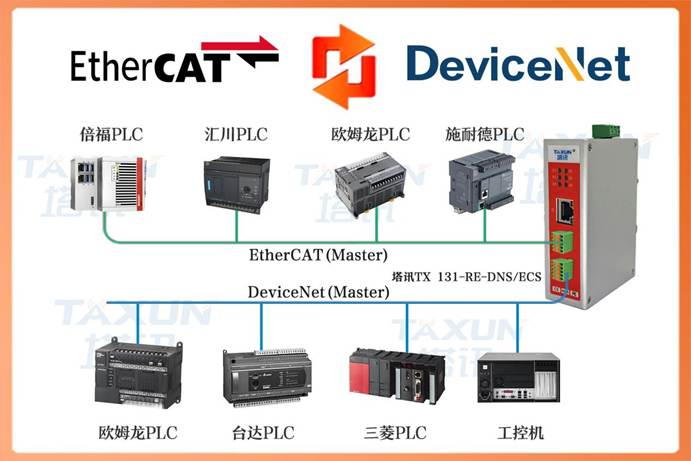
The application uses the TX131-RE-DNS/ECS industrial gateway as a protocol conversion interface between the EtherCAT and DeviceNet networks.
The gateway acts as an intermediary between the two communication domains, allowing selected process data to be exchanged between the motion-control layer and the field-monitoring layer.
A simplified architecture is:
Beckhoff CX5100 Embedded PC
↓ EtherCAT
TX131-RE-DNS/ECS Industrial Gateway
↓ DeviceNet
Rockwell CompactLogix 1769-L33ERM + 1769-DNB
↓ DeviceNet
Sensors / Inspection Devices / Field Equipment
This structure creates a defined communication boundary between the two industrial networks.
Instead of replacing the existing controllers or rebuilding the entire communication architecture, the gateway can provide an integration point for the data that needs to cross between the systems.
Supporting Food Production Traceability
Connecting previously isolated networks also creates opportunities for broader production-data integration.
Field-level information collected through DeviceNet can be made available to higher-level automation or industrial IoT systems through the gateway architecture.
For a food and beverage manufacturer, production traceability may involve recording information such as:
Filling conditions
Sterilization temperature and pressure
Production timestamps
Equipment alarms
Inspection results
Product rejection events
Sensor status
Machine operating conditions
When these data points are associated with production batches, manufacturers can obtain a more complete picture of the production process.
This can support quality analysis, equipment troubleshooting, production reporting, and food-safety traceability.
Why Protocol Gateways Matter in Brownfield Automation
Replacing an entire automation system is not always practical.
Existing machinery may still have significant service life, while changing PLCs, sensors, drives, and communication networks can require extensive engineering and downtime.
A protocol gateway provides another option: retain the existing automation equipment while adding a communication layer between incompatible networks.
For food and beverage packaging applications, this approach can be particularly useful when:
Motion control and inspection systems use different protocols.
Existing Rockwell DeviceNet equipment remains in operation.
New machine control is based on Beckhoff EtherCAT.
Manufacturers want to minimize rewiring.
Production data needs to cross network boundaries.
Existing equipment needs to be integrated into a modern industrial IoT architecture.
Engineering Considerations for EtherCAT and DeviceNet Integration
Before implementing a gateway, engineers should define the required data exchange in detail.
Important considerations include:
EtherCAT master and slave configuration
DeviceNet scanner and node configuration
Input and output data sizes
Data mapping between the two protocols
Boolean, integer, and floating-point data formats
Update rates required by the application
Communication diagnostics
Network fault handling
PLC programming requirements
Environmental requirements for the installation location
Not every process signal needs to be transferred between networks.
Critical high-speed motion data should normally remain within the dedicated motion-control architecture, while status, inspection, process, and supervisory data can be exchanged through the gateway according to the control strategy.
This separation helps maintain a clear automation architecture while avoiding unnecessary traffic between networks.
Conclusion
The integration of Beckhoff EtherCAT and Rockwell DeviceNet demonstrates a common challenge in modern industrial automation: different automation platforms often need to work together without forcing manufacturers to replace existing equipment.
In this beverage packaging application, the TX131-RE-DNS/ECS industrial gateway provides a communication bridge between the EtherCAT motion-control layer and the DeviceNet field-monitoring network.
By enabling selected process and equipment data to cross the protocol boundary, the architecture can help connect filling, sterilization, inspection, and packaging functions within a more integrated automation system.
For brownfield food and beverage plants, protocol gateways can therefore serve as a practical tool for gradual automation modernization, helping manufacturers connect heterogeneous equipment, improve data visibility, and build a foundation for more connected and traceable production.