Rockwell Automation Reports Strong 2026 Growth as Demand for Industrial Automation and Software Acce
Time:2026-09-03 Browse: 28
The industrial automation market continues to show strong demand in 2026, with manufacturers investing in automation hardware, software, industrial networking, data systems, and technologies designed to improve production efficiency. A recent financial update from Rockwell Automation provides another indication of this trend, with the company reporting strong third-quarter fiscal 2026 results and continued growth across important parts of its automation business.
Rockwell Automation reported fiscal third-quarter 2026 sales of approximately $2.313 billion, representing an 8% increase compared with the same quarter of the previous fiscal year. Organic sales increased 10%. The company also reported particularly strong performance in its Intelligent Devices and Software & Control businesses.
For the global PLC and industrial automation market, the results are significant because Rockwell Automation is one of the world's major suppliers of industrial control technology. Its portfolio covers programmable automation controllers, I/O systems, industrial networking, drives, motion control, safety systems, software, and services.
The company's results provide insight into where industrial customers are currently spending money and which areas of automation are experiencing stronger demand.
Semiconductor and Data Center Automation Support Growth
One of the most notable points in Rockwell Automation's latest results is the strength of demand from semiconductor, data center, and warehouse automation applications.
These industries have become increasingly important to industrial automation suppliers.
Semiconductor manufacturing requires highly controlled production environments, sophisticated equipment, precise motion systems, and extensive monitoring.
Data center construction is also creating demand for automation in areas such as power management, cooling systems, material handling, and facility infrastructure.
Warehouse automation is expanding as companies seek faster material movement, improved inventory control, and more efficient fulfillment operations.
Rockwell Automation specifically identified continued strength in semiconductor, data center, and warehouse automation as factors supporting its third-quarter performance.
This trend demonstrates how the automation market is expanding beyond traditional manufacturing.
Industrial automation is increasingly connected with digital infrastructure.
Intelligent Devices Remain a Core Automation Segment
Rockwell's Intelligent Devices segment generated approximately $1.1 billion in third-quarter fiscal 2026 sales, an increase of 12% compared with the previous year. Organic sales increased 10%.
Intelligent Devices represents an important part of modern automation because physical equipment remains essential to industrial production.
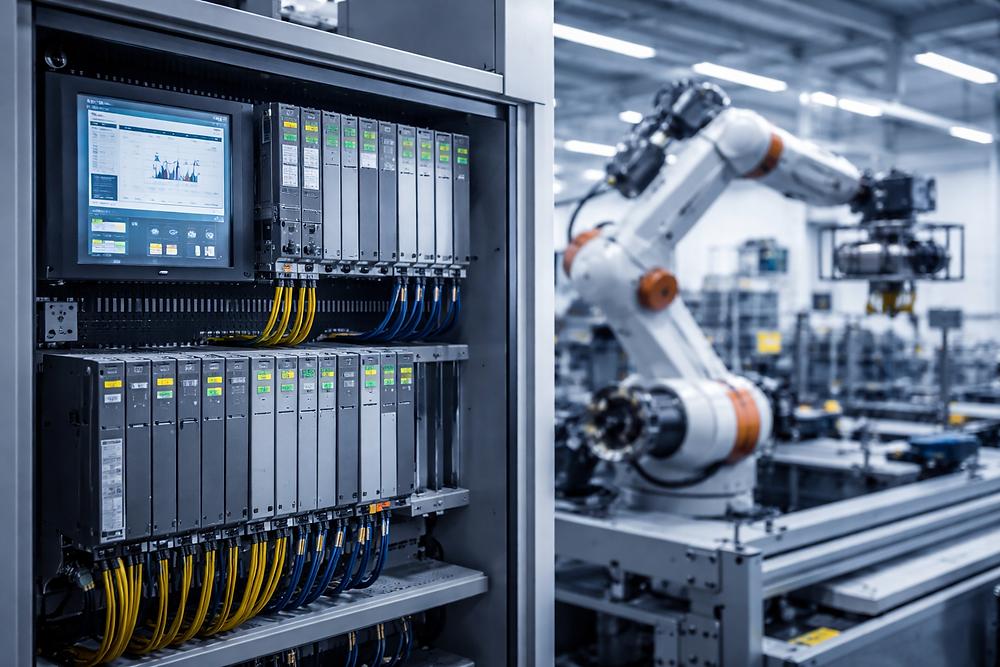
Controllers, sensors, drives, safety equipment, motion products, and other intelligent devices form the foundation of a connected factory.
Although industrial AI receives significant attention, AI cannot operate effectively without reliable physical data.
Sensors need to measure production conditions.
Controllers need to execute machine logic.
Drives need to control motors.
I/O systems need to connect field devices.
Industrial networks need to move data.
This means the growth of AI and digital manufacturing does not eliminate the importance of traditional automation hardware.
Instead, it can increase the value of connected industrial devices.
Software and Control Shows Even Stronger Growth
One of the most significant figures in Rockwell Automation's latest results came from its Software & Control segment.
The segment reported third-quarter fiscal 2026 sales of approximately $751 million, representing a 19% increase year over year. Organic sales increased 18%.
This is important because it illustrates the increasing role of software in industrial automation.
For many years, automation projects were primarily associated with hardware.
Customers purchased PLCs, I/O modules, drives, industrial switches, HMIs, and other equipment.
Today, software has become a much larger part of the automation value chain.
Manufacturers increasingly require engineering software, asset management, analytics, production monitoring, simulation, cybersecurity, data integration, and lifecycle tools.
The growth of software therefore reflects a broader transformation of industrial automation.
From PLC Hardware to Connected Automation Platforms
The traditional PLC remains one of the most important components of factory automation.
However, a PLC rarely operates alone.
A modern manufacturing cell may include a controller, remote I/O, safety controller, HMI, variable frequency drives, servo systems, industrial Ethernet, machine vision, robots, and manufacturing software.
These systems need to communicate.
The PLC may exchange data with an HMI.
The HMI may communicate with a SCADA system.
Production information may move into MES software.
Operational information may then be analyzed by higher-level applications.
This creates a connected automation architecture.
The value of the controller is therefore increasingly linked to its ability to participate in the wider industrial ecosystem.
This is one reason software and control businesses are becoming increasingly important to major automation suppliers.
Industrial AI Is Changing Customer Expectations
Artificial intelligence is another factor influencing the industrial automation market.
Manufacturers are interested in AI because they want to reduce downtime, improve quality, optimize energy consumption, increase production efficiency, and support workers.
But AI needs industrial data.
That means factories need connected equipment.
A PLC that previously existed mainly to control a machine can now become a source of valuable operational information.
For example, controller data can help reveal:
Machine cycle times.
Motor operating conditions.
Production rates.
Alarm patterns.
Temperature changes.
Equipment utilization.
Energy consumption.
Process deviations.
When this information is collected consistently, analytics and AI systems can use it to identify patterns.
The industrial automation market is therefore developing toward a model in which control and data are increasingly connected.
Why Semiconductor Manufacturing Is Important
Semiconductor manufacturing is particularly attractive for automation suppliers because production processes are complex and require high levels of precision.
Manufacturing equipment must operate consistently.
Environmental conditions need to be controlled.
Production processes need extensive monitoring.
Equipment downtime can be extremely expensive.
This creates strong incentives to invest in automation and advanced control systems.
The semiconductor industry's expansion is also connected with broader demand for artificial intelligence infrastructure.
AI applications require computing hardware, and the production of advanced chips requires sophisticated manufacturing equipment.
This creates a connection between two major technology trends.
AI is increasing demand for semiconductor capacity, while semiconductor manufacturing is increasing demand for automation.
For industrial automation companies, this can create a powerful long-term market opportunity.
Data Center Automation Is Becoming an Industrial Automation Opportunity
Data centers may not look like conventional factories, but they increasingly require sophisticated automation.
Large data centers contain cooling systems, electrical distribution equipment, backup power systems, monitoring devices, pumps, fans, and other infrastructure.
These systems must operate reliably around the clock.
Automation technologies can help monitor equipment conditions and manage facility operations.
As data center construction expands due to cloud computing and AI workloads, demand for automated facility systems can also increase.
This represents a broader definition of industrial automation.
Automation is no longer limited to manufacturing machines.
It can also be applied to complex infrastructure where reliability, monitoring, energy efficiency, and real-time control are essential.
The Importance of Brownfield Automation
Despite strong investment in new facilities, a large part of the industrial automation market remains focused on existing plants.
Manufacturers have thousands of installed PLCs, DCS systems, I/O modules, HMIs, drives, and communication systems.
These systems cannot all be replaced at once.
Brownfield modernization therefore remains a major opportunity.
Companies may upgrade individual controllers while retaining existing field devices.
They may replace obsolete HMIs.
They may add industrial Ethernet connectivity.
They may introduce new data collection systems.
They may migrate legacy control systems gradually.
They may also purchase replacement PLC and DCS modules to keep existing production lines operating.
This creates a continuing demand for automation components throughout the lifecycle of industrial equipment.
Lifecycle Services Remain Important
Rockwell Automation's third-quarter results also demonstrate that hardware and software growth does not eliminate the importance of lifecycle services.
Industrial equipment requires maintenance, troubleshooting, spare parts, upgrades, commissioning, and technical support.
Manufacturers cannot simply purchase a PLC and forget about it.
Automation equipment may remain in operation for many years.
During that time, customers may need replacement components, engineering services, firmware updates, system modifications, and migration support.
For global manufacturers, spare parts availability can be particularly important.
A production line may depend on a specific controller, communication module, I/O card, or interface that has been installed for years.
If the component fails, obtaining a compatible replacement quickly can help reduce downtime.
This is one reason the industrial automation aftermarket remains important even as new digital technologies emerge.
What Rockwell's Results Mean for the PLC Market
Rockwell Automation's latest financial results suggest that industrial automation demand remains resilient in several high-value sectors.
The growth of Intelligent Devices indicates continued demand for physical automation equipment.
The stronger performance of Software & Control highlights the growing importance of software and connected automation.
The strength of semiconductor, data center, and warehouse automation shows that automation demand is expanding across multiple industries.
For PLC suppliers and buyers, the message is clear.
The market is not simply moving from PLCs to AI.
Instead, PLCs are becoming part of larger automation architectures that include software, data, networking, analytics, robotics, and AI.
This creates a more complex but also more valuable industrial technology ecosystem.
The Future of Allen-Bradley and Industrial Control Systems
Allen-Bradley products remain widely associated with Rockwell Automation's industrial control portfolio.
In many factories, Allen-Bradley PLCs and control systems are integrated into production lines that may have been operating for years.
The next phase of industrial automation will therefore involve both new installations and modernization of existing systems.
New factories can adopt modern architectures from the beginning.
Existing factories need migration strategies that protect production continuity.
This creates opportunities for automation integrators, component suppliers, maintenance companies, and industrial equipment specialists.
The ability to support both current-generation automation systems and legacy installations can become an important competitive advantage.
Industrial Automation Is Moving Toward Autonomy
The broader direction of the market is increasingly clear.
Industrial automation is moving from simple machine control toward connected and increasingly intelligent operations.
PLC technology remains essential for deterministic control.
DCS technology remains critical for complex process industries.
Industrial networking connects equipment.
Software organizes production information.
Analytics turns data into operational insight.
AI can assist with optimization and decision-making.
Robotics provides flexible physical automation.
Cybersecurity protects the increasingly connected environment.
These technologies are not competing replacements.
They are becoming interconnected layers of a larger industrial system.
Rockwell Automation's 2026 third-quarter performance provides a real-world example of this transition. Strong growth in Intelligent Devices and Software & Control demonstrates that manufacturers continue to invest in both physical automation equipment and digital capabilities.
For manufacturers, the future of automation will likely depend on how effectively these technologies can work together.
For PLC and DCS users, this means that controller selection should increasingly be considered as part of a complete automation strategy rather than as an isolated hardware decision.
For the industrial automation supply chain, it means opportunities will continue to exist across hardware, software, integration, modernization, spare parts, maintenance, cybersecurity, and digital transformation.
As factories become more connected and intelligent, the PLC will remain an important foundation of industrial control—but its role will increasingly extend beyond simply executing logic. It will become one of the key data and control points within a much broader industrial automation ecosystem.