Schneider LTMR27MFM Motor Controller Troubleshooting Guide
Time:2026-09-04 Browse: 18
Schneider LTMR27MFM troubleshooting should begin with the actual motor behavior and measured data rather than with controller replacement. The LTMR27MFM monitors motor current and provides protection against conditions such as overload, phase failure, phase imbalance, locked rotor, earth leakage, and thermal overload. It also records diagnostic and motor-history information that can help identify the cause of a trip.
LTMR27MFM Motor Controller Fault Symptoms
A useful Fault Diagnosis starts by defining exactly what has failed.
An LTMR27MFM installation may present as:
The motor trips during startup.
The motor runs but repeatedly generates overload alarms.
The PLC reports the motor as offline.
The controller shows a phase-related fault.
The motor unexpectedly stops during normal operation.
The controller appears powered but does not respond correctly.
The protection trips after several minutes rather than immediately.
These symptoms point toward different diagnostic paths.
The most important first question is:
Does the fault occur before starting, during acceleration, or after the motor has reached normal operating speed?
That timing often narrows the investigation faster than simply looking at the fault label.
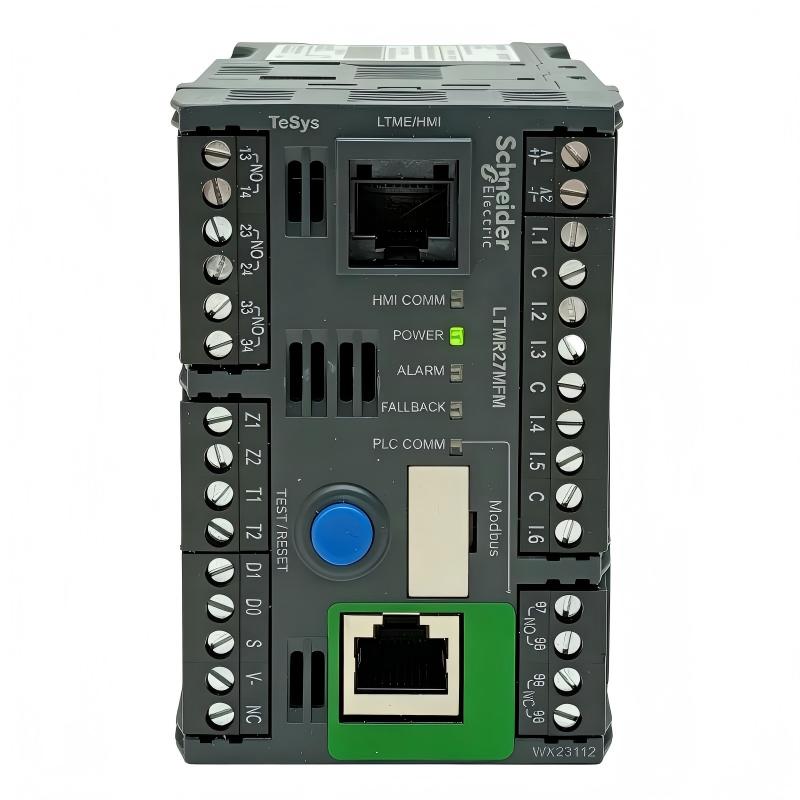
Schneider LTMR27MFM Overload Fault Diagnosis
An overload trip should not automatically be treated as an incorrect controller setting.
Start by checking the actual motor current.
The LTMR27MFM supports a measurement range of 1.35–27 A, so the measured operating current should be compared with the motor's nameplate full-load current and the expected mechanical load.
Suppose a motor normally operates around 10 A but begins drawing 15–17 A after a process change.
The controller may be correctly identifying a real increase in load.
Possible causes include:
Pump blockage.
Conveyor overload.
Bearing deterioration.
Mechanical friction.
Incorrect process conditions.
Excessive starting frequency.
Before changing the protection setting, investigate why the current increased.
A protection device that trips more frequently after a mechanical change may be providing useful information rather than malfunctioning.
LTMR27MFM Phase Imbalance Fault Troubleshooting
A phase imbalance fault requires comparison between the individual phase currents.
If the three measured currents are approximately equal under stable operation, a severe current imbalance is less likely.
If the readings show a persistent difference, inspect the power circuit and motor.
Check terminal tightness.
Check contactor contacts.
Check motor cable connections.
Check the motor winding condition.
Check incoming supply balance.
Check whether the load itself is producing abnormal motor behavior.
The controller includes phase-unbalance protection, so the Fault Diagnosis should determine whether the imbalance exists electrically before changing the protection threshold.
For example, if the motor current is 9.8 A, 10.1 A, and 15.2 A across the three phases, that pattern deserves investigation rather than a simple parameter reset.
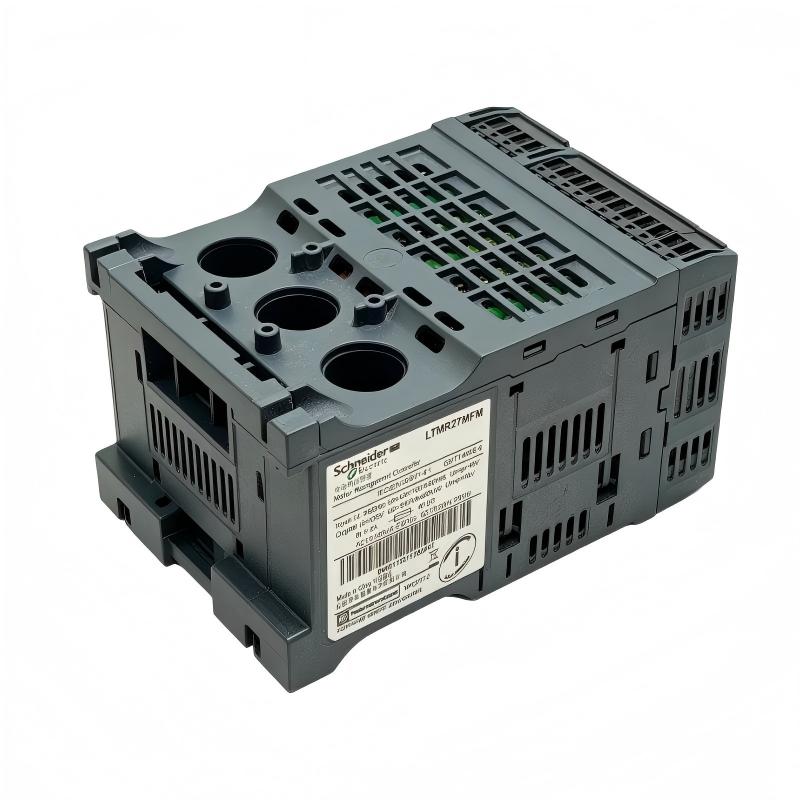
Schneider LTMR27MFM Phase Failure Fault
A phase failure can create a rapid change in motor current and temperature.
If the motor stops shortly after starting and the LTMR27MFM records a phase-related trip, inspect the complete motor power path.
Do not limit the inspection to the controller terminals.
Check the incoming supply, contactor, motor cable, terminals, and motor connections.
A loose terminal can behave differently under load than when checked with the machine de-energized. This is why visual inspection alone is not always enough.
If the controller records a phase fault only when the motor starts, compare the event with the motor starting current and contactor operation.
The LTMR27MFM is designed to provide phase-fault and earth-fault trip information, making its recorded event history useful during this investigation.
LTMR27MFM Modbus Communication Fault Diagnosis
A communication fault is one of the most common situations where technicians replace working hardware unnecessarily.
The LTMR27MFM communicates using Modbus over two-wire RS-485. The supported addressing range is 1–247, while communication speeds range from 1.2 to 19.2 kbit/s.
If the motor operates correctly but the PLC cannot read the controller, separate the problem into four areas:
Controller configuration.
PLC Modbus configuration.
RS-485 wiring.
Network topology.
Check the slave address first.
Then compare baud rate and parity.
Then inspect RS-485 polarity and cable connections.
Finally check whether another device is using the same address.
A useful field observation is whether communication fails immediately after power-up or disappears intermittently during operation.
Immediate failure often points toward configuration or wiring.
Intermittent failure deserves closer attention to cable routing, loose terminals, shielding, electrical interference, or duplicate addressing.
Schneider LTMR27MFM Locked Rotor Fault
A locked rotor condition should be treated as a potentially mechanical problem.
If the motor starts and immediately develops high current without reaching normal speed, inspect the driven machine before changing protection parameters.
Possible causes include a seized pump, blocked conveyor, jammed gearbox, or mechanical obstruction.
The LTMR27MFM includes locked-rotor protection as part of its motor protection functions.
A useful diagnostic comparison is starting time.
If a machine historically reaches normal speed in approximately 1.5 seconds but now remains in the starting condition for several seconds, the change itself is evidence.
The controller's motor history can help here because it records last-start current ratio and last-start duration.
This allows maintenance personnel to compare a current event against previous operating behavior instead of relying only on operator descriptions.
LTMR27MFM Earth Leakage Fault Diagnosis
Earth leakage requires a different diagnostic approach from overload.
If the LTMR27MFM reports an earth-related trip, inspect the motor cable, motor insulation, junction boxes, and connected equipment.
Moisture can create intermittent insulation problems, particularly in outdoor equipment, pumps, and washdown environments.
The important observation is whether the fault occurs immediately when the motor is energized or only after the machine has operated for some time.
An immediate fault can suggest an existing insulation or wiring problem.
A delayed fault may require inspection after the equipment reaches its normal operating temperature or after vibration causes a damaged cable to move.
The LTMR27MFM provides earth-leakage protection and trip information that can support this type of diagnosis.
Schneider LTMR27MFM Unexpected Motor Stop
When a motor stops unexpectedly, avoid resetting the controller repeatedly before recording the event.
The TeSys T system provides fault recording, trip history, event information, running-hours data, and other diagnostic functions.
Record:
The active fault.
Motor current before the trip.
Motor starting history.
Operating time.
Number of previous trips.
Whether the PLC issued a stop command.
Whether the fault occurred under high load.
This information helps distinguish a genuine protection trip from a control-system command.
For example, if the LTMR27MFM records no protective trip while the PLC sequence simultaneously changes the motor command from RUN to STOP, the motor controller may not be the root cause.
LTMR27MFM Controller Powers Up but Motor Will Not Run
A powered controller does not necessarily mean that the motor-control sequence is ready.
Check the control logic and output status.
Then verify the contactor or actuator controlled by the LTMR27MFM.
Next check whether a protection condition is preventing operation.
The controller can be controlled through its terminal strip, HMI, or communication port, so the control path must be identified before testing.
A useful Fault Diagnosis method is to compare the command source with the controller's recorded motor-control command.
If the PLC requests RUN but the controller never receives the expected command, investigate communication or control logic.
If the controller receives RUN but blocks operation because of a protection condition, investigate the protection event.
This avoids confusing a control problem with a hardware failure.
Real Field Case: LTMR27MFM Communication Failure
In one representative field troubleshooting case, the motor continued operating normally, but the PLC displayed a communication-loss alarm for the motor feeder.
The controller's local status remained normal.
The first diagnostic step was therefore not to replace the LTMR27MFM.
The Modbus configuration was compared between the controller and PLC. The baud rate matched, but the slave address did not.
After the correct address was entered, communication returned immediately.
The useful lesson is that an intelligent motor controller can remain completely functional at the motor level while appearing defective to the PLC.
For LTMR27MFM Troubleshooting, always separate motor operation, controller operation, and network communication into independent diagnostic layers.
Schneider LTMR27MFM Thermal Fault Troubleshooting
Thermal protection faults should be evaluated against operating history.
The LTMR27MFM can record operating time, starting frequency, controller temperature information, and motor starting data.
If a motor trips after ten minutes of heavy operation but runs normally for a short test, investigate actual thermal loading.
Possible causes include:
Excessive motor load.
Repeated starts.
Insufficient cooling.
High ambient temperature.
Mechanical friction.
Incorrect motor protection parameters.
A useful comparison is to run the machine under its normal process load and compare the time-to-trip with previous records.
If the trip time changes from 30 minutes to 8 minutes after a mechanical modification, that trend is more informative than simply resetting the thermal protection.
LTMR27MFM Fault Diagnosis Using Motor History
One of the strongest features for Troubleshooting is the controller's historical information.
The TeSys T documentation identifies motor start count, starts per hour, load-shedding count, last-start current ratio, last-start duration, operating time, and maximum internal controller temperature among the available motor-history information.
This allows maintenance teams to ask better questions.
Has the motor been starting more frequently?
Has starting time increased?
Has operating current changed?
Has the controller temperature increased?
Has the number of protection trips increased?
These trends can reveal developing mechanical or process problems before a complete motor failure occurs.
Schneider LTMR27MFM Repair Decision
Repair or replacement should be considered only after external causes have been eliminated.
A practical repair decision should confirm:
The control supply is correct.
Motor current measurement is credible.
Power connections are secure.
Protection settings are appropriate.
The motor and driven equipment are mechanically healthy.
Modbus communication parameters are correct.
RS-485 wiring is intact.
Control commands reach the controller.
The recorded fault is repeatable.
If the same internal fault remains after these checks, the LTMR27MFM itself becomes a stronger suspect.
The Schneider Electric product page currently identifies LTMR27MFM as approaching discontinuation, with end of commercialization scheduled for September 30, 2026 and end-of-service information listed separately. This makes accurate Fault Diagnosis particularly important when deciding whether to repair an existing unit, keep a tested spare, or plan a replacement architecture.
LTMR27MFM Troubleshooting Long-Tail Keywords
Useful search phrases include Schneider LTMR27MFM Troubleshooting, LTMR27MFM Fault Diagnosis, LTMR27MFM Modbus communication fault, LTMR27MFM overload trip, LTMR27MFM phase failure, LTMR27MFM phase imbalance fault, LTMR27MFM earth leakage fault, LTMR27MFM motor controller repair, Schneider TeSys T Troubleshooting, LTMR27MFM motor protection fault, and LTMR27MFM communication troubleshooting.
Final LTMR27MFM Fault Diagnosis Approach
The most reliable way to troubleshoot an LTMR27MFM is to work from evidence.
Start with the recorded fault.
Check when it occurred.
Review motor current and operating history.
Separate electrical faults from mechanical faults.
Separate local motor-control problems from Modbus communication problems.
Only after those areas have been checked should the controller itself be considered defective.
The LTMR27MFM is designed to provide considerably more diagnostic information than a conventional motor starter. Using its measured current, protection functions, fault records, and motor history can turn a vague “motor stopped” complaint into a much more specific engineering diagnosis.