Siemens Pushes Industrial AI Further With AI Agent for PLC and Automation Engineering
Time:2026-09-07 Browse: 28
Industrial automation is entering a new phase as artificial intelligence moves from a supporting technology to an active engineering tool. In 2026, Siemens has taken a major step in this direction with the expansion of its Eigen Engineering Agent, an AI system designed specifically for industrial automation engineering.
Unlike conventional AI assistants that mainly generate text, answer questions, or provide coding suggestions, the new approach is designed to perform practical engineering tasks within an automation environment. The technology is closely connected with Siemens engineering tools and is intended to support tasks such as PLC programming, HMI visualization, device configuration, and engineering project generation.
The development is significant for manufacturers, system integrators, machine builders, and automation engineers because engineering time has become an increasingly important factor in modern manufacturing projects.
AI Moves From Assistance to Automation Engineering
For many years, industrial AI focused mainly on data analysis, predictive maintenance, quality inspection, and production optimization. These applications normally operate around the automation system rather than directly inside the engineering workflow.
The latest development is different.
An AI engineering agent can work with the actual structure of an automation project. Instead of simply explaining how a PLC function could be programmed, the system can use project information and engineering context to help generate usable automation logic.
Siemens introduced its Eigen Engineering Agent in 2026 as a purpose-built AI solution for industrial automation engineering. The technology is designed to plan, execute, and validate engineering tasks rather than simply provide suggestions.
This distinction is important.
A general-purpose AI model may generate a PLC code example, but an industrial automation project requires much more than a piece of code. Engineers must consider hardware configuration, I/O relationships, device parameters, communication networks, naming conventions, safety requirements, existing program structures, and company-specific engineering standards.
Industrial AI therefore needs to understand the environment in which the engineering work is performed.
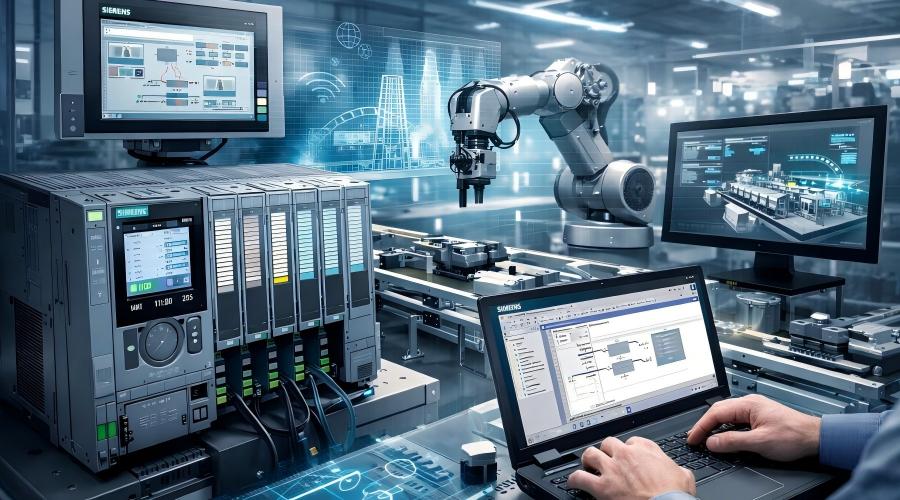
Direct Connection With TIA Portal
One of the most important elements of Siemens' approach is the connection between the AI agent and the TIA Portal engineering environment.
TIA Portal is widely used for Siemens automation systems, including SIMATIC PLCs, HMIs, drives, and industrial networking components. By working with the engineering environment, the AI agent can access project-specific information instead of producing completely generic answers.
This can be particularly valuable in complex automation projects.
For example, an engineer working on a production line may need to create PLC logic for multiple motors, sensors, valves, drives, and communication devices. Traditionally, engineers need to review the electrical design, identify the hardware configuration, create tags, develop program blocks, configure devices, test the logic, and then make corrections.
An AI-assisted engineering workflow can potentially reduce the amount of repetitive work involved in these steps.
The goal is not simply to replace the engineer. Instead, the technology is intended to allow engineers to spend less time on repetitive programming and configuration and more time on system architecture, process optimization, troubleshooting, and final validation.
PLC Programming Becomes a Key AI Application
PLC programming is one of the areas where industrial AI could have a particularly strong impact.
Modern PLC applications can contain thousands of variables, hundreds of program blocks, and complex relationships between machines and process equipment. As factories become more automated, engineering projects are becoming larger while project schedules are becoming shorter.
AI-assisted PLC engineering could help automate repetitive activities such as generating standard logic structures, configuring devices, creating HMI elements, and adapting existing engineering patterns to new projects.
For machine builders, this could be especially useful when similar machines are produced for multiple customers.
Instead of developing every project completely from the beginning, an AI system can work with established templates and engineering standards. The engineer can then review and modify the generated result according to the actual production requirements.
This approach could improve engineering consistency while reducing the time required for routine programming.
Industrial AI Must Understand Engineering Context
The biggest challenge for AI in industrial automation is not generating code. It is generating the correct code for the correct machine.
A PLC program cannot be evaluated only by whether the syntax is valid. It must also behave correctly when connected to real sensors, motors, actuators, drives, valves, and safety systems.
For this reason, industrial AI requires access to structured engineering information.
Electrical schematics, hardware configurations, device relationships, PLC tags, network structures, and engineering standards all provide important context. Siemens has also expanded the capabilities of its Eigen Engineering Agent to work with electrical engineering information and generate automation data based on electrical topology.
This represents an important direction for the industry.
The future of automation engineering may increasingly involve a continuous connection between electrical design, automation software, simulation, commissioning, and production data.
Impact on System Integrators and Machine Builders
The development of AI-assisted engineering could have a major impact on system integrators.
System integrators often work on multiple automation projects simultaneously. Each project can require PLC programming, HMI development, drive configuration, industrial networking, testing, documentation, and commissioning.
Engineering resources are therefore a major factor in project capacity.
If AI can reduce repetitive engineering work, system integrators may be able to handle more projects without increasing engineering teams at the same rate.
Machine builders could also benefit from faster customization.
Many machine manufacturers build equipment based on standardized mechanical and electrical platforms. However, every customer may require different I/O configurations, communication systems, process sequences, or HMI screens.
AI-assisted engineering could help adapt standard automation architectures to individual customer requirements more efficiently.
What This Means for PLC Engineers
The development of industrial AI does not necessarily mean that PLC engineers will become unnecessary.
Instead, the skills required by automation engineers may gradually change.
Traditional PLC programming knowledge will remain important because engineers still need to understand machine behavior, control logic, industrial networking, sensors, drives, safety systems, and commissioning.
However, engineers may increasingly need to understand how to work with AI engineering tools.
The role could move from manually creating every line of code toward reviewing, validating, optimizing, and integrating AI-generated engineering results.
This could make system-level knowledge even more valuable.
An engineer who understands PLCs, electrical systems, process control, industrial communication, and machine operation will be better positioned to evaluate whether an AI-generated solution is actually suitable for a real production environment.
From PLC Automation to Software-Defined Automation
The development also reflects a broader transformation in industrial automation.
Automation systems are gradually moving toward more software-defined architectures. Instead of treating controllers, engineering software, data platforms, and industrial networks as completely separate technologies, manufacturers are increasingly connecting them into integrated digital environments.
Industrial AI can become another layer in this architecture.
AI can analyze engineering information, generate automation logic, support commissioning, monitor system behavior, and eventually assist with optimization during operation.
This creates a potential connection between engineering and production that was difficult to achieve with traditional automation tools.
A New Stage for Industrial Automation
The introduction and expansion of AI engineering agents represents a significant development for the PLC industry.
The most important change is not simply that AI can write code. The larger transformation is that AI is becoming capable of interacting with real engineering environments and industrial project data.
For manufacturers, the potential benefits include shorter engineering cycles, improved consistency, faster machine development, and better utilization of engineering resources.
For automation engineers, the technology could reduce repetitive tasks while increasing the importance of system architecture, validation, troubleshooting, and process knowledge.
The transition will not happen overnight. Industrial automation requires high levels of reliability, safety, cybersecurity, and engineering validation. AI-generated results still need appropriate testing and human oversight before they are used in critical production systems.
Nevertheless, the direction is becoming increasingly clear.
Industrial AI is moving beyond the role of a digital assistant. It is becoming part of the engineering process itself.
As PLC, HMI, industrial networking, digital twins, and AI technologies continue to converge, automation engineering is likely to become more software-driven, more intelligent, and increasingly integrated across the entire industrial lifecycle.