Siemens Pushes Industrial AI Deeper Into Automation Engineering and PLC Development
Time:2026-09-08 Browse: 33
Siemens Advances Industrial AI for PLC Engineering and Automation Development in 2026
Artificial intelligence is moving from the experimental stage into practical industrial engineering, and Siemens is continuing to expand the role of AI in automation development.
In September 2026, Siemens highlighted a new phase of industrial AI adoption in which artificial intelligence is being integrated not only into factory analytics but also into engineering tools, operations software and automation development workflows.
For PLC programmers and automation engineers, this shift could be particularly significant.
Industrial AI is no longer limited to predictive maintenance dashboards or machine vision applications. AI is increasingly being used to assist engineers with PLC programming, project documentation, troubleshooting, configuration and other repetitive engineering activities.
This development could fundamentally change how automation projects are designed and maintained.
AI Moves Into the Engineering Environment
For many years, industrial AI discussions focused primarily on what happens after a machine or production line is running.
Manufacturers used machine learning to analyze production data, detect abnormal behavior and predict equipment failures.
The latest development is different.
AI is increasingly moving into the engineering environment itself.
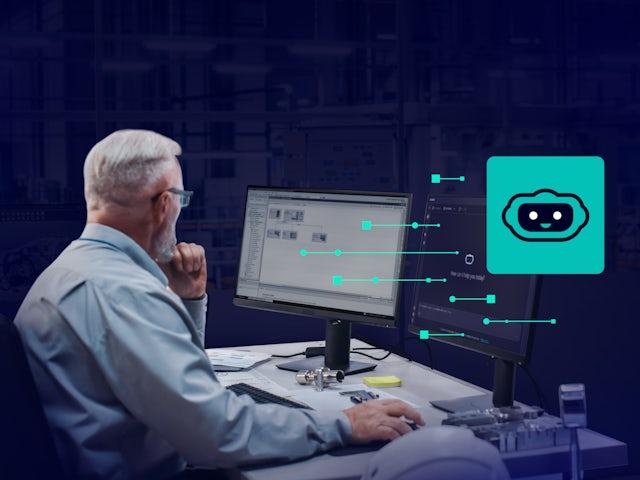
Siemens has been developing AI-assisted capabilities within its automation engineering ecosystem, including tools associated with TIA Portal. These capabilities are designed to help engineers work with PLC applications and industrial automation projects more efficiently.
Instead of treating AI as a separate software platform, the objective is to place AI assistance closer to the engineer's existing workflow.
This distinction matters.
An automation engineer does not necessarily want to export an entire PLC project into a separate AI application, manually explain the project structure and then transfer the results back into the engineering environment.
A much more useful approach is to provide AI assistance directly where engineering work already takes place.
AI-Assisted PLC Programming
PLC programming can involve a significant amount of repetitive work.
Engineers may need to create similar logic structures for multiple machines, write descriptive comments, generate tags, document sequences or troubleshoot existing code.
These tasks require engineering knowledge, but many of them also consume considerable time.
AI assistants can help automate portions of this work.
For example, an engineer may describe a required control function in natural language and use AI assistance to generate a starting point for PLC code. The engineer can then review, modify and validate the generated logic.
This is important because industrial AI is not replacing the engineering validation process.
A PLC program controlling a production machine cannot simply be accepted because an AI model generated it.
Engineers still need to verify the logic, understand the process, test abnormal conditions and ensure that safety requirements are satisfied.
AI is therefore better viewed as an engineering assistant rather than an autonomous replacement for a qualified control engineer.
From Code Generation to Engineering Documentation
One of the less visible but potentially valuable applications of AI is documentation.
Industrial automation projects generate a large amount of documentation.
Engineers may need to describe PLC logic, explain program functions, create equipment documentation, maintain change records and prepare information for maintenance personnel.
Documentation can become especially difficult when engineers inherit older automation systems.
A plant may contain PLC programs created years earlier by engineers who are no longer available. Comments may be incomplete, naming conventions may be inconsistent and documentation may not accurately describe the current machine behavior.
AI-assisted tools can help engineers analyze existing program structures and produce explanations.
This could reduce the amount of time required to understand legacy automation projects.
For industrial companies operating equipment for decades, that capability could become increasingly important.
AI and the Skills Shortage in Industrial Automation
The expansion of AI-assisted engineering is also closely related to a broader workforce challenge.
Industrial automation systems are becoming more complex at the same time that experienced automation engineers are becoming increasingly difficult to recruit.
Many experienced control engineers have decades of practical knowledge, but younger engineers entering the industry may need years to develop the same level of experience.
AI tools can potentially shorten the learning curve by providing contextual explanations.
A junior engineer working with a PLC project could ask an AI assistant to explain a section of logic, identify possible configuration issues or describe the relationship between hardware components.
This does not replace mentorship or field experience, but it can provide another layer of support.
Industrial AI Requires Industrial Context
One of the biggest differences between industrial AI and general-purpose AI is context.
A general AI system may understand programming concepts, but an industrial automation system must also understand the relationship between hardware, control logic, sensors, actuators and physical processes.
For example, a PLC program controlling a conveyor system is not simply a collection of software instructions.
The logic is connected to sensors, motors, safety devices, timing requirements and physical movement.
An AI assistant therefore needs access to the right engineering context to provide useful results.
This is why integrating AI into established automation engineering platforms is becoming increasingly important.
The closer AI is connected to the actual engineering project, the more relevant its assistance can become.
AI Does Not Eliminate the Need for PLC Knowledge
The rise of AI-assisted PLC programming could create a misconception that traditional programming skills will become unnecessary.
The opposite may actually be true.
As AI generates more code, engineers may need stronger technical knowledge to evaluate whether that code is correct.
Understanding ladder logic, structured text, function blocks, PLC scan cycles, I/O behavior, industrial networking and machine sequences remains essential.
An engineer who does not understand PLC operation may not be able to recognize an incorrect AI-generated program.
Therefore, AI could change the role of the automation engineer rather than eliminate it.
The engineer may spend less time writing repetitive code and more time reviewing architecture, validating control strategies, solving complex problems and improving machine performance.
Siemens and the Broader Industrial AI Trend
Siemens is not approaching industrial AI as an isolated feature.
The company has been building a broader industrial AI strategy that covers engineering, manufacturing, operations and digital twins.
This reflects a wider industry movement.
Automation companies are increasingly looking at how AI can be integrated across the complete industrial lifecycle.
The long-term objective is not simply to add an AI chatbot to an engineering application.
Instead, industrial companies want AI to understand engineering data, machine behavior, production requirements and operational information.
That could eventually allow AI to assist with tasks ranging from project design and PLC development to production optimization and maintenance.
The Relationship Between PLC, DCS and AI
The same trend is also affecting DCS environments.
Process control systems generate enormous amounts of operational data. Temperature, pressure, flow, level, valve position, controller output and equipment status can all provide information for analytics.
AI can analyze these signals to identify patterns that may not be obvious through traditional monitoring.
For example, an AI model could potentially identify gradual changes in equipment performance before they result in a significant process problem.
However, the AI layer generally works alongside the control system rather than replacing the deterministic control layer.
The PLC or DCS remains responsible for predictable control behavior, while AI can provide additional analysis and recommendations.
This separation is likely to remain important in safety-critical industrial applications.
The Future of Automation Engineering
The development of AI-assisted engineering suggests that automation engineering is entering a new phase.
In the past, productivity improvements often came from better PLC hardware, faster processors, improved communication networks and more efficient programming environments.
The next productivity improvement may come from combining these technologies with AI.
An engineer may increasingly work with an automation platform in which hardware configuration, PLC programming, documentation and diagnostics are supported by intelligent software assistants.
This could make automation project development faster while allowing engineers to focus on higher-value technical decisions.
What Automation Companies Should Watch
For companies investing in PLC, DCS and industrial automation technology, the key issue is not whether AI will become part of automation.
That transition is already underway.
The more important question is how AI will be integrated without compromising reliability, cybersecurity and engineering accountability.
Automation systems must continue to operate safely even when connected to increasingly intelligent software.
For this reason, AI adoption in industrial automation will likely develop gradually, with engineers remaining responsible for validation and final control decisions.
The direction, however, is clear.
Industrial AI is moving closer to the engineering workstation, closer to the PLC project and closer to the control system itself.
For automation professionals, this means that future expertise may require a combination of traditional control engineering and modern AI capabilities.
The PLC engineer of the future may not simply write code.
They may design control architectures, supervise AI-generated engineering work, validate machine behavior and connect industrial data with intelligent applications.
That transition could become one of the most important developments in industrial automation throughout 2026 and beyond.