Rockwell Automation 2026 Report Shows Manufacturers Are Accelerating AI, Digital Transformation and
Time:2026-09-09 Browse: 21
September 2026 | Smart Manufacturing News
Manufacturing companies are moving beyond small-scale digital transformation projects and increasingly treating artificial intelligence, industrial automation and connected production systems as strategic business priorities.
The 2026 State of Smart Manufacturing findings from Rockwell Automation highlight this shift across global manufacturing markets. The research surveyed more than 1,500 manufacturers across 17 major manufacturing countries and examined how companies are approaching artificial intelligence, digital transformation, cybersecurity, manufacturing execution systems, workforce development and operational technology.
One of the most notable findings is the strong importance manufacturers place on digital transformation.
In Asia Pacific, 95% of manufacturers surveyed said digital transformation is essential to their competitiveness. The report also found that 71% of APAC organizations planned to increase their use of artificial intelligence and machine learning over the following 12 months.
These figures demonstrate that smart manufacturing is moving from an experimental concept toward a practical industrial requirement.
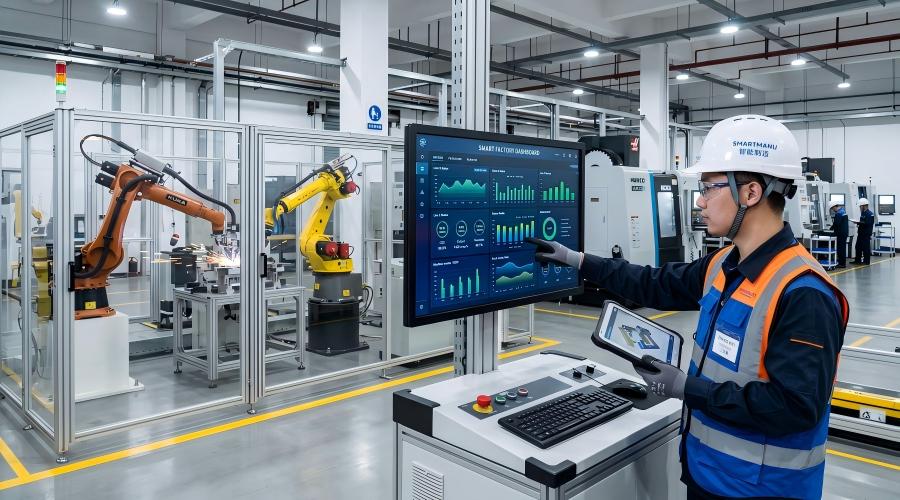
Manufacturing Is Moving From Automation to Intelligence
Industrial automation has traditionally focused on controlling machines and processes.
PLCs execute control logic.
Sensors measure physical conditions.
Drives control motors.
HMIs provide operator interfaces.
SCADA systems provide supervisory monitoring.
DCS platforms control complex continuous processes.
These technologies remain fundamental.
However, manufacturers increasingly want more information from the same automation infrastructure.
They want to know not only whether a machine is running, but why it is running differently from normal.
They want to identify potential equipment failures before production stops.
They want to understand energy consumption.
They want to improve product quality.
They want to optimize production schedules.
This is where artificial intelligence and advanced analytics are becoming increasingly important.
AI Is Becoming Part of the Factory Architecture
The growth of industrial AI does not mean that PLCs are becoming obsolete.
In fact, the opposite may be true.
AI applications require reliable operational data.
That data often originates from the factory floor.
Sensors generate measurements.
PLCs process machine-level information.
DCS systems manage continuous processes.
Industrial networks transport data.
SCADA and MES systems provide additional operational context.
AI applications then use this information to identify patterns and support decisions.
The quality of the AI system therefore depends heavily on the quality and availability of industrial data.
This makes automation infrastructure increasingly valuable.
A factory with reliable instrumentation, connected PLCs and structured operational data has a stronger foundation for industrial AI.
The 2026 Findings Show a Shift Toward Implementation
The latest research indicates that manufacturers are becoming more serious about implementation.
This is important because the industrial sector has spent many years discussing Industry 4.0.
Smart factories, Industrial Internet of Things, cloud manufacturing and digital twins have all been widely discussed.
However, the challenge has often been moving from demonstration projects to production-scale deployments.
The 2026 findings suggest that this transition is accelerating.
Manufacturers are increasingly looking at AI and digital technologies as tools for competitiveness rather than experimental technology.
That distinction matters.
A pilot project may only need to demonstrate that a technology works.
A production system needs to demonstrate measurable operational value.
The technology must integrate with existing automation.
It must be reliable.
It must be maintainable.
Operators must be able to use it.
Cybersecurity must be addressed.
The business case must also be clear.
Why MES Integration Remains a Challenge
One of the important findings in the Asia Pacific data is that only 22% of organizations have fully integrated manufacturing execution systems.
This illustrates a common problem in industrial digitalization.
Factories often have many independent systems.
The PLC may know what a machine is doing.
The SCADA system may know what is happening on the production line.
The MES may contain production information.
The ERP system may contain business data.
Maintenance software may contain equipment history.
Quality systems may contain inspection results.
The challenge is connecting these sources into a consistent information architecture.
Without effective integration, companies may have large amounts of data but limited ability to use it.
The Importance of Industrial Data
Industrial AI requires context.
A temperature reading by itself may not be particularly useful.
The system also needs to understand which machine produced the measurement, what operating mode the machine was in and what production condition existed at that time.
This is why industrial automation data is different from generic IT data.
Operational information is connected to physical processes.
For example, a pressure change may indicate normal operation during one production phase but abnormal behavior during another.
An AI model therefore needs access to operational context.
This increases the importance of structured automation architectures.
PLCs Remain the Foundation of Smart Manufacturing
As factories become smarter, PLC technology continues to provide the foundation for machine control.
PLCs are responsible for executing deterministic logic.
They interact with sensors, actuators, drives and other field devices.
They provide real-time responses to changing machine conditions.
This reliability is essential.
AI systems can recommend an optimization strategy, but the final machine response still needs to be executed safely and predictably.
In many architectures, AI will therefore sit above the PLC rather than replace it.
The PLC controls the machine.
The digital layer analyzes the machine.
The two systems work together.
This distinction is likely to remain important as industrial AI develops.
AI and Predictive Maintenance
Predictive maintenance is one of the clearest examples of how AI can work with automation.
Consider a production motor.
The PLC may already monitor current, speed and operating status.
Additional sensors may monitor vibration and temperature.
Historically, this data might have been displayed to an operator or stored for troubleshooting.
With advanced analytics, the same information can be analyzed continuously.
The system may identify a pattern suggesting bearing wear.
Maintenance teams can then inspect the motor before a failure occurs.
This can reduce unplanned downtime and improve maintenance planning.
The important point is that predictive maintenance does not require the PLC to become an AI computer.
The PLC remains responsible for machine control.
Analytics provide additional intelligence.
Quality Control Is Another Major Opportunity
Manufacturing quality is another area where AI can complement industrial automation.
Traditional quality control may depend on manual inspection or predefined control rules.
AI-based systems can analyze large amounts of production data and identify relationships that are difficult to detect manually.
Production speed, temperature, pressure, material conditions and machine parameters can all influence final product quality.
By connecting these data sources, manufacturers can gain a more complete understanding of production performance.
This can allow companies to move from reactive quality management toward predictive quality management.
Instead of discovering a problem after products have been produced, manufacturers can potentially identify conditions associated with quality problems earlier.
Cybersecurity Is Becoming a Parallel Priority
The increasing use of AI and connected systems also increases cybersecurity requirements.
Industrial networks are becoming more connected to enterprise systems and external applications.
Remote access is becoming more common.
Cloud platforms are increasingly involved in analytics.
These developments create operational benefits but also increase the potential attack surface.
Manufacturers therefore need to treat cybersecurity as part of smart manufacturing.
Protecting the PLC network is not enough if an unsecured workstation can provide access to the same environment.
Similarly, protecting the enterprise network does not automatically protect industrial controllers.
A modern cybersecurity strategy needs to consider the entire operational technology environment.
Workforce Skills Are Changing
Digital transformation is also changing the skills required inside factories.
Traditional automation engineers need to understand more than PLC programming.
They may increasingly need knowledge of industrial networking, cybersecurity, data structures and analytics.
Maintenance engineers may need to interpret machine data.
Operators may interact with advanced software systems.
IT teams need to understand industrial control requirements.
This convergence between IT and OT is becoming increasingly important.
However, manufacturers cannot simply assume that existing employees will automatically develop all of these skills.
Training and workforce development therefore become important parts of digital transformation.
Digital Transformation Does Not Mean Replacing Everything
Another important lesson from the current industrial environment is that manufacturers do not necessarily need to replace every legacy system.
Many factories have older PLCs, drives and control systems that continue to perform their basic functions reliably.
Replacing everything may be expensive and operationally disruptive.
A more practical strategy can involve incremental modernization.
For example, a company may retain existing machine control while adding modern data collection.
It can connect selected equipment to a new industrial network.
It can introduce edge computing.
It can add analytics software.
It can gradually modernize PLC hardware as equipment reaches the end of its lifecycle.
This approach allows manufacturers to capture digital value without requiring an immediate plant-wide replacement.
Why Interoperability Matters
As factories adopt more digital technologies, interoperability becomes critical.
A modern production line may include PLCs, robots, sensors, vision systems, drives, HMIs, MES software and cloud applications.
If these systems cannot communicate effectively, digital transformation becomes expensive.
Engineers may need to build custom interfaces.
Data may need to be manually transferred.
Different systems may use different naming conventions.
This creates engineering complexity.
Standardized industrial communication and open data architectures can therefore become major advantages.
The future smart factory will depend on information flowing between different layers of the production system.
The Growing Role of Edge Computing
Edge computing can also play an important role.
Not every industrial application needs to send all operational data to a remote cloud environment.
Some information needs to be processed close to the machine.
Edge systems can analyze data locally and provide faster responses.
This can be useful for predictive maintenance, machine monitoring and quality applications.
The combination of PLC control, edge computing and cloud analytics creates a layered architecture.
Real-time control remains local.
Higher-level analysis can take place at the edge.
Long-term data analysis can take place in cloud or enterprise systems.
This architecture can provide both responsiveness and scalability.
What the Report Means for Automation Suppliers
The increasing adoption of smart manufacturing creates opportunities throughout the industrial automation supply chain.
Demand can grow for PLCs, industrial PCs, remote I/O, sensors, drives, industrial Ethernet devices, HMIs and control software.
At the same time, customers increasingly require integration expertise.
They need suppliers who understand how different automation components work together.
This is particularly important for international buyers purchasing replacement or expansion equipment.
Compatibility remains critical.
A replacement module must work with the existing control architecture.
Communication protocols need to be supported.
Firmware versions need to be considered.
Engineering software may need to be compatible.
Lifecycle status also matters.
The Future of Smart Manufacturing
The 2026 findings suggest that smart manufacturing is entering a more practical stage.
Manufacturers are no longer asking only whether AI can be used in a factory.
They are increasingly asking where AI can generate measurable value.
This is an important change.
The future factory will not necessarily be fully autonomous overnight.
Instead, automation will likely become progressively more intelligent.
Machines will generate more data.
PLCs will remain responsible for deterministic control.
DCS systems will continue to manage complex processes.
Industrial networks will connect more devices.
AI will analyze operational information.
Operators and engineers will use these insights to make better decisions.
Over time, these capabilities can combine to create increasingly autonomous production environments.
Conclusion
The 2026 State of Smart Manufacturing findings show that industrial digital transformation is accelerating.
In Asia Pacific, a large majority of manufacturers surveyed now view digital transformation as essential to competitiveness, while many organizations are increasing their use of AI and machine learning.
However, the transition to smart manufacturing is not simply an AI project.
It depends on the entire industrial automation architecture.
PLCs, DCS systems, sensors, networks, SCADA, MES and enterprise software all contribute to the flow of information required for intelligent manufacturing.
The companies most likely to benefit from industrial AI will therefore be those that build strong foundations first.
Reliable automation remains essential.
Clean operational data matters.
Cybersecurity cannot be ignored.
Workforce capabilities need to evolve.
And digital systems need to integrate effectively with existing production technology.
The smart factory of the future will not replace industrial automation.
It will build intelligence on top of it.