ABB to Supply Automation and Hybrid-Electric Technology for New Zealand's Next-Generation Rail-
Time:2026-09-16 Browse: 0
ABB has been selected to provide integrated power, propulsion and automation technology for two new rail-enabled Ro-Pax ferries that will operate across New Zealand's Cook Strait.
The two vessels, named Kupe and Cook, are part of the Cook Strait Ferry Replacement Programme. They will be built by Guangzhou Shipyard International and are scheduled for delivery in 2029.
The project demonstrates how industrial automation is expanding beyond traditional factories and process plants into transportation, marine engineering and infrastructure.
For automation engineers, the project is particularly relevant because it combines several important technologies in a single integrated system, including power management, electric propulsion, battery energy storage, drives, remote diagnostics and automated control.
Integrated Automation for a Complex Marine Environment
The two new ferries will operate on the approximately 92-kilometer Wellington-Picton route across Cook Strait.
The environment presents significant operational challenges. Strong winds, rough seas, changing weather conditions and strong currents can create demanding requirements for propulsion and maneuvering systems.
Each ferry will measure approximately 200 meters in length and 28 meters in width.
The vessels are designed to carry up to 1,530 passengers and approximately 2,400 lane meters of freight. Compared with the vessels they replace, this represents an increase in passenger capacity and freight capability.
The ships will also be rail-enabled.
Rail freight can be loaded directly onto the ferries, reducing the need for multiple cargo-handling steps during transportation between New Zealand's North and South Islands.
From an automation perspective, this type of infrastructure requires coordinated control of propulsion, electrical power, energy storage, auxiliary systems and onboard equipment.
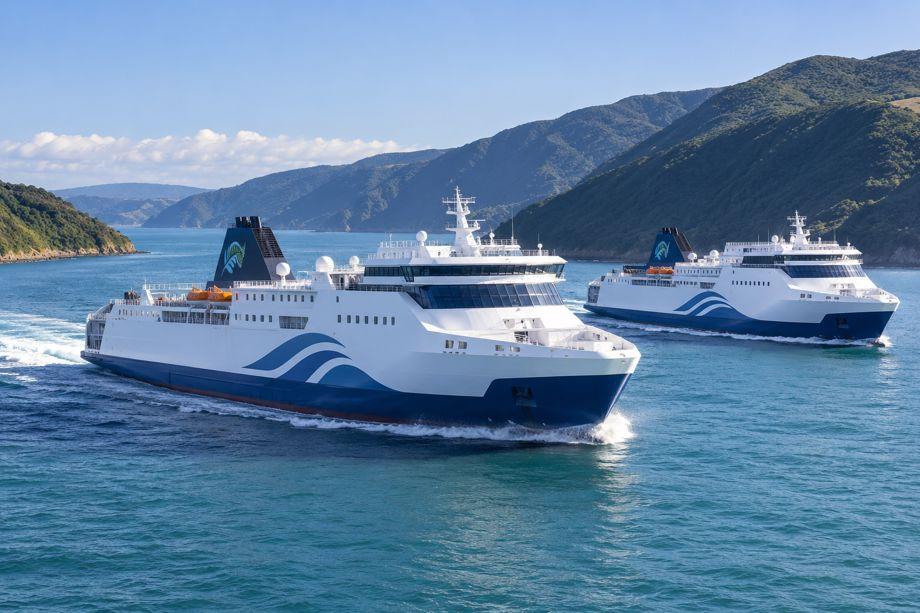
ABB Azipod Propulsion Technology
One of the major components of the project is ABB's Azipod propulsion system.
The two ferries will use two Azipod propulsion units. Unlike conventional propulsion systems that use fixed propeller shafts and rudders, Azipod units can rotate through 360 degrees.
This provides the vessel with high maneuverability.
The propulsion system is particularly important for ferry operations because vessels frequently need to maneuver in confined port environments.
The new ferries are designed to provide lateral maneuvering capability in challenging wind conditions.
The automation system plays an important role in coordinating propulsion commands, electrical power and auxiliary equipment.
8.2 MWh Battery Energy Storage System
Another significant feature of the project is the hybrid-electric power architecture.
The ferries will be equipped with an 8.2 MWh battery energy storage system.
The battery system will support near-zero-emission harbor operations and can also provide spinning reserve for a defined period.
The architecture is designed to allow the battery capacity to increase to 12.3 MWh in the future, with additional potential integration with shore charging infrastructure.
This type of architecture illustrates an important trend in modern industrial automation: energy management is becoming increasingly integrated with control systems.
In a traditional electrical system, generators, motors, propulsion equipment and auxiliary loads may be managed as separate systems.
Modern energy management platforms can instead coordinate these resources as one integrated system.
This allows operators to balance energy production and consumption according to operating conditions.
ABB PEMS Power and Energy Management System
At the center of the vessels' power architecture will be ABB's Power and Energy Management System, or PEMS.
The system is designed to coordinate energy across generators, battery storage, propulsion systems and auxiliary loads.
For an automation engineer, this is similar to the way an advanced industrial control system coordinates multiple equipment layers.
The system continuously monitors operating conditions and manages available power according to demand.
During harbor operations, the battery can be used to support electric operation.
During normal sailing, generators and energy storage can be coordinated with propulsion requirements.
If a fault occurs, the energy management system can also support power continuity by adjusting the distribution of available energy.
This type of control architecture can be particularly valuable on large vessels because electrical demand can change significantly depending on propulsion, maneuvering, hotel loads and port operations.
Remote Diagnostics and Predictive Maintenance
The new ferries will also use remote diagnostic technology.
Remote diagnostics are becoming increasingly important in industrial automation because equipment operators want to identify potential problems before they result in unplanned downtime.
For a ferry operating on a fixed transportation route, unexpected equipment failure can have consequences beyond the vessel itself.
A propulsion or electrical system problem can affect passenger schedules, freight transportation and connections with other transport systems.
Remote monitoring can allow technical teams to review equipment conditions and operating information without always needing to be physically present on the vessel.
This approach is similar to predictive maintenance strategies increasingly used in manufacturing plants.
Instead of waiting for a PLC module, drive, motor or other component to fail, engineers can monitor operating data and identify abnormal conditions.
Automation, Electrification and Digitalization Converge
The project demonstrates how three major industrial technology areas are increasingly connected.
Automation systems coordinate equipment and processes while providing operators with monitoring and control capabilities.
Electrification is enabling greater use of electric motors, drives and battery systems to improve energy efficiency and reduce dependence on conventional propulsion architectures.
Digitalization provides remote diagnostics, data analysis and connected services that give operators greater visibility into asset performance.
These technologies are no longer independent.
A modern vessel can operate as an integrated cyber-physical system in which physical equipment generates data, automation systems process that information and digital services use the data for monitoring and maintenance.
This is similar to the evolution taking place in smart factories and process industries.
Lower Emissions and Reduced Underwater Noise
Environmental performance is another important part of the new ferry design.
The vessels are intended to reduce fuel consumption and emissions while also lowering underwater radiated noise.
The reduction of underwater noise is particularly relevant to the marine environment around the Marlborough Sounds.
The new vessels are designed to meet DNV SILENT-E class requirements, reflecting the importance placed on reducing underwater radiated noise.
The combination of electric energy storage, efficient propulsion and advanced control demonstrates how automation can contribute to environmental performance.
Automation itself does not create the environmental benefit independently. Instead, it provides the control layer needed to coordinate energy sources and equipment efficiently.
Why This Project Matters to Industrial Automation
Although the application is maritime rather than manufacturing, the technologies involved are familiar to automation engineers.
The project includes power management, battery energy storage, electric motors, drives, propulsion control, remote diagnostics, digital monitoring and automated energy optimization.
These technologies are also common in factories, power plants, water treatment facilities and other process industries.
The same principle applies across these sectors: complex physical equipment requires coordinated control, reliable data and continuous monitoring.
The Future of Marine Automation
The Cook Strait ferry project highlights the growing importance of integrated automation in transportation infrastructure.
As electrification expands, control systems must manage increasingly complex relationships between energy generation, energy storage and equipment demand.
At the same time, operators need better diagnostic capabilities and more information about asset health.
This creates opportunities for industrial automation suppliers to combine traditional control technologies with digital services.
For system integrators and automation engineers, the development is also a reminder that PLCs, drives and control systems are becoming part of larger digital architectures.
The future automation engineer may increasingly work across electrical systems, software, data networks and energy management.
Conclusion
ABB's selection for New Zealand's new Cook Strait ferries represents a significant application of integrated power, propulsion and automation technology.
The combination of Azipod propulsion, hybrid-electric power, battery energy storage, PEMS energy management and remote diagnostics demonstrates how modern automation can coordinate complex infrastructure.
The project is also an example of how automation technology is moving beyond traditional industrial plants.
Whether the application is a manufacturing line, power station, water treatment facility or advanced ferry, the underlying objective remains similar: improve control, increase operational visibility, optimize energy use and maintain reliable operation.
As electrification and digitalization continue to develop, integrated automation architectures are likely to play an increasingly important role across industrial and infrastructure applications.