Rockwell Automation Showcases AI-Driven Water Treatment and Industrial Control Technologies at WEFTE
Time:2026-09-16 Browse: 0
Rockwell Automation is preparing to showcase a range of industrial automation, artificial intelligence and cybersecurity technologies for water and wastewater applications at WEFTEC 2026.
The company announced on September 15, 2026, that it will demonstrate advanced control technologies designed to help water and wastewater utilities modernize operations, improve efficiency and strengthen operational cybersecurity.
WEFTEC 2026 is scheduled to take place in New Orleans from September 26 to September 30.
The announcement highlights an important trend in industrial automation: the growing convergence of PLC-based control, machine learning, advanced process control, industrial cybersecurity, power management and digital technologies.
Water and Wastewater Become More Data-Driven
Water treatment facilities operate complex processes that require continuous monitoring and precise control.
Typical systems can include pumps, valves, motors, chemical dosing equipment, filtration systems, sensors and electrical equipment.
Each component contributes to the overall treatment process.
Industrial automation provides the control infrastructure required to coordinate these systems.
Traditionally, PLCs and SCADA systems have been used to monitor equipment and execute control logic.
Modern systems are now becoming increasingly data-driven.
Operational data can be collected from sensors, controllers and other field devices and then analyzed to identify patterns, optimize processes and support maintenance decisions.
Rockwell's latest WEFTEC showcase reflects this transition.
The company plans to demonstrate how AI, machine learning and integrated control platforms can be used together to improve water and wastewater operations.
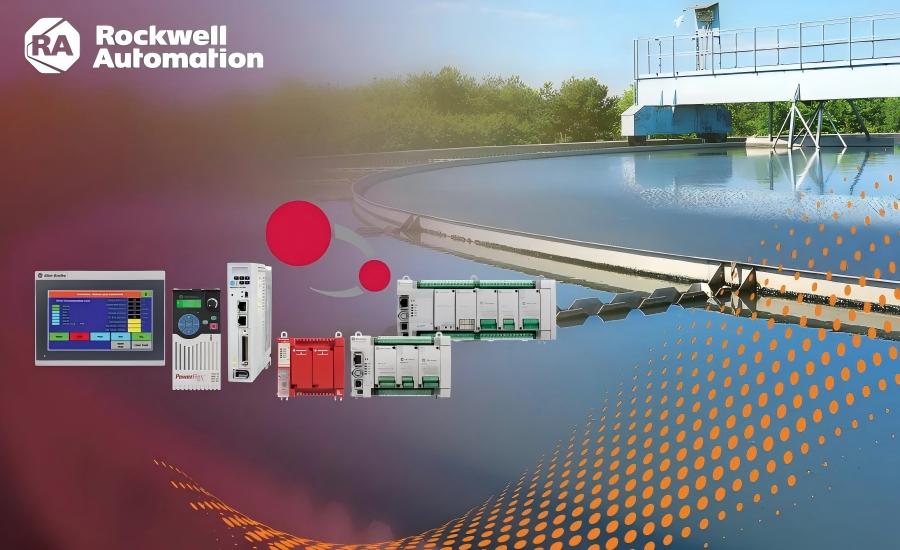
Allen-Bradley CompactLogix 5480 Controller
One of the technologies featured at the event is the Allen-Bradley CompactLogix 5480 controller.
The controller is designed to provide control and computing capabilities for industrial applications.
In water and wastewater facilities, controllers are responsible for coordinating processes such as pumping, flow control, chemical treatment and equipment sequencing.
Real-time process information can help operators understand current conditions and make faster operational decisions.
For automation engineers, the importance of the controller is not limited to its ability to execute PLC logic.
Modern industrial controllers increasingly serve as important data sources within larger automation architectures.
Information from sensors and equipment can be processed at the control level and made available to higher-level systems.
This creates a foundation for analytics and optimization.
Artificial Intelligence and Machine Learning in Water Treatment
Artificial intelligence is becoming increasingly relevant to process industries.
In water treatment, AI and machine learning can potentially be used to identify patterns in operating data and support process optimization.
For example, a treatment facility may collect information about flow rates, pressure, pump operation, chemical consumption, energy use and water quality.
When historical and real-time data are combined, analytics tools can help identify relationships between operating conditions and process performance.
This can support decisions about equipment operation and process settings.
However, AI does not replace the fundamental control system.
A reliable PLC, DCS or other industrial control platform remains responsible for executing deterministic control functions.
AI and machine learning can operate alongside the control architecture to provide additional analysis and optimization.
This distinction is important for industrial environments.
Control systems must continue to operate safely and reliably even when higher-level analytics are unavailable.
Integrated Control for Process, Power and Motor Systems
Rockwell also plans to demonstrate how process control, power distribution and motor control information can be integrated into a unified automation architecture.
Water treatment facilities often contain large numbers of motors and pumps.
These systems can represent a significant portion of a facility's energy consumption.
Without integrated visibility, operators may have difficulty understanding how individual equipment decisions affect overall energy performance.
A unified control architecture can provide a more complete view of the plant.
Process conditions, motor status, electrical information and production data can be brought together.
This allows engineers and operators to make decisions based on a wider range of information.
For example, pump operation can be considered alongside flow requirements, energy consumption and process conditions.
This is one of the key benefits of industrial digitalization: data from different equipment layers can be combined rather than managed separately.
Desalination Automation
Another important technology Rockwell plans to showcase is a desalination process control solution.
Desalination is becoming increasingly important in regions where conventional freshwater resources are limited.
Reverse osmosis systems require precise management of seawater, brine, pressure, pumps, membranes and other equipment.
The process can involve significant energy consumption, making automation and optimization particularly important.
Rockwell's solution includes preconfigured libraries designed for seawater and brine reverse osmosis applications.
Preconfigured engineering components can reduce repetitive programming and help standardize system development.
They can also support faster deployment when engineers are working on similar process architectures across multiple projects.
Cybersecurity Becomes a Core Automation Requirement
Industrial cybersecurity is another major focus of the Rockwell WEFTEC demonstration.
Water and wastewater facilities are critical infrastructure in many regions.
A disruption to an automation system can affect pumping, treatment and distribution operations.
As more industrial systems become connected, cybersecurity becomes increasingly important.
Modern water treatment systems may connect PLCs, HMIs, SCADA platforms, remote monitoring systems, engineering workstations and enterprise networks.
Each connection creates a point that must be managed.
Rockwell plans to demonstrate approaches for strengthening operational resilience and protecting critical infrastructure.
The company also highlights the importance of aligning OT and IT cybersecurity strategies with recognized cybersecurity frameworks.
OT and IT Convergence
Historically, operational technology and information technology were often separated.
The control system operated equipment, while IT systems managed business information.
Industrial digitalization is reducing this separation.
Manufacturing and process facilities increasingly require operational data to move between control systems, edge devices, analytics platforms and enterprise applications.
This creates opportunities for improved decision-making but also introduces new cybersecurity requirements.
The challenge for automation engineers is to maintain reliable control while allowing appropriate data access.
A well-designed architecture needs to balance connectivity, performance, security and availability.
This is particularly important for water utilities because many systems must operate continuously.
Energy Efficiency and Chemical Consumption
Another objective highlighted by Rockwell is reducing energy and chemical consumption.
Water treatment requires energy for pumping, filtration, aeration and other processes.
Chemical treatment can also represent a significant operating expense.
Better automation can help operators understand how equipment and process conditions affect resource consumption.
With integrated monitoring and analytics, operators can identify inefficient operating conditions.
For example, equipment can be monitored for abnormal energy use, while process data can be evaluated to determine whether operating parameters remain within desired ranges.
The long-term objective is not simply to collect more data.
The value comes from turning operational data into actionable information.
Predictive Maintenance for Water Infrastructure
Water utilities also face the challenge of maintaining aging infrastructure.
Pumps, motors, valves and electrical systems can experience wear over time.
Unexpected failures can lead to service interruptions and costly emergency maintenance.
Predictive maintenance strategies use operating data to identify abnormal equipment behavior.
Machine learning can potentially help detect patterns that are difficult to identify through simple threshold alarms.
For example, changes in vibration, motor current, temperature or operating cycles may indicate developing equipment problems.
When these signals are integrated into a broader automation system, maintenance teams can gain greater visibility into equipment health.
The goal is to move from reactive maintenance toward more data-supported maintenance planning.
Why This Matters for PLC and DCS Engineers
The Rockwell announcement is particularly relevant to professionals working with PLC, DCS and SCADA technologies.
The traditional automation architecture remains important, but new layers are being added.
A modern process control system may include:
PLC controllers
Remote I/O
Industrial Ethernet
HMI systems
SCADA platforms
Variable frequency drives
Motor control centers
Power monitoring
Edge computing
Machine learning
Cybersecurity systems
Cloud or enterprise data platforms
The challenge is to make these technologies work together without compromising control reliability.
This is where system integration becomes increasingly important.
Industrial Automation Moves Toward Intelligent Operations
The WEFTEC 2026 announcement illustrates how industrial automation is evolving.
The PLC remains an essential component, but the modern automation system is becoming much more than a controller.
Data from controllers can support analytics.
Analytics can support optimization.
Optimization can influence operational decisions.
Cybersecurity protects the communication infrastructure connecting these systems.
Together, these technologies create a more intelligent industrial environment.
This development is occurring not only in water treatment but also in manufacturing, oil and gas, chemicals, energy, pharmaceuticals and other process industries.
Looking Ahead
Rockwell Automation's WEFTEC 2026 showcase demonstrates how industrial control technology is being adapted to address modern water and wastewater challenges.
The combination of PLC control, AI, machine learning, integrated power and motor control, desalination automation and cybersecurity represents a broader movement toward connected process automation.
For water utilities, the focus is on improving operational visibility, reliability, resource efficiency and infrastructure resilience.
For automation engineers, the development shows that future control systems will increasingly combine traditional PLC and SCADA technologies with data analytics and intelligent software.
The underlying control logic remains essential, but the surrounding digital ecosystem is becoming increasingly sophisticated.
As utilities and industrial facilities continue to modernize, automation systems will play an increasingly important role in connecting equipment, data and operational decision-making.