Schneider ATS22C14S6 Soft Starter Installation Guide (Wiring & Commissioning)
Time:2026-10-08 Browse: 0
Schneider ATS22C14S6 installation requires correct three-phase power wiring, a suitable motor current setting, and verification of the control circuit before the first start. The ATS22C14S6 is an Altistart 22 soft starter rated at 140 A, with a 230 V control supply and a 230–600 V three-phase motor supply range. Its typical motor ratings are 37 kW at 230 V, 75 kW at 400/440 V, and 90 kW at 500 V.
Schneider ATS22C14S6 Soft Starter Installation Requirements
Before beginning the Installation Guide, verify that the motor nameplate, incoming supply, and soft starter rating belong to the same application class.
The ATS22C14S6 is intended for asynchronous three-phase motors and is particularly suited to applications such as pumps and fans. The starter uses torque-controlled starting with current limitation and has an internal bypass function. The device is designed for vertical installation and forced-convection cooling.
For a 400 V motor rated around 75 kW, for example, the engineer should not simply copy the factory current value into the System Configuration. Motor full-load current must be taken from the actual motor nameplate and checked against the selected starter rating.
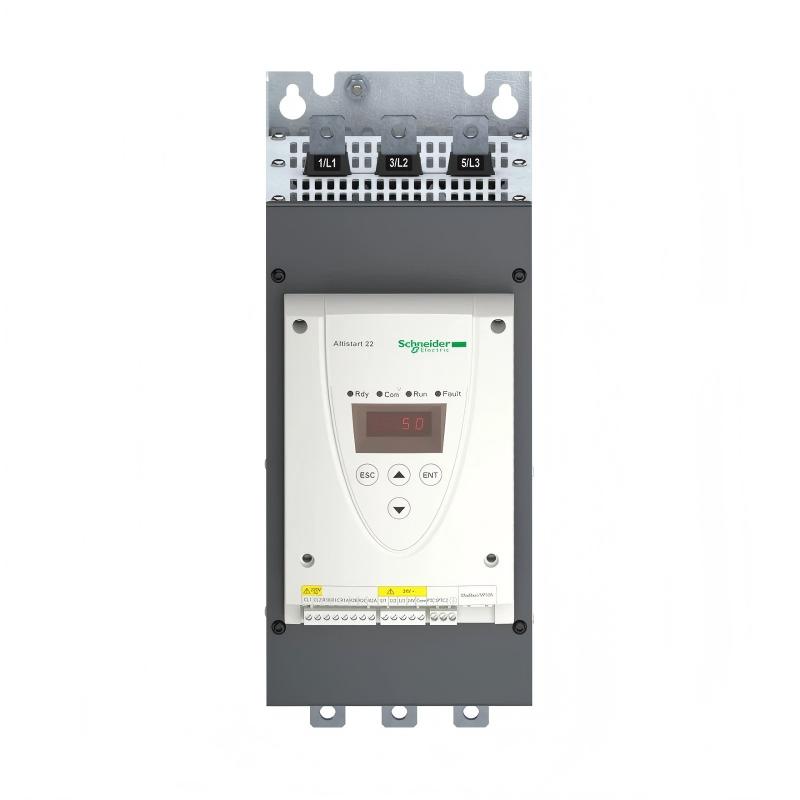
ATS22C14S6 Wiring and Power Connection Strategy
The power circuit should be checked separately from the control circuit.
For a standard line connection, the incoming three-phase supply is connected to the starter input terminals and the motor is connected to the corresponding output terminals. The protective earth connection and upstream protection must be completed according to the electrical design and applicable local standards.
For the ATS22C14S6, Schneider documentation specifies a 140 A starter rating for standard motor-line connection. The published connection data also gives a 50 mm² minimum IEC copper cable section for the power connection under the stated conditions, while terminal hardware and tightening requirements must be verified against the applicable installation documentation.
Do not judge a power connection only by whether the motor can rotate. A motor may start successfully while one phase has an abnormal voltage drop, an incorrectly tightened termination, or an unsuitable protection arrangement.
ATS22C14S6 Control Circuit Setup and Commissioning
The ATS22C14S6 uses a 230 V control supply in this version. Its control interface includes three logic inputs and two relay outputs, while a PTC probe input is available for motor protection. The unit also provides an RS-485 Modbus communication interface.
During Setup / Commissioning, verify the control voltage before issuing a start command.
A practical commissioning sequence is:
Power isolated → mechanical inspection → power-terminal inspection → control-voltage verification → motor data verification → input/output test → no-load or controlled first start → current observation → loaded commissioning.
This sequence is preferable to immediately starting the motor after energizing the cabinet because it separates wiring problems from parameter problems.
Schneider ATS22C14S6 Motor Current and System Configuration
The current setting is one of the most important parameters in the ATS22C14S6 System Configuration.
For example, if the motor nameplate indicates approximately 118 A at 400 V, the engineer should configure the starter according to the motor's actual rated current rather than automatically using the starter's factory-setting value of 124 A.
The starter supports an adjustable output-current range of approximately 0.4 to 1 times the IcL rating. Its standard starter rating is 140 A.
Starting characteristics should then be evaluated under the real mechanical load. A pump with a high static load may require a different starting profile from a lightly loaded fan, even when both motors have similar rated power.
ATS22C14S6 Installation Validation Before First Start
A useful field check is to record the three incoming line-to-line voltages before starting the motor.
For example:
L1-L2: 401 V
L2-L3: 399 V
L3-L1: 402 V
These readings indicate a reasonably balanced 400 V supply. If one measurement were significantly lower, correcting the supply or connection problem would be more appropriate than modifying the soft starter parameters.
After the first start, record motor current during acceleration rather than checking only the final running current. A high starting current combined with a long acceleration period can indicate an unsuitable load condition or starting configuration.
Schneider ATS22C14S6 Commissioning Case: Phase Sequence Verification
In one ATS22 commissioning case documented by Schneider Electric, a phase-sequence fault occurred because the motor wiring did not correspond to the configured phase sequence. Schneider identifies the PHR parameter as the phase-sequence detection setting; if the configured sequence and actual motor wiring disagree, the ATS22 can trip.
The important engineering point is that this condition should not immediately be interpreted as a failed power semiconductor section.
The diagnostic path is:
Configured phase sequence → actual incoming phase sequence → motor-side wiring → operating mode → fault status.
Correcting the wiring or configuration resolves the problem when the hardware itself is healthy.
ATS22C14S6 Installation Guide: Final Commissioning Checklist
Before handing the equipment to operation, confirm:
Three-phase supply is within the permitted voltage range.
Motor rating matches the application.
Motor current is correctly entered into the System Configuration.
Power terminals are correctly wired and tightened.
Control voltage is correct for the ATS22C14S6 version.
Start/stop logic operates correctly.
Motor rotation direction is verified.
Acceleration current and time are recorded.
Thermal protection settings are appropriate.
Modbus communication is tested if used.
No phase-sequence, thermal, or starter alarms remain active.
The ATS22C14S6 is rated for 230–600 V three-phase operation, with 50/60 Hz supply frequency and an IP00 enclosure rating, so panel installation and environmental protection must be considered as part of the complete installation rather than treated as an accessory issue.
Long-Tail Keywords for Schneider ATS22C14S6 Installation
Schneider ATS22C14S6 Installation Guide, ATS22C14S6 soft starter wiring, ATS22C14S6 Setup, ATS22C14S6 Commissioning, Schneider Altistart 22 installation, ATS22C14S6 motor configuration, ATS22C14S6 power connection, ATS22C14S6 control wiring, 140 A soft starter installation, ATS22C14S6 System Configuration.