Schneider ATS22C14S6 Soft Starter Troubleshooting Guide (Fault Diagnosis)
Time:2026-10-08 Browse: 0
Schneider ATS22C14S6 communication and control faults should be diagnosed by separating the Modbus network, control inputs, and power-stage operation instead of replacing the soft starter immediately. The ATS22C14S6 provides an RS-485 Modbus interface, three logic inputs, two relay outputs, and a PTC input, so a control-related failure can occur even when the power section is operating normally.
Schneider ATS22C14S6 Communication Fault Symptoms
A typical communication fault appears differently from a power-stage fault.
The motor may run normally from the local control interface while the PLC reports that the ATS22C14S6 is offline. In another situation, the PLC may repeatedly lose the starter during operation even though the motor current remains stable.
This distinction matters.
If the motor starts, accelerates, and stops correctly from the local control circuit, the first suspicion should be the communication path rather than the thyristor power section.
The ATS22 communication interface uses Modbus over RS-485, with selectable transmission rates including 4800, 9600, and 19200 baud.
ATS22C14S6 Modbus Fault Diagnosis Process
The first diagnostic question is simple:
Is the ATS22C14S6 itself unable to operate, or can it operate locally while the PLC cannot communicate with it?
If local operation is normal, check the communication configuration before opening the starter.
The investigation should include:
PLC communication settings → slave address → baud rate → parity configuration → RS-485 wiring → termination → cable shielding → connector condition → Modbus response.
A useful test is to temporarily reduce the network to the PLC and one ATS22C14S6 device. If communication becomes stable after removing other nodes, the problem is more likely to be related to addressing, bus loading, termination, or network topology.
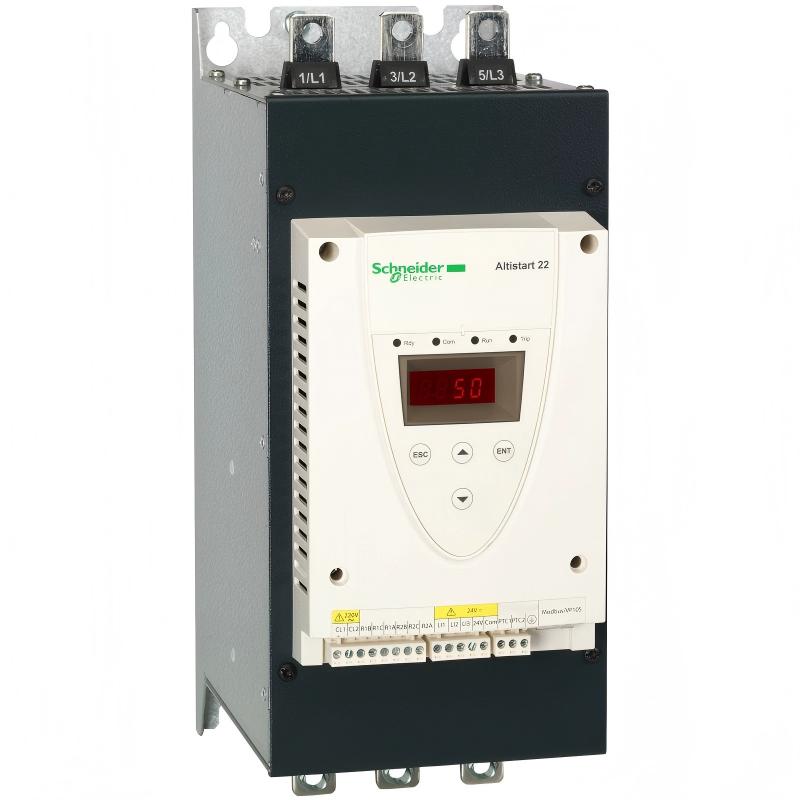
Schneider ATS22C14S6 RS-485 Signal Analysis
RS-485 problems are often intermittent rather than completely dead.
For example, a network may communicate correctly for several minutes and then generate timeout alarms when a motor contactor, pump, or other high-current equipment changes state.
In this situation, replacing the soft starter is premature.
The engineer should inspect:
RS-485 polarity
Cable routing
Shield termination
Ground-potential differences
Communication baud rate
Device address duplication
Termination resistance
Physical connector condition
The ATS22C14S6 uses an RJ45 communication connector for its serial Modbus interface.
A practical diagnostic comparison is especially useful:
Motor operation normal + local control normal + PLC communication unstable = investigate communication first.
Motor operation abnormal + local control abnormal + communication abnormal = investigate the starter, supply, motor, and configuration together.
ATS22C14S6 PLC Communication Troubleshooting Case
Consider a field situation where the PLC intermittently reports a communication timeout, while the ATS22C14S6 continues running the motor.
The first observation is important: the motor does not stop when the PLC loses the data response.
That suggests that the starter's basic control function is still active.
The engineer then checks the Modbus settings and finds that the PLC and starter are configured at different transmission rates. After matching the communication parameters and checking the RS-485 cable termination, the timeout disappears during repeated motor starts.
The engineering lesson is straightforward: a communication alarm does not automatically mean that the ATS22C14S6 hardware has failed.
Schneider ATS22C14S6 Fault Diagnosis Using Motor Behavior
A different diagnostic path is required when the starter trips during acceleration.
The important measurements are motor current, acceleration time, supply voltage, motor load, and the starter's displayed fault condition.
Suppose a 400 V motor normally runs at approximately 110 A but rises rapidly toward the starter's current limitation during acceleration. If the motor then fails to reach operating speed, the investigation should move toward mechanical load and acceleration requirements rather than immediately replacing the starter.
The ATS22 uses torque-controlled starting with current limitation, and its published starting behavior is based on a current-limited starting strategy.
A pump with a blocked impeller, excessive static pressure, or an incorrectly sized motor can therefore produce symptoms that initially resemble a soft starter fault.
ATS22C14S6 Phase Sequence Fault Diagnosis
Phase-sequence faults require a different approach.
Schneider documents that the ATS22 PHR parameter is used for phase-sequence detection. If the configured sequence does not match the actual motor wiring, the soft starter can trip on phase sequence.
The correct diagnostic order is:
Configured sequence → incoming phase order → motor terminal wiring → connection type → PHR setting.
Do not bypass phase-sequence protection simply to make the motor run. First establish why the detected sequence differs from the intended machine direction.
This is particularly important after motor replacement, cabinet rewiring, or maintenance work involving incoming power cables.
Schneider ATS22C14S6 Thermal Fault Troubleshooting
Thermal faults should be evaluated using operating history rather than a single temperature observation.
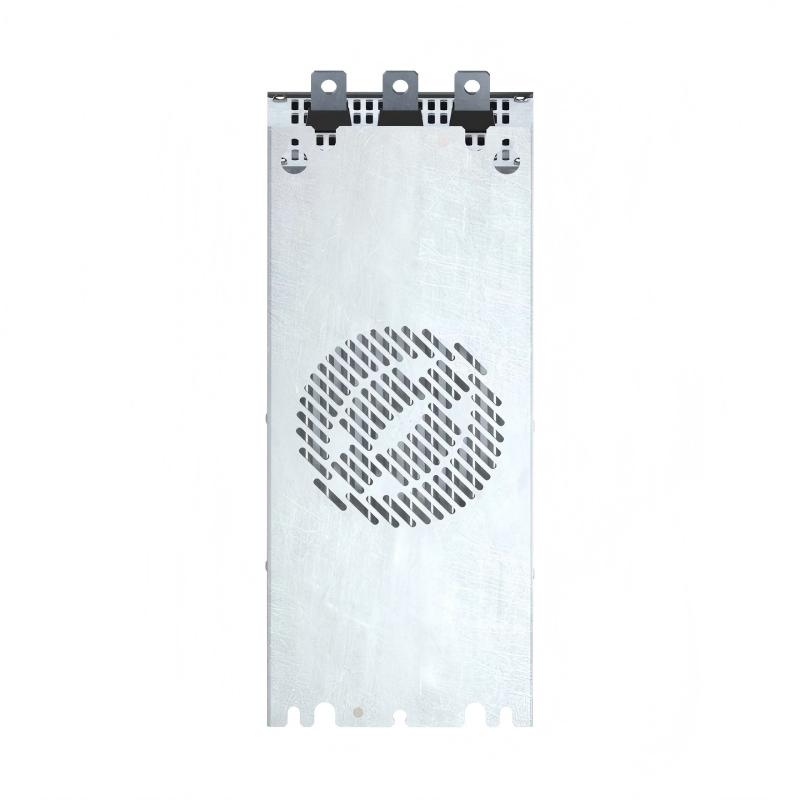
The ATS22C14S6 includes thermal protection for both the motor and starter. The device also uses forced convection cooling, so airflow around the heat sink has a direct effect on operating conditions.
If a starter trips thermally after several repeated starts, inspect:
Motor load → number of starts per hour → acceleration duration → ventilation → ambient temperature → current setting → mechanical resistance.
A motor that repeatedly draws high current for a long acceleration period can accumulate thermal stress even when its final running current appears normal.
ATS22C14S6 Repair Decision: Configuration or Hardware?
Before recommending repair, divide the failure into three categories.
Category A — Configuration fault
The starter powers up and operates, but incorrect motor, phase-sequence, or communication settings cause abnormal behavior.
Category B — External system fault
The starter is healthy, but the motor, power supply, control wiring, PLC, or RS-485 network creates the symptom.
Category C — Hardware fault
The starter shows abnormal behavior that remains after the external supply, motor, wiring, and configuration have been verified.
This classification prevents unnecessary replacement of an expensive soft starter.
The ATS22C14S6 is a 140 A device with internal bypass and a published standard power dissipation of approximately 82 W, so thermal and cabinet conditions should also be considered when assessing suspected hardware problems.
ATS22C14S6 Troubleshooting Checklist for Field Engineers
When troubleshooting the Schneider ATS22C14S6, record actual measurements instead of relying only on the alarm description.
Recommended records include:
Line-to-line voltage
Motor running current
Starting current
Acceleration duration
Motor direction
Control voltage
Logic-input status
Relay-output status
Modbus address and communication settings
Ambient and cabinet temperature
Cooling-fan condition
Active and historical fault information
A useful field rule is to change only one variable at a time. If several parameters are modified simultaneously, it becomes difficult to determine which change actually corrected the fault.
Schneider ATS22C14S6 Troubleshooting and Repair Conclusion
The most reliable ATS22C14S6 Fault Diagnosis process begins with the symptom and works toward the hardware, not the other way around.
A communication timeout should first be separated from a motor-control failure. A phase-sequence fault should be checked against actual wiring. A thermal trip should be evaluated against current, load, acceleration frequency, and cooling. Only after these external conditions have been verified should internal starter hardware become the primary suspect.
For maintenance teams supporting older Altistart 22 installations, this approach also matters because Schneider has published lifecycle information for ATS22C14S6, including replacement guidance toward the ATS430C14S6 in applicable markets.
Long-Tail Keywords for Schneider ATS22C14S6 Troubleshooting
Schneider ATS22C14S6 Troubleshooting, ATS22C14S6 Fault Diagnosis, ATS22C14S6 communication fault, ATS22C14S6 Modbus troubleshooting, ATS22C14S6 soft starter fault, ATS22C14S6 phase sequence fault, ATS22C14S6 thermal fault, ATS22C14S6 Repair, Schneider Altistart 22 troubleshooting, ATS22C14S6 PLC communication problem, ATS22C14S6 System Configuration fault.