Siemens Establishes New Automation Business Unit to Accelerate AI-Enabled Industrial Automation
Time:2026-10-08 Browse: 0
Siemens Brings Major Automation Businesses Together
Siemens has taken a significant organizational step in its industrial automation strategy by establishing a new unified Automation business unit. The new organization officially became effective on October 1, 2026, bringing together four major areas of the company’s automation activities: Customer Services, Factory Automation, Motion Control and Process Automation.
The move represents more than an internal organizational change. It reflects a broader transformation taking place across the industrial automation industry, where traditional control technologies such as programmable logic controllers, distributed control systems and motion controllers are increasingly being connected with industrial software, artificial intelligence, digital twins and data-driven production systems.
For manufacturers, system integrators and automation engineers, the development is particularly relevant because industrial control is moving toward a more integrated architecture. PLCs, HMIs, drives, motion systems, process control, industrial networks and software platforms are no longer being viewed as completely separate technologies. Instead, manufacturers increasingly expect these systems to work together as part of a connected industrial environment.
Siemens says the new Automation organization is intended to help industrial customers develop production systems that are more flexible, productive and resilient.
From Traditional Automation to Software-Defined Automation
One of the most important trends behind the change is the rise of software-defined automation.
For decades, industrial automation projects were largely built around dedicated hardware. A typical production line could include PLC CPUs, remote I/O modules, industrial Ethernet switches, variable frequency drives, servo systems, HMIs and safety controllers. Engineering teams would configure each part of the system according to the requirements of the machine or process.
That model remains extremely important. However, modern manufacturing environments are becoming more software-intensive.
Manufacturers now need to collect large amounts of production data, connect machines across different production areas, analyze equipment performance and respond quickly to changes in production requirements. At the same time, industrial companies are increasingly exploring artificial intelligence to support maintenance, quality control, production optimization and decision-making.
This means the role of automation technology is expanding.
A PLC may still execute deterministic control logic, but the overall automation architecture may also include edge computing, cloud connectivity, digital twins, industrial data platforms and AI-based applications.
Siemens' new structure brings different automation disciplines closer together as the company moves toward this more integrated model.
Why PLC Technology Remains Important
Despite the rapid growth of AI and industrial software, PLCs remain a fundamental component of factory automation.
Industrial facilities require deterministic control, reliable communication and predictable behavior. PLCs are designed to operate continuously in demanding environments and control machines and processes with high reliability.
The future of PLC automation is therefore unlikely to mean replacing PLCs with AI.
Instead, a more realistic direction is to connect PLC-based control with higher-level digital technologies.
For example, a PLC can continue to control a conveyor, pump, motor or production machine while an edge or software platform collects operational data. That information can then be used for monitoring, optimization or predictive analysis.
This creates a layered automation architecture in which each technology performs the function it is best suited for.
The PLC handles real-time control.
Industrial networks connect devices and controllers.
Edge systems process operational data close to the machine.
Higher-level software provides visualization, analytics and optimization.
AI can assist with identifying patterns, predicting potential problems and supporting operational decisions.
This approach allows manufacturers to modernize existing systems without necessarily replacing every piece of automation hardware.
Process Automation and Factory Automation Move Closer Together
Another important aspect of Siemens' new Automation organization is the combination of factory automation and process automation.
Factory automation traditionally focuses on discrete manufacturing applications such as automotive production, packaging machinery, material handling and assembly systems. PLCs, motion control, robotics and machine vision are common technologies in these environments.
Process automation, meanwhile, is widely used in industries such as chemicals, oil and gas, power generation, pharmaceuticals, food processing and water treatment. DCS platforms, process instrumentation and continuous control are central to these applications.
Although the applications are different, the underlying industrial requirements are becoming increasingly connected.
Both environments need secure communications, reliable control, operational data, remote monitoring and increasingly sophisticated software.
The convergence of these technologies can also help manufacturers develop more consistent automation strategies across different types of production assets.
Industrial AI Becomes Part of the Automation Conversation
Artificial intelligence is one of the biggest factors influencing industrial automation in 2026.
Industrial AI is increasingly being applied to areas such as production optimization, predictive maintenance, quality inspection, engineering assistance and operational decision support.
However, implementing AI in an industrial environment is fundamentally different from using AI in a consumer application.
A factory cannot simply allow an AI model to make uncontrolled changes to a critical production process.
Industrial systems must consider safety, reliability, cybersecurity, deterministic control and operational continuity.
This is why the combination of automation engineering and AI is becoming increasingly important.
AI can analyze information and identify potential optimization opportunities, while established automation systems continue to provide the deterministic control layer required by industrial operations.
The new Siemens Automation organization is positioned around this intersection between automation, software and AI.
Implications for Industrial Automation Engineers
For automation engineers, the development suggests that the skill requirements of the industry will continue to expand.
Traditional PLC programming remains essential, but engineers may increasingly need knowledge of industrial networking, cybersecurity, data acquisition, edge computing and software integration.
Knowledge of technologies such as OPC UA, industrial Ethernet, MQTT, APIs and data platforms can become increasingly valuable.
At the same time, engineers working with Siemens automation technologies may find that digital engineering and simulation become more closely integrated with physical automation projects.
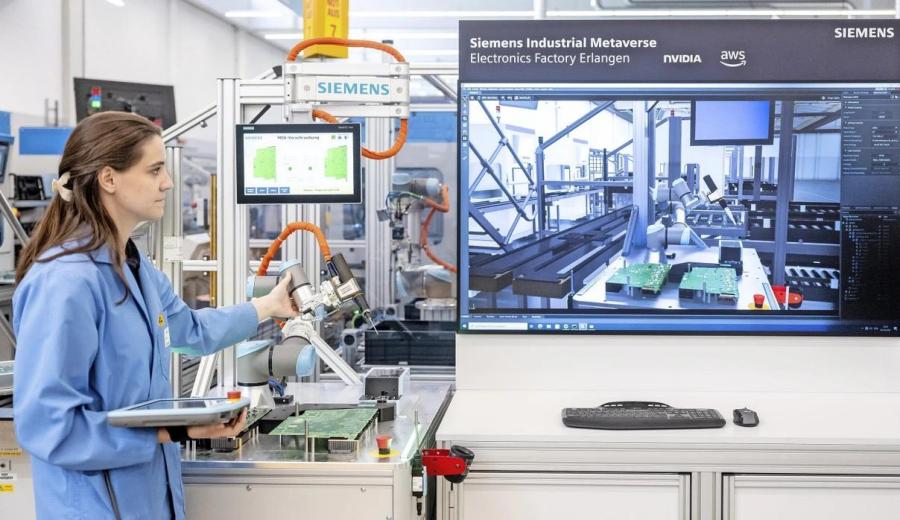
Digital twins can allow engineers to test equipment behavior, production layouts and control strategies before changes are implemented on the physical production line.
This can reduce commissioning risks and make engineering processes more efficient.
What the Development Means for Manufacturers
For manufacturers, the most important question is not simply whether AI should be adopted.
The more practical question is how existing automation infrastructure can become a foundation for future digital capabilities.
Many factories still operate equipment installed years or even decades ago. Replacing an entire control architecture can be expensive and disruptive.
A gradual modernization strategy can therefore be more realistic.
Existing PLCs, drives, sensors and industrial networks can continue operating while additional software, data collection and analytics capabilities are introduced.
This approach allows manufacturers to improve their production systems step by step rather than attempting a complete transformation at once.
The Future of Industrial Automation
Siemens' new Automation organization reflects a larger shift occurring throughout the global industrial automation market.
The industry is moving from isolated automation systems toward connected, software-defined and increasingly intelligent industrial architectures.
PLCs, DCS platforms, motion controllers and industrial networks will continue to provide the foundation for reliable control. At the same time, AI, digital twins, industrial software and data platforms will increasingly influence how factories are designed, operated and optimized.
For industrial automation professionals, this means the future will not simply be about replacing PLCs or traditional control systems.
Instead, the most important development will be the integration of established automation technologies with new digital capabilities.
As manufacturers seek greater flexibility, productivity and resilience, automation will increasingly become a combination of control hardware, industrial software, data and AI.
Siemens' newly established Automation business is a clear example of this broader industry transition and highlights how industrial automation is evolving toward more integrated and intelligent production systems.