Rockwell Automation Highlights Practical Path Toward Autonomous Manufacturing at PACK EXPO 2026
Time:2026-10-08 Browse: 0
Rockwell Automation Focuses on the Practical Road to Autonomous Operations
Rockwell Automation is preparing to showcase a broad range of industrial automation technologies at PACK EXPO International 2026 in Chicago, highlighting a practical approach to increasingly autonomous manufacturing operations.
The company announced on October 5, 2026, that its PACK EXPO exhibition will bring together advanced control, industrial software, artificial intelligence, digital twins, robotics and autonomous production logistics.
The focus is significant because autonomous manufacturing is becoming one of the most discussed areas in industrial automation.
However, completely autonomous factories cannot be created simply by installing artificial intelligence or robots.
Modern autonomous production requires a reliable automation foundation, high-quality production data, connected industrial equipment and software capable of coordinating multiple systems.
Rockwell Automation's approach emphasizes building these capabilities step by step.
Automation Foundations Come Before AI
One of the most important ideas behind the Rockwell Automation strategy is that manufacturers do not necessarily need to replace their existing automation infrastructure before moving toward greater autonomy.
Many industrial plants already have PLCs, variable frequency drives, remote I/O, industrial networks and machine control systems installed.
These systems represent significant investments and often control critical production processes.
Replacing everything at once can create unnecessary cost, engineering complexity and production downtime.
Instead, manufacturers can build new digital capabilities around existing automation infrastructure.
This means collecting better data from machines, improving connectivity, introducing digital engineering tools and gradually adding AI-driven optimization.
The result is an evolutionary approach to industrial automation rather than a complete factory transformation.
Next-Generation PLC and Control Architecture
At the control level, Rockwell Automation is highlighting its Integrated Architecture approach, including PowerFlex drives, PointMax I/O and On-Machine technologies.
The company is also highlighting upcoming LogixEdge Controllers designed around greater flexibility through software-defined automation.
This development reflects an important trend in PLC technology.
Traditional PLC architectures were primarily designed to execute control logic and communicate with field devices.
Modern industrial controllers increasingly need to operate within larger software ecosystems.
They must connect to sensors, drives, robots, industrial networks, edge systems and enterprise applications while maintaining reliable control.
For automation engineers, this means the controller is becoming part of a broader industrial computing architecture.
The physical controller remains essential, but the software environment around it becomes increasingly important.
Digital Twins for Industrial Engineering
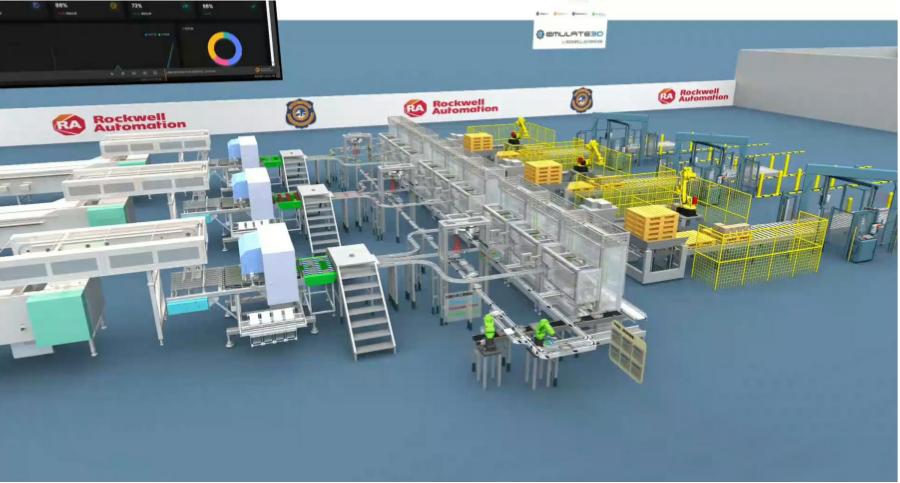
Another major part of Rockwell Automation's PACK EXPO demonstration is the use of digital twins.
Digital twin technology allows manufacturers to create virtual representations of machines, production lines or industrial processes.
Instead of testing every change directly on physical equipment, engineers can use virtual models to evaluate machine designs, production scenarios and control strategies.
This can be particularly valuable during machine development and commissioning.
For example, an engineering team developing a packaging machine may need to evaluate equipment layout, machine sequences, product movement and production rates.
A digital twin can provide a virtual environment where different scenarios can be evaluated before physical commissioning.
This can help identify potential problems earlier in the engineering process.
The benefits can include reduced commissioning risk, faster engineering and improved collaboration between machine builders and plant operators.
From Machine Data to Production Intelligence
Collecting data is only the first step.
Manufacturers need to transform machine data into useful information.
Rockwell Automation is also highlighting FactoryTalk Optix and Emulate3D technologies as part of its approach to connecting operational data with digital engineering and visualization.
The idea is to create a stronger relationship between physical production systems and their digital representations.
This can allow engineers and plant operators to understand how machines are performing and how changes could affect production.
In a traditional factory, machine data may be available in PLCs, HMIs or local control systems but remain isolated from other applications.
A more connected architecture can make that information available to higher-level software.
This creates opportunities for performance monitoring, production optimization and advanced analytics.
AI Moves From Analysis Toward Action
Artificial intelligence in manufacturing has often been associated with analytics and prediction.
However, the next stage is moving from simply identifying information to supporting or influencing operational decisions.
Rockwell Automation is highlighting FactoryTalk Analytics Model Predictive Control as part of this development.
Model predictive control is already an established industrial control concept. It can consider multiple variables and predict how changes may affect a process.
The integration of AI capabilities can potentially make these systems more adaptive and useful for complex production environments.
The important point is that AI does not have to replace conventional control logic.
Instead, AI and advanced analytics can operate at a higher level, providing recommendations or optimization while the underlying automation architecture continues to maintain deterministic machine control.
This distinction is particularly important in industrial environments where safety and reliability are critical.
Autonomous Material Movement With AMRs
Autonomous mobile robots are another important part of Rockwell Automation's PACK EXPO strategy.
Production logistics can represent a significant challenge for manufacturers.
Raw materials need to move between storage areas and production lines. Finished products may need to be transported to packaging, inspection or warehouse locations.
Traditionally, these tasks may rely on forklifts, manual carts or fixed conveyor systems.
Autonomous mobile robots provide another option.
Rockwell Automation is highlighting OTTO autonomous mobile robots as part of its approach to autonomous material movement.
AMRs can navigate industrial facilities and transport materials with less reliance on fixed infrastructure.
When connected with production systems and workflow orchestration software, autonomous material movement can become part of a broader automated production process.
Intelligent Workflow Orchestration
Autonomous manufacturing is not simply about individual robots.
A robot can move materials, but the production system must know when materials are required, where they need to go and what production condition currently exists.
This is where workflow orchestration becomes important.
Rockwell Automation is showcasing FactoryTalk Orchestration to coordinate material movement and production workflows.
The broader objective is to connect machines, software systems and production logistics.
This creates a more coordinated industrial environment.
Instead of each machine operating independently, production equipment and logistics systems can exchange information and respond to changing production requirements.
Why This Matters to Machine Builders
The development is particularly relevant to OEMs and machine builders.
Customers increasingly expect machines to provide more than basic automation.
They want equipment that can connect to factory networks, provide useful operational data and integrate with broader production systems.
Digital twins can also become valuable during machine development.
Machine builders can simulate equipment behavior before final assembly, helping identify potential design problems.
They can also demonstrate machine concepts to customers using virtual environments.
This can improve communication between equipment manufacturers and end users.
The Future of Autonomous Manufacturing
The path toward autonomous production will probably not happen through one major technological breakthrough.
Instead, it will develop through the integration of several technologies.
PLCs provide deterministic machine control.
Industrial networks connect equipment.
Sensors generate operational data.
Edge and software platforms process information.
Digital twins provide virtual engineering and simulation.
AI supports advanced analytics and optimization.
Robots and AMRs automate physical movement.
Orchestration software coordinates workflows.
When these technologies operate together, manufacturers can gradually move toward more autonomous production environments.
Rockwell Automation's PACK EXPO 2026 strategy demonstrates this integrated approach.
The message for manufacturers is practical: autonomy does not require rebuilding the entire factory overnight.
Existing automation systems can become the foundation for future digital capabilities.
By improving connectivity, data quality, simulation, control, analytics and robotics step by step, manufacturers can create a more flexible and intelligent production environment while protecting their existing automation investments.
As industrial automation continues to evolve in 2026, the combination of PLC control, AI, digital twins, robotics and autonomous logistics is becoming an increasingly important direction for the future of manufacturing.