Schneider Electric Accelerates AI Data Center Thermal Management Innovation with China-Based R&D
Time:2026-06-11 Browse: 36
Keywords: Schneider Electric data center cooling, AI thermal management, liquid cooling data centers, air cooling systems, hybrid cooling, high-density computing, AI infrastructure, China R&D center, data center efficiency
Schneider Electric Strengthens Thermal Management Capabilities for AI Data Centers
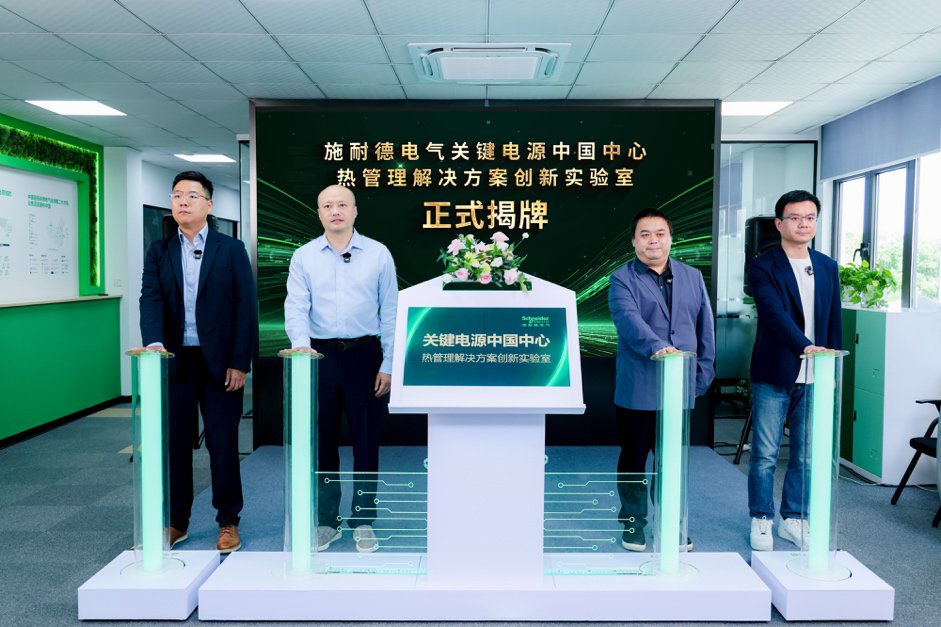
Schneider Electric has officially inaugurated its Critical Power China Center Thermal Management Solution Innovation Lab in Shanghai, marking a significant expansion of its localized research and development capabilities in China.
The new laboratory is designed to address the growing thermal and energy efficiency challenges driven by the rapid rise of AI and high-density computing workloads in modern data centers.
By building a full-stack validation platform covering air cooling, liquid cooling, and hybrid air-liquid cooling systems, Schneider Electric aims to accelerate the development of next-generation, energy-efficient, and highly reliable data center infrastructure solutions.
AI Era Driving Rapid Transformation in Data Center Cooling
As AI workloads continue to scale, data center architecture is undergoing a fundamental shift. Traditional facilities focused primarily on stability and reliability, while next-generation AI data centers prioritize computing density, energy efficiency, and thermal performance.
Industry data indicates that server rack power density in AI computing clusters has commonly exceeded 50 kW, with some projects already reaching 120 kW per rack.
According to IDC forecasts, by 2027, training workloads will account for approximately 27.4% of total AI compute demand, while inference workloads will rise to around 72.6%, further increasing demand for continuous and efficient heat dissipation systems.
Schneider Electric noted that liquid cooling is no longer optional but has become a critical operational requirement for AI data centers due to rising thermal loads.
Full-Stack Cooling Validation Platform: Air, Liquid, and Hybrid Systems
The newly expanded innovation lab significantly enhances testing and validation capabilities, increasing its physical capacity by approximately 50%.
It integrates a complete thermal testing ecosystem, including:
Air cooling enthalpy environmental chambers simulating temperatures from -40°C to 55°C
Megawatt-scale liquid cooling performance test benches
Pipeline and coolant system validation platforms
System-level air-liquid hybrid integration testing infrastructure
This setup enables end-to-end validation from cooling source to IT workload simulation, allowing engineers to evaluate system efficiency, reliability, and control strategies under dynamic operating conditions.
The lab also supports full lifecycle energy efficiency analysis and extreme condition simulation, helping identify potential risks early in the design stage.
Enabling Faster Deployment of High-Density AI Infrastructure
With increasing demand for rapid deployment of AI computing clusters, customers are pushing for accelerated delivery cycles, often requiring “T+3” project execution timelines, meaning design, testing, prefabrication, and delivery must be completed within approximately three months.
The innovation lab is designed to support this requirement by enabling:
Rapid prototyping and validation of cooling systems
Pre-integration testing of customized thermal solutions
Reduced on-site commissioning time
Improved predictability of system performance
This helps data center operators reduce deployment risks while improving overall efficiency and time-to-market for AI infrastructure projects.
Localized Innovation Under Schneider Electric’s “China Center” Strategy
The launch of the thermal management innovation lab further strengthens Schneider Electric’s China Center strategy, which integrates global R&D resources with local market needs.
Since 2023, the Critical Power China Center has focused on aligning product development priorities with China’s fast-evolving data center requirements, particularly in high-density computing and integrated power-cooling solutions.
The company emphasizes collaboration with local ecosystems and supply chains to deliver end-to-end solutions spanning:
Air cooling systems
Liquid cooling infrastructure
Critical power systems
Prefabricated data center modules
Insights and technologies developed in China are also expected to contribute to Schneider Electric’s global innovation roadmap.
Strategic Outlook: Designing for Uncertainty in AI Computing
Schneider Electric stated that its future product development strategy will be guided by a balanced approach focusing on:
Adapting to current requirements while preparing for future demands
Coordinated evolution of power and thermal systems
Balanced optimization between efficiency, scalability, and reliability
This approach reflects the increasing uncertainty in AI workloads, energy consumption patterns, and deployment scenarios, where flexible and scalable cooling architectures are becoming essential.
Conclusion
The establishment of Schneider Electric’s Thermal Management Solution Innovation Lab represents a major step forward in addressing the challenges of AI-driven data center cooling. By integrating air, liquid, and hybrid cooling validation capabilities, the company aims to accelerate innovation and provide more efficient, reliable, and scalable infrastructure solutions for the next generation of AI computing environments.